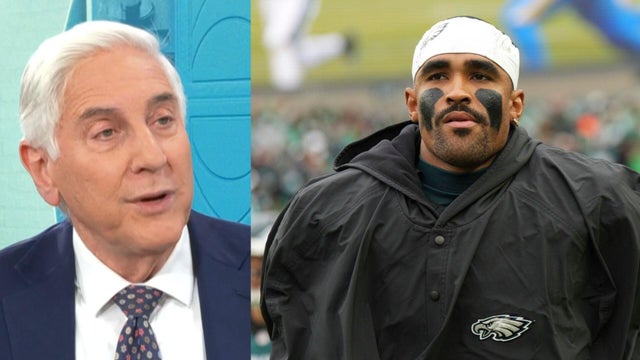
TONY DOKOUPIL:
00:00:12
One of the first things you realize about Nick Thompson is just how busy he is-- I'm going to say, hey, Nick, I'm back as the CEO.
TONY DOKOUPIL:
00:00:20
--as CEO of The Atlantic, as a public speaker in his own right-- These relationships and these bots are going to change the way we have real human relationships.
TONY DOKOUPIL:
00:00:30
--and as a family ma on top of it all. But he is also a world-class long-distance runner. Did you run to the office today? I did run to the office today. You did run to the office? I did, of course. Why do you like it? Every time I go running, I'm opening my mind up. I'm engaging with nature. I have a chance to think. I like to have my body in motion. It's a break from the rest of life. It's something I've always loved.
TONY DOKOUPIL:
00:00:59
And if you can imagine, Thompson has actually gotten faster as he's gotten older, shaving 14 minutes off his best marathon time at 44 and just this year posting the fastest 50-mile time in the world for his age group. If you're wondering how he does it and why, he explains in The Running Ground,part memoir, part call to the runner in all of us. Everybody can run. Everybody can run. Go to Prospect Park and look at the incredible, beautiful variety, short people, tall people, really skinny people, white people. Everybody can run. Humans were made to run. I love that. Yeah.

TONY DOKOUPIL:
00:01:40
Thompson says he started running because his father was a runner. If you didn't have this book and someone said, what kind of man was your father, what would you say? How do you describe him? There was always energy and chaos and life around him. He never slowed down. He never stopped.
TONY DOKOUPIL:
00:02:00
But in a life of great professional success, teaching and working in both the Ford and Reagan administrations, Scott Thompson also suffered personal turmoil. One of his refrains in the book frequently is to tell you that your life is going to crack apart when you turn 40. He told me that all the time. His father, his life had gotten much harder and falling apart at 40. And then my dad felt that his life had kind of fallen apart at 40.
TONY DOKOUPIL:
00:02:28
He left the family when Nick was just a kid and then struggled with just about everything. Was he an addict? Yeah, he was definitely-- he was an alcoholic, and he was a sex addict. But he wasn't a mean drunk. He wasn't a fall over drunk. He just drank way too much. And then in his later life, after he came out of the closet in his 40s and 50s, 60s, 70s, he had a terrible problem with sex addiction.
TONY DOKOUPIL:
00:02:57
Running for Nick became both a way to be like his father while also rejecting the chaos that followed him. You're running toward him and away from him at the same time.
NICHOLAS THOMPSON:
00:03:07
Yes. In some ways, running is a way of mourning him after he passed away. I also am well aware that he could not control his emotions. He could not control what he did during the course of a day. I felt like one of the ways I could prevent that from happening to me was to run, that running gave me discipline through the rest of my life.
TONY DOKOUPIL:
00:03:29
So Nick ran. He ran in high school and briefly in college at Stanford. And after a break, he picked it up again in his late 20s, which is when he got the news. I had just run my first really good marathon. I felt on top of the world. And its two weeks later, the next week, I go in and see the doctor, and he's like, I feel something.
TONY DOKOUPIL:
00:03:50
It turned out to be thyroid cancer.
NICHOLAS THOMPSON:
00:03:53
I was diagnosed when I was 30 years old, and it was just a shock.
TONY DOKOUPIL:
00:03:59
Shocking as it was, it was treatable, and it gave Thompson a new goal.
NICHOLAS THOMPSON:
00:04:05
One of the reasons I kept marathoning in my 30s and in my 40s was because I wanted to feel like the person I had been before I got sick.
TONY DOKOUPIL:
00:04:15
As he got faster, his career took off, too. He He joined Conde Nast, where he would eventually become editor of newyorker.com and editor in chief of Wired. And longtime viewers of Sunday Morning may remember he even reported for this show. Do you think you'd be where you are professionally without running? Definitely not. I think running has been a great tool professionally. It is a way for me to add discipline to my days, for me to have time where my mind can just wander, where I can think through things.
TONY DOKOUPIL:
00:04:48
But for Thompson, now 50, what's really unexpected is what happened next. You're faster today than you were at 35. Yeah. Explain that. So I like to think of it as the aging process is a moving sidewalk pushing you backwards. Every year, I get a little bit weaker. But you can do things to move forward faster than the moving sidewalk is going backwards. You can figure out how to train more intelligently. You can get a better understanding of your body. You can eat differently.
TONY DOKOUPIL:
00:05:21
Which is not to say it's easy. If you're trying to encourage people to run, why do you post from time to time pictures of yourself looking in absolute agony?
NICHOLAS THOMPSON:
00:05:31
Crossing a finish line, I mean, terrible photos, some of the all-time worst anyone's ever put out in public voluntarily. So that race was really hard. And so that was a race. It was the Lake Waramaug 50-miler, and I wanted to set the American record for my age group. And I was on pace through 45, 46 miles. Crazy. And then the last few miles, I knew I was going to be close, and so I was pushing so hard. And so I was just hurting so much everywhere. But I still won the race. I still ran the fastest time in the world this year. It was still a pretty good result.
TONY DOKOUPIL:
00:06:14
Running continues to be a family tradition for the Thompsons. Nick runs with his own three sons-- On your marks, get set, go.
TONY DOKOUPIL:
00:06:23
--and coaches weekly track sessions with his youngest son's soccer team. It feels full circle to have learned the sport from my father when I was about five or six and now being able to pass it to my children. James is 11, Zachary's 15, and Ellis is 17. It's a great thing. And to all these other kids.
TONY DOKOUPIL:
00:06:40
And as it turns out, life hasn't fallen apart like his father warned. You've done it. Well, I mean, I keep going because I enjoy it. I keep running because my life didn't fall apart at 40 because I didn't lose my discipline at 40, but could still fall apart at 50, which I just turned. And so I don't want to let it go. The really interesting transition in my life will be at some point, I won't be able to do this. And then I'll have to figure out how else to hold on.