VLAD DUTHIERS:
00:00:25
That's right.
GAYLE KING:
00:00:26
We're going to put it out in the universe. Henry stars as Coalhouse Walker Jr., a Harlem musician flourishing at the start of the 20th century. So his story overlaps with the lives of a Jewish immigrant and an upper class mother, all searching for their own version of the American dream. Here's a look. [JOSHUA HENRY, "MAKE THEM HEAR YOU"] Make them hear you When they hear you I'll be near you again


VLAD DUTHIERS:
00:01:05
I mean, we just got to clap right here again.
GAYLE KING:
00:01:08
Bravo! All you can do is go--
VLAD DUTHIERS:
00:01:11
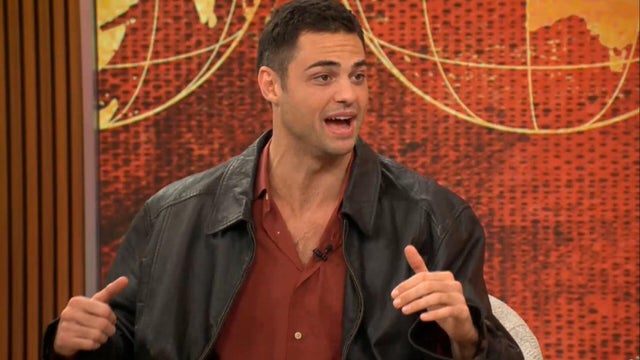
That's right. That's what the audience was doing too, last night, Gayle. We're happy to say, Joshua Henry joins us now. Congratulations to you. Joshua, I was blown away. I had goosebumps. The hair stood up on the back of my neck. Please, tell me, how you feel up there and what this role means to you at this time in your life and career. Thank you. Thanks for having me.
GAYLE KING:
00:01:31
We've all seen it, by the way. Thanks for coming. Y'all came yesterday.
GAYLE KING:
00:01:34
Yes. This moment, as a father, as an artist, this moment I'm having in Ragtimeright now is the pinnacle of my time in New York.
ADRIANA DIAZ:
00:01:46
Wow.
JOSHUA HENRY:
00:01:47
For me, the role of Coalhouse Walker Jr. that I get to play, he's a really complex guy, who goes on a massive journey from hoping and dreaming, to finding the love of his life, to having something really tragic happen, and it's like how he recovers from that. Much like what we all go through. It's like how we fall down and how we recover. How do we maintain a dream and a hope throughout all that. So I feel a really big connection with Coalhouse. And I think his story and the other stories in Ragtime are really resonating with audiences. Yeah, this musical takes place at the start of the 20th century, and it emphasizes race, class, immigration, inequity, but it feels very reflective of the current anxieties that people are feeling right now. How so? Absolutely. I mean, I think, the magic of this piece is that it's showing us a mirror of who we are with a Black family, a Jewish family, an upper class white family at the turn of the century, and how they collide. And they're asking themselves, what does it really mean to have this American dream? It's a beautiful thing.
GAYLE KING:
00:02:56
Yeah.
JOSHUA HENRY:
00:02:56
It's also a really complicated thing.
GAYLE KING:
00:02:58
Yeah.
JOSHUA HENRY:
00:02:58
And it doesn't quite pan out for everyone in the same way. Yeah. That's the moment we're having now. We're asking ourselves questions that we've asked before, but they feel more pressing than ever. And I think Terrence McNally, the incredible book writer, and Ahrens + Flaherty, the composer and lyricist, really captured that question right now, just as they did in 1998 when it originally debuted. Very painful. When I saw it with Kelly O'Grady, our colleague, both of us were sitting there silently crying. Can you hear people crying in the audience? What does that do to you? I can because the stage of the Vivian Beaumont on three sides is surrounded by the audience. And so when you hear [SNIFFLE] or [GASP]--
GAYLE KING:
00:03:39
Gasp, yes. For instance, at the end of the piece, there's a really unexpected moment, let's say, musically. Yes. And it almost takes the rug from under you, and you hear the audience go [GASP]. There are many moments. It's audible. But I want to know about you, Joshua, and what you're thinking when you're up there singing, the way you're singing. What is your intention when you're up there? Because I was so deeply affected and deeply moved by you, your expressions in your voice. So thank you. What are you doing? For me-- what am I doing? Well, I'm having a lot of fun, but I grew up singing in church. And my first intention and experience with singing for real was singing to glorify God or for singing for a higher purpose, serving something. So when I sing, each day before I go on that stage, it's not just about hey, let me sound good, let me sound pretty. I've always been obsessed with shifting people, with shifting people's emotional state for a higher purpose. And so as I sing, Coalhouse, as I sing a song like "Wheels of a Dream" or "New Music," my hope is that people feel something coming through me that's not just pretty, but that could change their life. Can you do a little bit of "Wheels of a Dream?" I know it's early. Can you do that? I sure can. The beginning of the song is when I'm looking at my child and having a dream, and I say-- [JOSHUA HENRY, "WHEELS OF A DREAM"] I see his face I hear his heartbeat And for me, I'm a father. I have an eight-year-old. I have five-year-old twins. All boys. And I remember that moment of seeing them for the first time. And, that's all I need.
GAYLE KING:
00:05:22
Can you do the belting part? Can I get-- We have lifted in 30 seconds. Oh, the belting part. When you go. Wheels of a dream I mean, it was. If I say a wheels of. Will you say the dream part. Yes OK. On the wheels of a dream. Hey, there it is. The Tony goes to Joshua. Henry
VLAD DUTHIERS:
00:05:48
Joshua Henry, oh, my gosh, that's amazing.
ADRIANA DIAZ:
00:05:51
Emotional.
VLAD DUTHIERS:
00:05:52
So emotional. Joshua Henry, this was so wonderful to have you. You're amazing. Ragtimeis playing at the Vivian Beaumont Theater at Lincoln Center. You can watch 79th Tony Awards hosted by Pink on June 7, right on CBS.