ROBERT BURNS:
00:01:28
Absolutely, ma'am. It's a tremendous honor to not only represent my country as a soldier in the US Army, but also as a member of Team USA. And more than anything, ma'am, I'm just excited to see what possibilities come out of this partnership.
ADRIANA DIAZ:
00:01:43
I love that.
TONY DOKOUPIL:
00:01:44
It's pretty cool. What kind of conversations have you had-- I'm curious-- with other members of the US Ski and Snowboarding Team? Are they surprised by the connection? Do they know the history? I think everybody is ultimately excited about this. Unsure about where it's going to go. But I just really think back to the unique history of what we were able to accomplish back in 1948 with the 10th Mountain Division in Italy. And it just-- it means a lot to us, thinking that we're going back to Italy for Milan Cortina in 2026, and we're going to bring the support of the US Army and the 10th Mountain with us.
ADRIANA DIAZ:
00:02:17
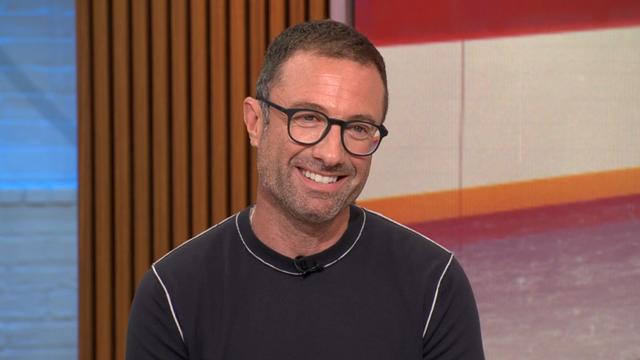
And Guy, what does this partnership mean for your organization? Yeah. So we fund about 240 athletes, as they try and achieve their World Cup and Olympic and Paralympic dreams. And we're 100 days out from Milan Cortina. And it couldn't happen without-- we have no government funding. So it couldn't happen without these sort of partnerships. And the Army partnership is so organic. The 10th Mountain Division veterans, when they came back after the Second World War, they founded a lot of the resorts where we compete, like Vail and Aspen, where we hold these World Cups. So our athletes and our organization are incredibly excited. And the Army team is going to be at our first World Cup event in Copper Mountain on Thanksgiving weekend, meeting the fans and working with the athletes.
ADRIANA DIAZ:
00:02:57
All right. We're so excited to have you both. Thank you.
TONY DOKOUPIL:
00:03:00
Yeah. Thank you very much. And we're back here at the table with Secretary Driscoll. I do have one question on news of the day here, because we're in a government shutdown. There's been an arrangement set up so that the military is still getting paychecks. But as I understand it, that will run out November 15. Doesn't seem like anybody's budging on this shutdown question. Does this affect the readiness of the US military? I think if you look at the average American soldier, they have showed up to work every single day since the shutdown occurred. They are still working every day to transform our Army. We're 250 years old. We're actually a year older than the country itself. And one of the things we talk about with our soldiers is, they are the legacy that built this nation through a lot of really hard times. And so the Army is built for moments like this. Our soldiers will continue to show up to work. But it does impact things. As we're trying to transform for modern warfare, it sets a lot of our programs back. It creates delays that are just going to be hard to restart from, to build back the momentum. But the one thing I would say is, President Trump and Secretary of War Hegseth are absolutely focused on caring for our soldiers, caring for their families, and making sure they can be paid as long as humanly possible. So this comes at a time, of course, where the administration is fighting several legal battles in states over having National Guard troops in those cities. What do you say to Americans who are concerned about the idea that the president has said that US cities should be used as training grounds for the military? I think if you look at DC as an example, where I live with my family-- and most weekends, I go out on runs and try to talk to our national DC National Guard members, who are positioned all over the city. And the first thing you see is, they're taking a lot of selfies. The next thing you see is, they're talking to the community because this is their community. This is where their kids go to school. This is where they go to church. And what you hear from them and what you hear from DC leadership is, my impression is people are waking up to this idea that their communities don't have to be as violence-ridden as they have been in the past, and that the National Guard is playing an incredibly important role in helping bring stability and a return to normalcy, that the greatest nation in the history of the world can actually maintain its capital in a relatively safe place, where people from all over our country and the world can come visit and experience it in a healthy way. Well, Secretary Driscoll, thank you very much for being here. Congrats on the new partnership. And thanks for three generations of service to the country from your family. I'm so grateful for having me. Thank you.