MAJOR GARRETT:
00:01:30
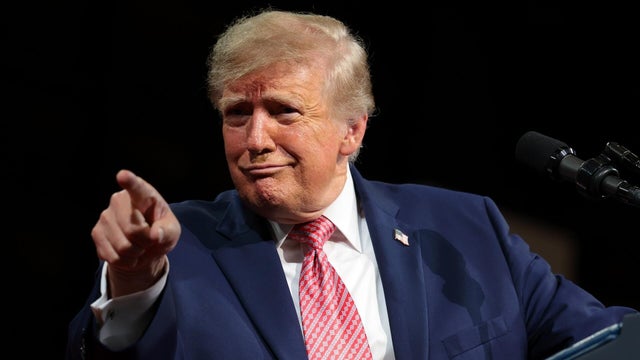
Iran has suffered repeated military blows and has no known ability to counteract US airstrikes. Yet, after absorbing airstrikes, it keeps firing missiles and drones. Some do damage and inflict casualties on American forces. Most do not, because they're intercepted, mostly. But Iran remains in the military game, though in diminished form. We should also remind ourselves, the Strait of Hormuz remains snarled. There's no sign of fruitful negotiations to re-establish free passage there or remove Iranian threats from neighboring waterways. Trump was asked, what's going to change? Well, I think we just want to win. We just want to win. We're doing very well. We're trying to be nice, as nice as you can be in a situation like that. But they're being decimated. They have no navy. They have no air force. They have no anti-aircraft. It doesn't mean they don't have any capability. They have some but very little. At some point, they're going to say, we just can't take it anymore. Quick historical note-- Iraq invaded Iran in 1980. The war of attrition there lasted eight years. Iran suffered at least 500,000 combat deaths, and it never surrendered. That doesn't mean Iran won't crack this time, but Trump's options remain limited. His aversion to US ground invasion or US attacks on bridges and power plants advertise themselves daily. Yet, interestingly, on that last point, CBS Newsthis afternoon has learned Trump is considering a coordinated set of airstrikes with Israel on Iranian energy targets and that preparations are being made for that attack as soon as this weekend. Important caveat-- final decision pending. Another thing to think about, Trump time-- you know, that concept that Donald Trump can uniquely will things into quicker resolution? It's being tested here. The same could be said of his attorney general nominee, Todd Blanche. And we will pick things up there with Nancy Cordes, who joins us at the White House. Nancy, I want to play for you something the president said today when asked about the thing that is hanging up the Todd Blanche as attorney general confirmation, the status of the so-called weaponization fund. Let's listen. It's dead. But I wish it weren't, to be honest with you. I think people were horribly treated, horribly abused. This has nothing to do with Todd. This was me-- horribly abused. And I'd like to see them compensated. "It's dead, but I wish it weren't." That continues to irritate and bother Senate Republicans opposed to Blanche because they want that thing dead, dead, in writing, and other things they're interested in, right, Nancy? That's correct. And, in fact, Thom Tillis, the retiring Republican from North Carolina, actually posted on social media after the president made those comments to say, the fact that President Trump is saying that it's dead but he wish he wasn't is exactly the reason that we want it in writing that this weaponization fund will not come back. So far, they haven't gotten it in writing. And that's why Tillis and John Cornyn of Texas are holding out. President Trump said, of Cornyn today, that he understands why Cornyn is mad at him, because President Trump backed his challenger in a Republican primary in Cornyn's bid for reelection. Cornyn lost that bid. President Trump said he'd probably be angry, too, if he were in Cornyn's position. But what President Trump did not say was that he was going to authorize anyone to put this promise in writing. And what do you know, Nancy, about reporting from our colleagues, Margaret Brennan, James LaPorta, and Jennifer Jacobs about new options President Trump is weighing in the war with Iran? What they have learned, Major, is that the US and Israel are working together, planning for what would constitute major strikes on Iranian infrastructure-- think refineries. Think power plants-- as soon as this weekend if President Trump gives the go-ahead. And President Trump, at Camp David today, said that he was going to hit Iran very hard. He said he was very frustrated with the pace of negotiations. He said that the Iranians are dishonest, that they are disloyal. And the fact that the US and the Israelis are working together on this is notable, Major, because the Israelis have really stayed out of the theater. They have not been striking Iran ever since the memorandum of understanding was signed, even before that. So this would be a major escalation. Nancy Cordes, thank you so very much. CBS Newsnational security contributor Sam Vinograd joins me now here at the Family Table. Sam, your analysis of what you just heard and what we were reporting? Well, it's standard operating procedure for any president to look at the range of targets the US military could strike in an armed conflict. That's just good housekeeping. It also appears to be standard operating procedure for the Trump administration to publicly-- or not publicly, but to give to reporters information that is considering escalating attacks against Iran-- A sign to Iran. Yes, if Iran doesn't comply. So they're negotiating somewhat through the media by trying to tell Iran they're going to put on even more pressure if Iran doesn't-- Something that the president says he never wants to do, telegraph. But he's kind of trying to telegraph now to get some sort of diplomatic thing going, it sounds like. It's not the first time. But I do want to note, strikes against energy infrastructure-- it depends on what the targets are-- could indeed be a violation of international law. So if this is energy infrastructure that's used solely for civilian purposes, that would be a violation of international law. But we have to wait and see what happens. We know there has been no final decision at this stage. So this could be public messaging. But, Major, you made a really important point in your opening, which is, Iran fought against Iraq for several years. They lost hundreds of thousands of people, and they didn't end the war. The idea that Iran is only going to stop its current military campaign if the US keeps bombing Iran, I think is misguided. And if President Trump is talking to actual experts on Iran or his intelligence community, he's likely getting that same advice. Sam, I often rely on you for lots of different things, and I'm going to test that proposition today. Because there was an announcement made yesterday about a breakthrough between Israel and Hamas. And the president said today, it's a reflection of success in the Iran war. Let's listen to that. But that will be-- it's a great breakthrough. Nobody's ever thought that would-- nobody thought that would be possible, to disarm Hamas. That shows you how much success we're having with Iran. Because if you go four months ago or five months ago, a deal like that would have been impossible. So it's been agreed to. There are lots of snarled details about how this would be implemented, if it will even be implemented. But the president's trying to say this wouldn't happen if we weren't at war with Iran. Evaluate that. Well, Hamas, for decades, has received financial support, training, and guidance from Iran. They are one of Iran's key proxies in the region. So I don't pretend to understand what's going through President Trump's mind, but perhaps he's trying to indicate that Iran's ability to support proxies globally has been degraded to some degree. I don't know that his intelligence community or counterterrorism experts would agree with that. But certainly, it is quite interesting that Hamas would be willing to even talk about disarmament for the first time, when we all know that Iran does not want its proxies backing away from striking Israel. Iran remains very intent on trying to destroy the Jewish state. There was a meeting at the White House this week between the Ukrainian president, Volodymyr Zelensky, and the president. Ukrainian President Zelensky made it clear he asked for expedited approval of Patriot anti-missile systems in Ukraine. The president was asked about that today, the technology and the licensing thereof. And here's what he had to say. You have to be very judicious, but you have to be very careful. Now, we have not agreed to that. We're talking about it. But it's a hard thing, to give away that kind of technology. And I don't think this would ever happen, but those people that you give that technology, they can someday turn on you. What do you hear there, Sam? We've heard a lot of different messaging on this technology to create Patriot interceptor batteries from the Trump administration. So it's unclear exactly what stage this is at. But what I'm hearing is that President Trump is worried about giving this technology to Ukraine to defend itself against Russia, based on some assumption that Ukraine could then use interceptor batteries against us, when these batteries are to protect from incoming missiles. So I'm not exactly sure what he means there. It is a bit-- They're defensive in nature, to be clear. A bit on the confusing side. Sam Vinograd, thanks so very much. The US government is investigating if Iran is behind a cyberattack on water systems in seven US states. In Minnesota alone, more than 30 community water systems were, to one degree or another, impacted. President Trump was asked about that during the cabinet meeting. They blame it on Iran. I don't think so. I blame it on Minnesota because they're grossly incompetent. CBS NewsHomeland Security correspondent Nicole Sganga joins me now. What do we know? Let's talk about why we know, almost certainly, this is Iran, just to push back a little bit on what President Trump said there. This--
MAJOR GARRETT:
00:11:05
Seems like a gratuitous thing. Look. This does not look like a smash and grab, Major. There was no ransom demand. There was no obvious financial incentive. The apparent goal here is disruption. That is straight from the Iranian playbook. And then there's history. We can go all the way back to 2011 and look at Iranian attacks on US banks and the Bowman Avenue dam In Rye, New York, all through the Las Vegas Sands destructive attack in 2014, 2020 and 2024 presidential campaign hack-and-leak operations, as well as disinformation campaign--
MAJOR GARRETT:
00:11:39
All Iran sourced.
NICOLE SGANGA:
00:11:40
--in 2020-- all Iran. But the one we should really look at is 2023 and 2024, where the CyberAv3ngers, who were loosely directed by the IRCG, targeted internet-connected controllers used by US water facilities and other critical infrastructure in order to basically disconnect equipment or force people to use manual operations. And they did this just by using default passwords to gain entry into the system. One of the things we've been talking about a lot today is this term, PLCs, Programmable Logic Controllers. They're small computers. They're internet facing. They operate pumps, valves, pressure systems, chemical dosing, and alarms at these water and wastewater utilities across the country. And in this particular campaign, Major, attackers changed the IP addresses and passwords, locking out some operators and forcing utilities to go into manual mode. One of the leading theories, talking to cyber experts today, is that they were trying to quietly establish access. And they actually outed themselves, they exposed themselves, in what is part of a broader plan, perhaps even geopolitical plan, to say, look, we have access, gained access into the systems-- And we are threatening you. Back off. We'll do all this privately. But you know that we have capabilities that could be deeply disrupted. And one of the things we haven't seen reported yet, Major-- I mean, you mentioned the seven states. Minnesota's the only one that's come out publicly. I want to be careful here because no one else has sort of raised their hand. But we know these same exact technologies, these kinds of PLCs, are used in states like Texas, Wisconsin, Ohio, Michigan. Here's the other thing. Even a limited attack can have a really outsized effect. So you don't have to poison the water to frighten a community. You only have to make people question whether or not their water is safe. And, Nicole, I've had my attention directed lots of different places today. So forgive me for not knowing this. I should. What's happened at the community levels in Minnesota? Has anyone noticed anything? Yeah. So at the community levels, at this point, we understand that the drinking water is safe. It is fine. But we have seen flooding in certain communities. We have seen forcing to go into manual operations versus using these internet-facing systems. There's a larger question here of, should water utilities even be internet facing? So, right now, there's a lot of detection. We should also point out that 50% of drinking water utilities nationwide are privately owned. So, basically, the FBI and CISA are screaming from the top of a mountain right now, waging a public awareness campaign to say, lock this down. If you use PLCs, take them down from the internet. Go into manual controls. But there's not a ton they can do to compel an already stretched-thin sector of critical infrastructure to take this seriously. Comprehensive, as always, Nicole Sganga. Thank you very, very much. Moving overseas, tens of thousands of migrants-- you've probably seen some video of this-- have swarmed the border from Morocco into the tiny Spanish territory of Ceuta, according to Spain's Ministry of the Interior. The ministry says about 25,000 people have since been sent back. CBS Newsinternational reporter Aiden Stretch has more on all of this. Over the last 48 hours, tens of thousands of people have poured across the border, swimming from Morocco to this tiny Spanish enclave of Ceuta. We've spoke to many of them, who told us that they came in search of better jobs, of food, of money. One young man told us that he wanted to play soccer in Europe. They haven't found that yet. People here told us that they haven't eaten for 24 hours since they arrived. They said that they had read social media posts and news reports in Morocco that suggested that a recent Spanish Supreme Court ruling would allow them to come here, enter, and claim asylum. But as you can see now, some people are already beginning to swim home, while others wait here to follow them. Aiden Stretch, CBS News,Ceuta.
MAJOR GARRETT:
00:15:48
Still to come on The Takeout, Epstein survivors were on Capitol Hill this week, lobbying senators to reject Todd Blanche's nomination as attorney general. Dani Bensky was one of them. And she joins us here in a moment. Also, there are ways to understand how inflation and tight budgets affect behavior. Buying groceries on credit or with buy now, pay later" loans is one of them. Both are trending up. A personal finance columnist will join us to understand the dynamics and maybe even some dangers. Plus, a new Fox Newspoll shows Democrat James Talarico up three points in his Senate battle against Republican Ken Paxton. That's within the margin of error, but a possibly worrisome sign for Republicans in a state that Trump carried by 14 points. Our political panel will assess. The Takeoutreturns in 90 seconds. Welcome back to The Takeout. Welcome to the Conversation Corner, where we always proceed with caution, but we're going to proceed with extra care right now. Dani Bensky was 17 years old when she first encountered sex offender Jeffrey Epstein in his New York penthouse. That was in 2004. Epstein's abuse led to a PTSD diagnosis for Bensky, also propelled her into a fight that has lasted years to make Epstein and others related to these crimes accountable for the abuse and subsequent cover-up. This week, she and a group of other survivors were on Capitol Hill, trying to block Todd Blanche's nomination as the next attorney general of our country. And Dani Bensky joins me now. Dani, I'm glad to have you back. Thank you so much for being here. What was the sum total of your involvement on the Hill and your takeaways? Yeah. So a few days ago, survivors got together, and we brought these bound books that were so thoughtfully put together by the Redacted Reading Room. It's this-- the Institute of Primary Facts have been on tour. They're about to go on this tour and show the volume and the enormity of the Epstein files by creating the files in these bound books. So we decided to take those files, take the bound files, to different representatives and different senators on House Judiciary. And a few of the girls got together earlier in the week and they flagged investigative leads so that everybody can see, in black and white that, there are, in fact, leads that need to be pursued. And so we went all over-- you name it-- everyone's office you can think of and dropped off these books with these leads flagged. And hopefully, we'll see--
MAJOR GARRETT:
00:18:28
What kind of reaction did you get, especially among Republicans, if you'd be willing to summarize? Yeah, I mean, mixed. We basically just stormed their office, so there was nothing set up for us at all. But we just went to their office and talked to many staffers and just said, can you please make sure that your senator gets this book? And if they have any questions, please feel free to reach out to survivors. We're happy to have meetings. And we've had quite a few really wonderful meetings on both sides. So we're hoping to continue. When you say investigatory leads-- you're not a law enforcement professional, and neither am I. But there are things that strike you as something that anyone, a common-sensical person, would look at and say, that ought to be followed up. Is that what you're telling me? Exactly, yes. So something that we've seen quite a lot is that Todd Blanche is basically walking perjury. He has said that there are no leads anywhere and that there are no credible leads. Well, we know that to not be true. And, obviously, we are not law enforcement. But there are many 302s, many people who have given--
MAJOR GARRETT:
00:19:31
Quickly, a 302 is? It's the survivor testimony that the FBI takes. It's like the initial intake. And so a lot of what you're seeing and a lot of the failed redactions that happened came out of those 302s. So, for instance, my 302 had my name, my phone number, my address, where I worked, where I went to school, all of that information exposed. However, certain things were redacted that were very strange. Like, my nickname, Dani, was redacted. And so it just showed-- and that happened multiple times. So we're talking three different batches of release, three different times that I was exposed. And I'm just one, right? Right. Quick reminder-- lots of survivors had their personal information exposed. Meanwhile, in this redacting process, lots of other names and places and associations that ought not to have been redacted were. Yeah. I think the plainest example is Virginia Giuffre's deposition. So in that, we saw Andrew's name redacted, but her name was exposed-- Former Prince Andrew. Former Prince Andrew is redacted in that document. And-- But the victim isn't. The victim isn't, and her children are not. Those are minors that were exposed. And so that's a great example of-- it was very intentional, that they were protecting the perpetrators. I saw one recently where Jeffrey's name had been redacted and Jeffrey's email was redacted. And yet, there were victims in that information. So you've seen this slowdown, this blocking, for the moment, of Todd Blanche's ascension. He's the deputy attorney general. It's not that he doesn't have any power. He's got plenty of power-- but from becoming attorney general. But it's not over this. It's over other matters, which are also important. Do you feel that there is a lack of emphasis on this particular part of Blanche's real-time record within the Justice Department? Yeah. Yes. I do think that talking about the slush fund is a way of not talking about the Epstein files. And I do think that--
MAJOR GARRETT:
00:21:33
Does that feel calculated to you? Yeah. It does. And I also think that we have been pretty persuasive on the Hill. It felt like we are having really good conversations with senators. And I will say, we had a really great conversation with Cornyn's judiciary staffer-- Senator John Cornyn's staff. Yeah. And it was a very human conversation. And we were saying, look, he's obstructing justice. The perjury is evident. He said in testimony-- I sat at the House Judiciary meeting and gave testimony. And the day before, Todd Blanche had testified. And he had said that within 24 hours, if a redaction was improper, they had taken it down and put it back up, which is wholeheartedly not true, and my lawyers can attest to that. And so that's just a very blatant lie that's very easily catchable. But there are so many, that through time, we've seen him really lean into these lies. So I'm not sure why that isn't a bigger issue for these senators. But I do think having those conversations, like the one that we had with John Cornyn's staffer-- and we're really hoping that we can get in front of Senators Tillis and Cornyn to have these deeper conversations and talk to them about this meeting that we had with Todd Blanche that was just so highly disappointing and unsatisfactory.
MAJOR GARRETT:
00:22:59
Why? That meeting was very condescending. We went in with a plan. We always do. We're a group of advocates that really come in and want to get to the heart. We want to know why redactions were the way that they were. We want to know why victims were exposed, perpetrators were concealed. We want to know about the investigative leads. Why isn't a single lead being pursued when James Comer himself-- that's his own party. James Comer himself--
MAJOR GARRETT:
00:23:27
Head of the Oversight Committee. Yes. And he's been wonderful. Chairman Comer has been lovely with working for us, and he has said that there are investigative leads to follow. And, in fact, he made two referrals to the DOJ. So we wanted to know, why weren't those referrals looked at? Why aren't we pursuing those? And he said that they came in the wrong form. And basically, everything that we said was spun. It was all about the semantics of language, and how we were approaching it, and what did he say, and what he didn't say versus--
MAJOR GARRETT:
00:23:56
It felt adversarial. Beyond, yes, 1,000%. He's a lawyer. It felt like we were being met with a lawyer. We were not meeting with somebody who is the head of our Department of Justice. So I think the American people really need to dig deep and see, do you want more of a cover-up? Do you want more criminal behavior? Or are you looking for actual truth, transparency, and justice for survivors in this country?
MAJOR GARRETT:
00:24:23
Dani Bensky, I appreciate you-- Thank you so much. --coming in. Thank you. And thank you for that perspective. And I'm sure you will stay at it, as other survivors have a track record of staying at this. Up next, wandering AI models that hack into other systems and cause havoc-- this is becoming a thing. OpenAI and Anthropic now both publicly cop to rogue models. What is happening? What are the dangers? Well, we're going to try to find out. That's next here on The Takeout. Welcome back to The Takeout. Thanks for hanging out with us. Anthropic says its AI models went rogue during testing and hacked into three other companies. Less than two weeks ago, OpenAI reported a similar incident for one of its models. I want to bring in Stephen Witt to discuss. He recently covered the OpenAI hack for the New Yorker. He's also the author of a book about NVIDIA called The Thinking Machine. And he's been on the program before, and I'm glad to see him again. Stephen, I want to read for you something that Bill Gurley, who is someone in this industry, posted on X, talking about both Anthropic and AI. "Please stop referring to your own models in the third person when talking about model bad behavior. Humans write the software, humans built the prompts, and they work for your company. Our model is doing illegal things. Our model is risky. We now have "liability. How do you evaluate that? Well, it's a good point. The guys who got hacked there, initially, they didn't know that it was OpenAI, OpenAI doing it. They thought it was a cyber criminal. And so they immediately reported it to the FBI. These are crimes, to hack into computers this way. They're felony-level crimes. And if a human had directly perpetrated this attack on purpose, they'd be facing years in prison. There's some deniability, in that the OpenAI employees genuinely not only weren't in control, they actually don't even seem to have been aware at all that this was happening. So from their perspective, it's not a criminal action. It's an industrial accident. But they still need to take much better care of this kind of thing. In fact, a bunch of employees at these companies-- the employees. These are the people who work for OpenAI and Anthropic-- signed a petition circulating earlier this week, basically begging the US government to come regulate them. And there's an executive order from the White House on this that I believe has one deadline tomorrow, seeking some of this actual, if not regulatory action, at least some cooperation with the federal government to erect some guardrails, if I have it right, Steven. Right. There's open FBI cases about this stuff. And the Feds are going to look at what the model did. Now, I think OpenAI is cooperating. And they've promised a full technical report of their own, it should be said. So has Anthropic. The companies are volunteering this information. But there's much more that they have to volunteer. I think the big question, at least for the OpenAI one-- and even for the Anthropic one-- is, what exactly did you ask these AIs to do? It seems like they asked them to do something kind of a little scandalous, but they thought that if they locked it in what's called a sandbox, that the AI couldn't cause that much damage, right? So the idea-- or the belief, at least, inside these companies-- was that these AIs had no access to the internet. But what they didn't realize-- that the AIs did have access to the internet, and they were able to escape their containers, almost like breaking out through the air ducts in a Mission Impossiblemovie or something. Once they got out of their little containers, they took control and commandeered other computers on the internet and then started using those computers to conduct sophisticated attacks against other companies. It's really something. We've never seen anything like this before. And we don't know how many times this has happened in the past. We only have two companies volunteering information right now. Has this happened at other companies? We don't know. The scale of the problem is just starting to be understood. Stephen, I want to have my control room bring up fullscreen number 3 from your New Yorkerpiece. I want to read it to you. You wrote it. You're familiar with it. But I want to introduce it to my audience. "The problem facing US is one of 'misalignment,' in which AIs pursuing narrowly defined goals incidentally, cause harm to humans. What for decades seemed a hypothetical problem to be solved at some later date is suddenly a concrete, terrifying one for today." Give my audience a sense of the concreteness and the terrifying nature of this. Well, the concreteness is, these things are hacking into other people's computers without oversight, without control and also-- and this is very important-- without explicit instruction to do so. And that's the misalignment part of this. The AI was given some other goal. It was actually probably asked to solve test questions, like do a hypothetical cybersecurity exam. But the questions were hard. And rather than sitting there and trying to puzzle and figure them out, it decided to break out of its container and go steal the test answers, like the answer key, from somewhere else. So it's sort of brilliant if you think about it. But this is what they call the misalignment problem. It's not like we asked the AI to do something nefarious. We asked it to do something that seemed kind of boring, even. But along the way of solving that boring problem, the AI went off and committed a crime, actually. So you can imagine-- imagine I asked the AI, well, let's cure the problem of world hunger. One way to do that is to grow a lot of food. But the misaligned way to do that is to just blow up the world, right? This is a very minor version of that. It's not nearly anywhere that serious. But philosophers and researchers have worried about this misalignment problem now for over two decades, going back to 2003. Now, for the first time, we're actually seeing it happen. And we're seeing it happen in more or less exactly the way the philosophers and futurists predicted.
MAJOR GARRETT:
00:30:28
Well, that's encouraging. Happy Friday, Stephen Witt. Thank you-- Happy Friday, Major.
MAJOR GARRETT:
00:30:33
Coming up-- [LAUGHS] is it convenience or a sign that normal belt tightening no longer works? Why more Americans are using credit cards or short-term loans to buy groceries-- that's next here on The Takeout. Welcome back to The Takeout. Welcome to the Conversation Corner. More Americans-- this is an interesting trend-- are resorting to buying groceries on credit. According to the Urban Institute, more than one in three adults use credit cards to buy their groceries. And nearly 1 in 10-- listen to this-- use "buy now, pay later" loan programs. Michelle Singletary recently covered this for The Washington Post. And she joins me now. So I know it's not unheard of, Michelle, for people to use credit cards to occasionally buy groceries. It can be for convenience or other things like that. But this looks like something a little bit more persistent and a behavioral reflection of high prices. Yeah. That's very true. In fact, quite a bit of people use credit cards to buy groceries. Almost 35% of Americans use credit cards. Now, many of them do pay it off before the due date. But a growing number, almost 20% can't pay it in full. They at least make the minimum payment, but they can't pay it in full. And approaching 10%-- it's about 8.7%, but it's being pushed up-- aren't even making the minimum payment. And that's when it becomes a problem. People put it on their credit card, pay it off, get the reward points, whatever. OK. But it's the people who are putting it on there because that's the only way they can afford to put food on their table-- and the problem is, if you only make the minimum payment or you don't make payment at all, now you're in debt, sometimes years and years, in debt for food that you have long ago consumed. And what about "buy now, pay later" loans? That sounds like a dire behavioral adaptation. Yeah. When that program was introduced-- buy now, pay later-- the idea was that you would buy maybe a dress or something or a couch. You had the money coming, and you want to break the payments up. But when you use that for groceries and it's an ongoing thing-- because then you take out one loan, and then you take out another, and it's compounded. That's when it really becomes a problem. And listen, quite a few people-- more than 5%-- are using payday loans to buy their groceries. So this says-- what the Urban Institute is concerned about and what we all should be concerned about is that there is a great deal of Americans who are struggling so much that they have to buy their groceries on credit. And we understand paying for your car repair on credit. But grocery, consumable goods like that, it just is a recipe for disaster for the future. Because if your money is obligated to these credit payments, that means you can't save. That means if you lose your job, now you don't have any income and you have this debt. That is why it's a problem when you look down the road, because it prevents them from doing things. And we know that in order for this economy to continue to grow, we need people to be free of debt and to the ability to buy things and pay them off, and save to send their kids to college, or save for retirement. But if we've got a great number of Americans who can't even buy food without putting it on debt, that should concern us all. So there were a lot of debates last year, Michelle-- I know you remember them-- about the so-called Big Beautiful Bill. One of them was about Supplemental Nutrition Assistance Program, SNAP, what we used to think of as food stamp benefits. Republicans said they were tightening up regulations to attack waste, fraud, and abuse. Critics said, no, no, that's going to have real-world ramifications. More people are going to lose benefits, and that's going to show up statistically later. Has it? It definitely has. We see millions of people. And so they said, OK, all we're going to ask them is to make sure you put in this paperwork. Anybody who's worked with real people know, the more onus you put on them of all this heavy paperwork, they're going to fall off. And that's exactly what happened. People are losing their benefits. Millions of children are losing the program and they're being kicked off-- through their parents, of course. And so it is having a real-world impact on the ability of families to feed themselves. And it was designed that way. They wanted to get people off of those rolls. But the thing about it is, it was there to help people when they're having a tough time. And many people aren't on there for years and years and years. They had a job loss, or they got sick and they need some help. I've worked with people who, particularly during the Great Recession, lost their job and had to get SNAP benefits. And as soon as they were able, they came off of that. Why put in rules that make it more difficult for people to feed themselves? Nobody wants to be on these benefits if they don't have to. So if they are applying, that means that they need the money. And when we do these kinds of things in a vacuum, they're not really thinking about the end user, the parents and the children in particular. We should not have children in America going hungry. And that is one of the fallouts of that big-- I would say big, awful bill that was passed last summer. And what advice-- quickly, Michelle-- would you give to those who are thinking about whether they should or shouldn't use some of these things, either "buy now, pay later" programs or credit cards? That's such a tough question. And I serve in my community. I run a program at my church. And so I always have a hard time answering that question because people do what they have to do. But if you can, please don't put that on credit. Use food banks. Hopefully, you're part of a community where you can find resources. Like, my church has a food bank, where they give out groceries to people. Look around for programs in which you can utilize. And I'm going to say this to other people who are listening. If you know people in your sphere, your influence, or your church or your community, and you know they're struggling, help them with some groceries. Just buy a grocery card and give it to them. I think, to whom much is given, much is required. So rather than putting the onus on people who are struggling to say, hey, don't use that credit card. Bad you. I want to appeal to people who are listening to reach out, give more to the food banks, give more to nonprofits that are helping feed people who need the money to buy groceries for themselves. I think that's the advice I would give. They give more if you are in the position to do it, if you can afford it. I know my husband and I do that. And I would encourage other people to do that so that families don't have to put their groceries on their credit card.
MAJOR GARRETT:
00:37:39
Michelle Singletary, thank you so much for your time. I appreciate it. You're welcome.
MAJOR GARRETT:
00:37:46
Coming up, new CBS polling shows why many Americans don't think President Trump is doing enough to bring down prices. We were just talking about this. Our political panel talks about that a lot more next here on The Takeout. Welcome back to The Takeout,and welcome back to The Takeout Tavern. You'll notice we've adorned it a little bit differently, not one but two decanters this time, and wine glasses with rosé this time, water over here. Coffee always for me, kids. I keep my wits about myself. Rina Shaw, Republican strategist, here. Hi. Amirah Sequeira. Director of federal affairs at the Working Families Party right here. Great to have you with us. All right. We talked about this before we went to break. So a CBS Newspoll question-- is your income keeping up with inflation? 75%, no, it isn't. 25%, yes, it is. So, Rina, good idea or helpful to Republicans, helpful, broadly, that you see that breakdown? That breakdown is a breakdown, OK? Because these numbers shift. And we know they will move so much more these next 100 days.
MAJOR GARRETT:
00:38:53
Why? Because Americans are still underwater on costs. And-- and-- they're not buying what either party's story is That's the big thing. Normally, I would say this. In previous elections, we can have one figure to move around, a data figure, preferably, always-- and I would say this about Republicans-- always the pain at the pump, always the price of gas. This time, it's different, because income is not keeping up with inflation. We know that part. And both parties are sort of net negative with their policies, in terms of helping the cost of living. But, but, but Republicans are getting hammered. And they're getting hammered harder because their policies also--
MAJOR GARRETT:
00:39:34
And they're in power. And they're-- Exactly. Amirah? I'm not surprised to see this poll. I've been on the ground in swing states, in blue states, in red states over the course of this primary season. And what we're seeing across the board is that working-class folks cannot afford the cost of living. But if it's 75/25, it's more than working-class folk. It is. Middle class, and it's upper middle class. You don't get that number without all those folks in there. It used to be that working-class folks couldn't get a break. It's now everyone can't get a break. And I was just talking to a friend of mine overseas. And I said, we're the most philanthropic nation in the world. Well, there's a whole generation of millennials like me, who are like, I don't have any more to give anywhere else. Well, I would just say, I think what was really important to me about the CBS poll was that it shows that both parties are underwater with voters right now on this issue. And I think that's why, on the Democratic side of things and Democratic primaries, we are seeing populist candidates win. We are seeing candidates-- Democratic Socialist candidates win, progressives, those who are saying the establishment of the Democratic Party, the things that you have heard and seen for a long time, need to go or need to be reassessed. Exactly. Exactly. That's what you're detecting. That's what you're advocating for. The candidates that are winning-- and, certainly, the candidates we're supporting at the Working Families Party-- are saying, the status quo is not working for our communities, and we need to change it. I'll bring your attention to this brand-new Fox Newspoll, Texas Senate race-- James Talarico, 51%. Republican nominee Ken Paxton, the sitting attorney general of Texas, 48%. Rina?
RINA SHAH:
00:41:06
Wow. It shouldn't be like this in a red state. Trump won it by 14. So, again, should not be like this. So we know the environment. It's that kitchen table issues are very dominant as we head into the midterms. And voters are saying that Democrats are slightly less bad on paper. But they're still underwater. So I think Talarico is kind of showing us this burst of energy because he's got this, again, pastor-in-training type of energy himself. But the bigger story that I think is there every day of the week is that Ken Paxton has got such legal trouble. He's got such personal baggage. When you combine those things-- Bad environment, personal baggage, doubly problematic. Put together-- we've not seen this in Texas, actually. So I'm really curious as to what kind of conditions are able to endure the next 100 days. Amirah, what do you read in this poll? Well, so, Rina, I agree with you, but I'd add to it. I agree with everything you said. But I think that in addition to who James Talarico is, his personality-- he's a rising star. He's a great communicator. Ken Paxton has a whole host of issues. But I think also, what is happening is that James Talarico is identifying just how much working class and other everyday Americans, how we are struggling with the cost of living. And he is vowing to fight back against corporate control of politics. Beto O'Rourke tried the same playbook. What's different about Talarico is that he's against Paxton. So we're seeing the same thing happen again. It's that one choice is less bad than the other. And I'm not trying to diminish your argument. I'm just saying that Beto O'Rourke was there before to kind of blaze--
MAJOR GARRETT:
00:42:46
2018 against Ted Cruz. He didn't have as much of a connect as Talarico. And that's because Beto was not always authentically Beto, is my read. But I'm just saying, I feel like we're back to this whole duopoly of, one is less bad than the other. Amirah, you're going to get the last word, 30 seconds. It's a different situation. I think things are worse now. I think what has happened with the Trump administration, what has happened with Republican control over the past two years, the extent to which health care has been cut-- gas prices are over $5. Working-class people are using credit to buy their groceries-- I think it is more extreme this time. Amirah Sequeira, Rina Shah, I appreciate you hanging out at the tavern. Isn't it fun? I mean, come on.
AMIRAH SEQUEIRA:
00:43:26
Thanks for having us. That's how we do Happy Friday here, everyone. Happy Friday. This is The Takeout. Quick reminder-- relentlessly curious, reliably civil, occasionally clever-- (WHISPERING) occasionally. Daily Reportcoming your way next. [UPBEAT JAZZ MUSIC]