Watch CBS News

5/29: The Takeout with Major Garrett

President Trump holds Situation Room meeting on Iran; Bondi testifies behind closed doors in House Oversight Committee's Epstein probe.
May 29 (44:10)

TRANSCRIPT FOR: “5/29: THE TAKEOUT WITH MAJOR GARRETT”

MAJOR GARRETT:
00:05:40

Thank you. There is no decision. [LAUGHS] I mean, I have been talking to many of our allies in the region who privately are so frustrated here that the president hasn't closed a deal, or made a decision. And that, in fact, he has been revising his own proposals. So it's not necessarily a negotiation with Iran. Sometimes it's a negotiation with himself. And that is frustrating the mediators, because there are folks in between passing these notes here back and forth. The US isn't in direct contact. You have got the Pakistanis, you've got the Qataris, you've got other allies in the region who are worried that a renewed conflict will directly impact their neighborhood. To that point, Margaret, is this a reflection of some divisions within the White House, or just within the president's own mind? A lot of it is the president himself. He is also getting pressure-- you mentioned political pressure, potentially-- in terms of the energy and gas prices. But remember, the United States didn't start this war alone. They did it lockstep with the state of Israel. And Prime Minister Netanyahu has a different set of aims. In fact, he was quite explicit when he spoke to you for 60 Minutes.

MAJOR GARRETT:
00:06:48

Yes. He said, the war is not over. And he went back to citing nuclear program and ballistic missiles. Not to mention Lebanon and Hezbollah. Exactly. None of those things are resolved. And let's be clear, what the president is talking about with this memorandum of understanding, it's a truce and an outline for potential talks. When we went through the Iran negotiations during the Obama administration, which we covered closely at that time, it took two years to get from the outline to the actual negotiated settlement here. Right. So these are very thorny and complicated issues. And when it comes to reopening the Strait of Hormuz, that wasn't a problem before the war. So it would only be trying to get back to February 27. Fix a problem now.

MARGARET BRENNAN:
00:07:32

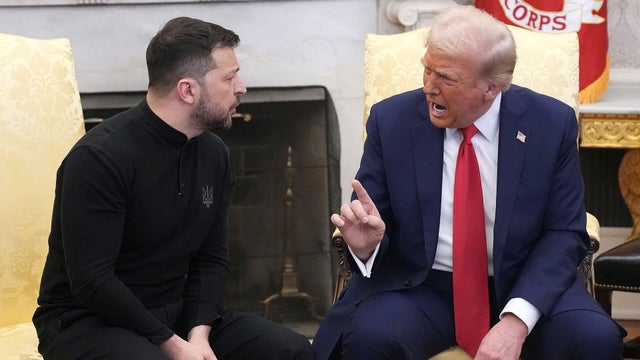
Mm-hmm. Let's get to this super important interview with Ukrainian President Zelenskyy. What are your big takeaways from that? President Zelenskyy spoke in English directly to the American people for a reason. He wrote a letter this week to the president of the United States and to the United States Congress pressing for anti-missile technology-- these Patriots, which are in short supply and high demand because of the war with Iran. But his country needs them right now, because the capital of Kyiv has come under intense assault. Last weekend, the most significant aerial campaign since the war began, and he says that the US and European allies told him they are about to get hit again. It's not just going to be drones on the capital. It's going to be cruise missiles, ballistic missiles. And he argues that's Vladimir Putin's only strategic advantage right now, those missiles. And he needs a way to take them out of the sky. Even with the Europeans footing the bill, it's America that produces these things. And our defense industrial base just can't make them quick enough right now. So he's really pleading here for some immediate help, and arguing to President Trump that the best way to get Vladimir Putin to peace is by giving him a way to defend his capital. And I want to play for you some of what he shared. Because, Major, it is so significant that it's not just Ukraine. Russia seems to be testing NATO's defenses, as we saw with that Russian drone that crossed into Romanian airspace overnight and fell on a building there. Also reports of a Russian drone hitting a Turkish cargo ship. That matters, because those are NATO members. Take a listen. We're hearing from European countries that Russia is taking more and more operational risks in Europe. Why do you think Vladimir Putin is taking these risks at this moment? First of all, it's not the first time he's doing such pressure. I think it's political pressure. It's messages from Russia, don't help Ukraine. I think this is the most usual meaning, what he used. If you will help Ukraine, I will do this-- such steps. So at the very beginning of this war, he did it in Romania, and then a little bit later it was in Poland when they used 21 drones. Then, for example, today at night it was again Romania, not the first time. We gave these messages to our Romanian partners at night. Usually we try to catch all the drones, even when their direction to other countries like Romania, Moldova, or in the direction of Poland, we try to catch everything. If we can't, of course, we give these messages to our partners. And just to remind our viewers again, these wars in the Middle East and in the middle of Europe are crossing over. The drones he's talking about are Iranian-designed drones that Russia has been buying. Those are the same drones that are hitting our Mideast allies. They are hitting Ukrainians, and have been for years, and now being sent increasingly into NATO member airspace. A senior NATO official told me today that they have increased some of their patrols to try to defend that territory, but it's just raising to the forefront that question of how far is Vladimir Putin really going to push this to test whether NATO is the paper tiger that you have heard President Trump refer to, or whether they will push back on him. Feels like things are intensifying. Margaret Brennan with the excellent interview. Thank you very, very much. You can watch more of Margaret's interview with President Vladimir Zelenskyy on Face the Nationthis Sunday, 10:30 AM Eastern, on CBS. Former Attorney General Pam Bondi defended the Justice Department's handling of the Epstein files on Capitol Hill today. She testified behind closed doors as part of the House Oversight committee's Epstein investigation. Bondi told lawmakers that during the release of the files, there were, quote, "redaction errors," unquote. Several Epstein survivors stood outside the Capitol office where the interview was held and yelled, quote, "tell the truth," unquote, as Bondi entered. CBS News congressional correspondent Nikole Killion joins me now. Nikole, what did we learn, if anything, today? Yeah, well, it was a bit of deja vu here on Capitol Hill, because it was just back in February where then Attorney General Pam Bondi appeared before the House Judiciary Committee with many of those Epstein survivors in the hearing room. The only difference this time around is that Bondi is no longer the attorney general. She was appearing before a different committee, House Oversight, and it was behind closed doors, in terms of being a voluntary, transcribed interview. I spoke with one of the Democrats on the House Oversight Committee, Congressman Yassamin Ansari, who basically gave a recap of what happened during this interview. And she said the things that struck her was that, for instance, the former attorney general really deferred to the acting attorney general, Todd Blanche, in terms of the handling of the Epstein files. Of course, many of these survivors were upset because a lot of victims' information was not redacted when these files were released. So that is something that they are still quite upset about. And so that was something that the former attorney general put on Todd Blanche, along with all of the other instances and concerns with respect to which these files were handled. The other thing Congressman Ansari said is that it also struck her that the former attorney general did not answer questions when it came to former President Trump. Take a listen to what she told me about that. It has been really disappointing, the level in which she is refusing to answer questions about the president, about his knowledge of events, about her conversations with him. Even though she's trying to say that by being here today she is complying with the Oversight Committee subpoena, which is absolutely not the case. Now, it's worth noting that the former attorney general, Pam Bondi, was represented today by Harmeet Dhillon, who is actually still with the Department of Justice. She is an Assistant Attorney General. She was joined by another official from the Justice Department, and she basically said that she was there in the capacity of making sure that the Department of Justice's processes were described accurately, and just to be there as a point of reference. But it did raise some eyebrows on the part of Democrats, as she also said after today's proceedings that, in terms of those questions about the current president and any conversations that he may have had with Pam Bondi, that they were just simply sticking to ground rules here. Also, when I asked specifically about those questions with respect to Todd Blanche, why Pam Bondi deferred to Todd Blanche in terms of the handling of the Epstein files, Dhillon told me that this is common. Obviously, Bondi had a very wide portfolio, dealt with a lot of different issues. So it's not uncommon that she would delegate some things to other officials within the Justice Department. That being said, Congresswoman Ansari and many Democrats on the panel say they now want to hear from the acting attorney general, Todd Blanche. In fact, Ranking Member Robert Garcia told me that he will ask Chair James Comer to see if it is possible to bring Blanche in. If not, he has also threatened the possibility of subpoena, which would require a substantial number of votes on the committee. So we will see where things go from here. But Chair Comer and Republicans on the committee, for their part, say they did not treat Pam Bondi any differently than any other witness. And that they are simply trying to get at the truth here when it comes to transparency for many of these victims and Epstein survivors.

MAJOR GARRETT:
00:15:39

Notably, this interview was transcribed not on video, as previous others had been. Nikole Killion, Capitol Hill, thank you very much. I'm joined now by Epstein survivor Annie Farmer. Annie, you just listened to Nikole. I'm sure you've gotten through your survivor sisters a sense of what happened or did not happen today. Give me your initial response. Hi, Major. Good to be back with you. I think we came into today hoping that potentially we would finally get some answers about what went wrong with this process, but expecting that it might be what we saw today, which was more just a lack of information, really, no substantive responses. A lot of saying she doesn't remember things, or passing the buck onto Todd Blanche. So, unfortunately, we're still left with a lot of questions.

MAJOR GARRETT:
00:16:33

That part about Todd Blanche strikes me as interesting, Annie, and I'd like your assessment. We all know, but just a quick reminder, Todd Blanche, former personal attorney to President Trump, he was essentially blamed by Bondi, the former attorney general, today, for all of the foul-ups in over-redaction or under-redaction. And that would suggest that maybe the former personal attorney to the President of the United States made mistakes. I don't know if they were intentional or not, but it seems to the average layperson, like me, that adds more smoke. Yeah, I don't think it's a good look at all. I also found that interesting. I would think as the head of the department that she would need to take accountability for what happened under her watch. But the fact that she says that Todd Blanche is really the one that made these decisions, I think it does raise the importance of bringing him in to answer the questions. And there's already been, I think, a real interest from Epstein survivors about getting answers to things related to Ghislaine Maxwell's questioning, her prison transfer. We knew that he was the person responsible for a lot of that. And I think this just adds now, knowing that maybe he was making some of these decisions in regards to the very problematic redaction issues, that we need to hear from him directly, and we need real answers. Annie, we've talked before, and I'm always grateful for your presence on this program. It's not, as I've heard you and other of your survivor sisters say, this is not about prosecuting President Trump. It's about unveiling anyone and everyone who had some manner of complicity. If that leads to charges, so be it. If it only leads to reputational harm, so be it. But let's lay it all out. How far away do you feel we are from that laying it all out reality? Yeah, I think we have a ways to go. I mean, we certainly have seen, with the information that's come out, that there's been more attention on some of these people that were very much involved in this network. They're not facing any criminal charges at this time. We haven't seen the prosecution piece. But we have seen a lot of loss of titles of power, in some cases, professional opportunities. So I think that that is something. But we also know that there are real substantive leads in these files that could potentially lead to criminal prosecution. And so until we have, number one, all of the information out, we really won't know what else is missing. We won't have answers to some fundamental questions about how this happened and why. And I think we won't feel closer to that truth and transparency. Let me ask you two questions, and they're related. There's activity in France and there's activity in the United Kingdom. Leads that have been detected are being followed actively in both of those countries. And in New Mexico, the legislature and the attorney general are pursuing leads related to Zorro Ranch. Give me your evaluation of those two things-- what's happening in Europe and what's happening in New Mexico. I think it's really hopeful to see that there are places that are taking this serious as an investigation of a crime. I know more about what's happening here in the US, in New Mexico. And I think since we have been so frustrated at the federal level by the ability to see progress happening, in terms of investigation, I'm really glad to know that lawmakers in New Mexico are taking this seriously. That they have convened this body to investigate, and they are holding public hearings to update the public on what they're finding out. And so I'm hoping that's a model for other states. I know there's already been some conversations about potential other states that might do something similar. We'll see how that plays out. But I believe there are many paths towards getting more accountability and more justice. And if the federal government, in particular the DOJ, is not willing to help us in that regard, there may be other ways that we can approach it. Before I let you go, Annie, on this program, the New Mexico Attorney General confirmed that among the things that they are investigating on Zorro Ranch property is the possible location of human remains. Do you think it could be that bad? It would just be speculation on my part. I hope that that is not the case, of course, that the tragedy included that type of death. But I'm glad that they are looking into it. Because if it's not investigated, we will never know.

MAJOR GARRETT:
00:21:34

Annie Farmer, it's always a pleasure to have you on the program. I thank you for your time, as always. Thank you so much.

MAJOR GARRETT:
00:21:41

Still to come on The Takeout, a win for progressives in Philadelphia. And a House Primary self-described a Democratic socialist, Chris Rabb, joins me live to discuss the significance of his victory and his path to Congress, which is pretty clear now. Also, a Blue Origin rocket explodes on the launch pad. You can see it right there. CBS News Space Consultant-- and he's an expert, I'm telling you. I love to talk to him. Bill Harwood joins me in a moment. Plus, why more workers are taking money out of their 401(k)s before retirement. What's behind this costly trend? The Takeoutreturns in 90 seconds. [THEME MUSIC] Welcome back to The Takeout. Last week's primary elections quite likely gave Democratic Socialists another voice in Congress. Democratic voters in Pennsylvania's Philadelphia-based third district, the most Democratic district in the nation, nominated Chris Rabb. He joins me now. Chris, I'm glad to see you. Thanks for joining the program. In American politics, lots of labels are attached. What we pride ourselves here at The Takeoutin is letting people in the political arena describe those labels themselves. So to start, what's the difference in your mind between a Democratic socialist and a standard garden variety Democrat? I think the standard garden variety Democrat believes in change, but perhaps not invested in systemic change. I believe, as a Democratic socialist, we believe in systemic change where we have to overhaul entire structures that do not benefit the Epstein class but, in fact, benefit average people in ways that have not really been the case ever. And the things that have been most meaningful, that have been embraced by most Americans are, in fact, socialist in nature-- whether it's Social Security, or public housing, public education, Medicare, Medicaid. These are all socialist things that in a pure, free enterprise capitalist system would not exist. What does that mean as your attitude when you think about CEOs in America, and pay disparities between those at the very top of a corporation, and the shareholders, or more importantly, the workers who labor for those corporations? Well, I don't think you need to be a Democratic socialist to realize what is increasingly unjust and unsustainable. I think there are traditional Reagan era conservatives who would have never imagined that the pay disparities between a CEO and entry level employee at a corporation would be as disparate as they are today. Even just since the pandemic, the wealth hoarded by the billionaire class is staggering. And yet, wages have stagnated for decades. I don't think you need to be a big old lefty to understand that that is deeply problematic.

MAJOR GARRETT:
00:24:42

I know it's a long time ago, but in 2005, you implied that CEOs should be somehow jailed or something like that. Do you still believe that? I'm not sure what you're referring to.

MAJOR GARRETT:
00:24:56

There's a couple of quotes where you were describing that CEOs were part of a class of Americans that should be treated harshly. There was a reference in general to the death penalty. I'm just curious what your overall attitude is about that. I'm not familiar with that. And I'm actually the lead sponsor of repealing the death penalty. So I don't believe that our government has the moral authority to kill anyone. I'm also anti-militarism, so I'm not sure where that came from.

MAJOR GARRETT:
00:25:22

Got you. But I do believe that anyone who's responsible for kleptocracy needs to be held to account. And unfortunately, that has become legalized in this nation. We also have to look at the corrosive influence of money and politics, and also something I'm sure you care deeply about, media consolidation. You talked about militarism. I'd like you, in your own words, to describe the Israeli policy in Gaza and in Lebanon. Genocide? Go on. Asked and answered. I think I am part of a growing set of voices internationally who calls it as we see it. I think we have to stop being complicit in a regime that is doing itself and its citizens no favors. Are Israeli Jews any safer under the current regime and what's led up to it? And the answer is no. And that also includes the so-called incursion into Iran by Netanyahu and Trump. This is not keeping that region, or the people in it, any safer. And we need to err on the side of diplomacy, and not on imperialism. Does Israel, as a nation state, have a right to exist? I don't even understand that question, and it's only asked about Israel. I do not understand that question. I think the bigger issue is, do people have the right to coexist in peace and with self-determination? And the answer is yes. But I don't accept the premise of that question.

MAJOR GARRETT:
00:27:09

Why not? Because it's a reality now, and there are some who advocate on the Democratic socialist side that it should not exist. I don't speak for anyone but myself. But the only time I've ever heard that question asked of anyone is as it relates to Israel. I've never had anyone ask me that question regarding any other nation, including our own. So do you believe that the United States has the right to exist?

MAJOR GARRETT:
00:27:36

Sure. OK. Even if it takes over Greenland, or Cuba, or Venezuela? Right to exist where? I think that's a fair question. And nobody's prepared to have that conversation who asks me questions like that. So I'm not going to answer questions specific to one nation when it's not applied to all. I do not believe in a hierarchy of human rights. I also am not a fan of nationalism. I'm interested in what's best for humanity, and the coexistence of people living peacefully and with justice. I do not believe in a tiered system of democracy or government. As someone who descends from 16 great great grandparents who withstood slavery, and Jim Crow, and segregation, my filter for what is right is, there's only one standard, and that's justice and shared prosperity.

MAJOR GARRETT:
00:28:33

I appreciate the time, and I appreciate the answers. Chris Rabb, I'll see you in Washington. Thank you very much. You're welcome.

MAJOR GARRETT:
00:28:41

An Ebola clinic for Americans blocked by Kenya's highest court. Why some local officials are concerned about the facility, and the timeline to get it up and running. We'll have more on that when we come back. You're watching The Takeout. [THEME MUSIC] Welcome back. Here's a look at what else we, and now you, are watching this evening. A federal judge has temporarily blocked the Trump administration's so-called anti-weaponization fund. Any potential payouts are now on pause until a June 12 hearing. The fund was created to resolve the president's lawsuit against the Internal Revenue Service over the unlawful leaking of his tax returns. A Justice Department spokesperson said the fund is legal with ample precedent. It, however, faces sizable Republican backlash in Congress. And in Kenya, the country's highest court today temporarily blocked the Trump administration from setting up an Ebola quarantine facility on an air base. We talked about this on the program yesterday. An organization that defends Kenya's Constitution cited a lack of transparency and public participation. The facility was supposed to be up and running today for Americans exposed to, or infected by, the virus. The outbreak is centered in the Democratic Republic of Congo, and has killed at least 220 people and infected more than 900 others. There are no known cases in Kenya. What can only be described as a significant setback for Blue Origin occurred last night. One of its rockets exploded on the launch pad. The massive fireball could be seen for miles. Blue Origin was conducting-- you see it right there-- a test of its new Glenn rocket. Despite the size of that blast, which you see there, no one was injured. The rocket is slated to aid NASA's goal of building a base for astronauts on the moon. CBS News Space Consultant Bill Harwood joins me now to discuss all this. Bill has been covering US space programs since 1984, and is one of the smartest people I know and have had the pleasure of talking to. So, Bill, we don't know a lot about what happened. That's still going to come in the days ahead. But I read in one of your dispatches that there's debris that might wash up on shore miles away? Yeah, that's possible. These launch pads are right by the Atlantic Ocean. They're just a few hundred yards from the beach. And as you saw in that video, this was a tremendous explosion. You could see debris arcing away from those clouds and all that fire, and obviously, that's going on in 360 degrees. So some of that debris ended up in the ocean. And the Space Force is just being careful. They're just warning people, if you do see anything wash up, don't mess with it. It could be dangerous. Dial 911, and people will come and dispose of it properly. It's just a precaution. I wouldn't expect anything significant to come out of that from a public safety standpoint.

MAJOR GARRETT:
00:31:34

Timeline ramifications of this disaster? It's really hard to say, Major. As you said, it's very early in this. Blue Origin hasn't told us anything about what they've been able to determine by reviewing all the telemetry from the rocket. And I got to tell you, they've got enormous amounts of data that come in all the time when they're running a test like this. They've also got lots of cameras all over that pad. The engineers may well have an idea of what went wrong at this point, but they haven't shared that with us. One thing I'll point out, and you mentioned I've covered this for a long time, a lot of times initial impressions are more negative than they turn out to be. And what I mean is, sometimes the initial outlook is, they'll be down for years, and it turns out it takes less time than that to recover. But that said, this was a major mishap. It was a serious problem, and the launch pad took a lot of damage. I mean, fixing the rocket is one thing, but those pads take years to build. And depending on how much damage is involved, that could really set Blue Origin back, because they've only got that one launch pad. SpaceX has two pads in Florida and one in California. If a problem takes one out, they can still fly. That's not the case with Blue Origin. They've got to rebuild this pad and do it fairly rapidly before they can fly again. And what is Blue Origin's anticipated role in NASA's pursuit of, not only getting to the moon, but in a small way, colonizing there? Well, it's a big role. NASA is counting on Blue Origin to provide one possible moon lander. They're paying SpaceX for a moon lander that company is designing, and they're paying Blue Origin for another to have redundancy and make sure at least one of them is ready to fly before the end of the decade. Blue Origin obviously wants it to be their lander. But they have to launch on the New Glenn. That's what it was designed for. And so if you can't launch these things to test them in Earth orbit, work the bugs out, it's pretty hard to see how they get selected to go to the moon. It's going to take more time, because they're going to have to recover from this mishap, and that'll play a role. And obviously, the moon, the Artemis program is just one aspect of Blue Origin's business model. They're launching Amazon internet satellites, commercial satellites. They're being certified to carry military satellites. So they have a big business going. But clearly, they're grounded now, and they're going to have to get back to flight before they can do any of that work-- including Artemis. When it comes to space reporting, he is deeply sourced and deeply experienced. Bill Harwood, always a pleasure. Thank you, sir. My pleasure.

MAJOR GARRETT:
00:34:09

Coming up, a new report on Americans retirement funds. Kelly O'Grady joins me to discuss why more people are dipping earlier than they should into their 401(k)s. That's next here on The Takeout. [THEME MUSIC] Welcome back to The Takeout. Welcome to the conversation corner. A new report from Fidelity shows more Americans are taking from their 401(k)s prematurely. This new data finds 2.5% of Americans have used what's called a hardship withdrawal. That's up slightly, that number, compared to last year. Kelly O'Grady joins us now from the Broadcast Center in New York to explain what it means. So, Kelly, what does it mean? Well, you never want to be dipping into your 401(k) early. That means that you're going to incur a 10% penalty. And on top of that, you're going to have to pay all the taxes that you would ultimately pay at the end of the day. And so what that means is, people are faced with that prospect, they know the consequences. But they're doing so poorly, they feel like they need that extra money that they're dipping into that, which everyone always says, don't touch your 401(k). You and I hear Jill Schlesinger say that all the time-- our business analyst colleague. Now, let me just emphasize, just because it's going up, it doesn't mean we're at 10% or 12% It was at 2.3%. It's ticked up to 2.5%. So it's slightly, but it's going in the direction that we don't want it to go. And we want people to feel like they have enough cash in the bank that they don't have to tap into assets that they're going to need later on in life, Major. Kelly, possibly another harbinger of financial hardship, I've recently seen data showing an uptick in the number of Americans who are 60 to 90 days behind on their basic credit card payments? Yeah, that's right. We've talked about this before. The credit card balances, they are at a record high, and they just keep going up and up. And so in the first quarter of this year, credit card delinquency rates-- people that weren't able to pay their credit cards on time at time at that 90-day mark-- ticked up to 13%. That is the highest that we have seen it in 15 years, the most since 2008. Remember 2008, great financial crisis. And so we talk about it all the time. We're still seeing good economic growth. People are still out there spending, the majority of those being, though, the high earners. They're sort of propping up the economy. But there are some people out there that are spending on gas, on food, on things maybe that they can't necessarily afford. And what's happening? They're delinquent. And what happens then? Then you're hit with the interest. And then it's just this cycle that people get into credit card debt, and it is so hard to get out of it. We don't want to see that number going in that direction.

MAJOR GARRETT:
00:36:57

And Kelly, I saw that credit card debt on average is right around 25% to 26%, when not too long ago, three or four or five years ago, it was in the mid-teens. Is that right? The credit card interest rates? Yes. Credit card interest rates, yes. Well especially around the holidays, you always go and they're saying, if you open up this credit card, you'll be able to get a discount. And a lot of times, those retail credit cards specifically, they're quite high, some even close to 30%. And so when you think about it, 25%, 30%, even something in the teens, that's really tough when you think about you also have to deal with that primary balance. And so if you're delinquent, then you're getting both. You have your principal you have to get rid of, then you have the interest, and it accumulates the more you fall behind. This can be a vicious cycle. That's right. And you likely have a delinquency fee that you have to pay every month if you're late, on top of that interest, on top of that principal. And it's just a hole that many Americans find themselves not able to work out of.

MAJOR GARRETT:
00:37:59

Harbingers of =, indeed. Kelly O'Grady, thank you so much. President Trump's party to celebrate America's 250th has a hole where the artist used to be.

VANILLA ICE:
00:38:11

(RAPPING) If there was a problem yo, I'll solve it Check out the hook while my DJ revolves it Ice, ice, baby

MAJOR GARRETT:
00:38:17

Don't despair if you're a fan of Vanilla Ice, that one-hit wonder. He's one of the artists still performing. He's still on the bill. But up next, we'll talk about the growing list of artistic cancellations, and sort out who's left and who's not. That we'll do with our reporter panel when we come back. This is The Takeout.

VANILLA ICE:
00:38:34

(RAPPING) With the bass kicked in and the Vegas are pumping Quick to the point, to the point, no faking Cooking MCs-- Welcome back to The Takeout. New York City Mayor Zohran Mamdani has endorsed the primary challenger to New York Congressman Adriano Espaillat. Mamdani says Darializa Avila Chevalier represents a new generation of leadership. And this is notable, because Espaillat is Chair of the Congressional Hispanic Caucus, which is kind of an important position here in DC, and Mamdani reportedly had planned on backing him. Let's bring in our reporter panel. Matt Brown, politics reporter for the Associated Press. Daniella Diaz covers politics for Notice, which as of Wednesday will be known as The Star. So what do we think about this? Mamdani sort of flexing a little bit of endorsement muscle? He has a lot of power right now. He was an upset in a mayor's race that everyone watched very closely. He's not traditionally what the Democratic establishment supports. It is very controversial that he endorsed an opponent, Adriano Espaillat, who, of course, as you noted, is the Chair of the Congressional Hispanic Caucus, has a lot of influence on the Democratic caucus House Democrats. I imagine, based on my conversations with people that I cannot name, that leadership is disappointed that this happened. And it was not something that they'd like to see, considering the influence he has in New York right now. And it's sort of an unnecessary distraction across what Democrats are trying to create, the impression of, which is a united front in the midterms. It reminds me a little bit of what Congresswoman Alexandria Ocasio-Cortez was like when she first entered political office. She was kind of a firebrand. She would go against the Democratic caucuses wishes--

MAJOR GARRETT:
00:40:14

And do her own flexes. --not endorsing encumbents, do her own flexes. What we've seen from her recently is a very much tamped down, join the caucus, be part of the effort, that united message. And it seemed that, potentially, Zohran Mamdani might have to have a similar awakening with the Democratic Party, too, Major. Before we went to break, we infected everyone watching and listening with the earworm that is Vanilla Ice from the early 1990s. We do apologize for that if you're offended, whatever. But he is part of a broader story, Matt, which I want you to help my audience understand. So there's this 250th concert that now has a lot of Trumpian overtones. And several artists didn't think they would have so many Trumpian overtones, got some blowback on social media, possibly within their own agencies, whatever. So let's go over the list of people who were on board and are now off board. Morris Day and the Time, Young MC, The Commodores, Martina McBride, Bret Michaels. What to make of all this? I think that this just gets to a bit of the confusion that everyone in America is having right now, given that there are two organizations that are celebrating the America's 250th. There's Freedom 250, which is President Donald Trump's main vehicle for celebrating this, and that's the organization that announced this list of artists that were going to be performing at the National Mall's celebration of America this summer. There's also America 250, which is the bipartisan, congressionally approved segment that is going to have iHeartRadio radio station. They're going to be celebrating in Charleston, Kentucky, South Carolina, New York, Los Angeles. And they're going to be having concerts as part of that series as well, but that hasn't been announced yet. So there are many A-list artists from all across the country who could be part of that series that's been approved by Congress that we won't know until the 4th of July. And the contest between these two things-- President Donald Trump wanting to have his own celebration of America with his own spin on it, his own energy, his own UFC fight, that has caused a lot of confusion-- not just, apparently, for political reporters like us covering this these days, but also the American people and apparently the artists who were trying to be involved. Thank you so much for explaining that, because I think the average person has no idea that there are two competing entities trying to have celebrations and then book guests or artists for them. Yeah. It's a brand fight. And we're just trying to celebrate a birthday here. Daniella? I mean, it's America's 250th. We should all celebrate the fact that the country-- Which should be a universal civic event. Universal. And there's been a lot of improvements here in Washington, DC, to prepare for that-- parks renovated. Which the president wants credit for. He probably deserves some for it. Deserves some credit for it. But I think it speaks to a bigger issue that is, right now, President Donald Trump's image is not so far the most bipartisan message, and artists are not eager to be associated with it. And let's be clear. Let's just cut right to the chase. In this second term, he has gone way overboard in making sure things look like him, or have his aesthetic attached to them-- the White House, the ballroom, the arch or whatever by Arlington National Cemetery, the Kennedy Center, the Institute of Peace, et cetera. Matt? Yeah. And I think that this is an effort that has run up into roadblocks. I mean, we just saw a judge recently say that the Trump name cannot be on the Kennedy Center, for instance. But this is what President Trump believes is part of his grand legacy. He really wants to literally leave his physical imprint on the city of Washington, DC, and the country at large. I think that this gets to, not just questions of is the reflecting pool going to be done by America's 250th birthday, but also, is the country literally going to be larger? I mean, this question of legacy with the president does affect our foreign policy in these moments. Are we going to have that annexed territory at the end of this term? You get the last 15 seconds, Danielle. I am looking forward to who the bipartisan organization is going to announce for their guests for the 250th anniversary. And may there be no last minute cancellations. Daniella Diaz, Matt Brown, thank you very much. I appreciate it. Happy Friday, everyone. You know what this is. We call ourselves The Takeout,and we are, as ever, relentlessly curious, reliably civil, occasionally clever. The Daily Report coming your way next.

View CBS News In
CBS News App Open
Chrome Safari Continue