Too much touching: Inside the botched prostitution investigations at Lewisville PD

Warning: This report contains mature content, including descriptions of sexual contact that may be disturbing to some.
Note: CBS News Texas contacted the officers who were found at fault in the internal investigation. All declined to comment.
For nearly two years, Lewisville police used questionable tactics to arrest women for prostitution. Then the cases fell apart, and the officers themselves were investigated. The department's internal affairs report filled more than 2,000 pages and included more than 50 interviews. The I-Team obtained the report and hours of audio of the officers explaining what went wrong.
From October 2022 to July 2024, officers in the Street Crimes Unit visited different locations posing as customers willing to pay for sex acts. But an internal investigation found in many cases they went too far.
Going undercover
In a sting operation, like much of police work, undercover officers are generally focused on obtaining probable cause. That is the minimum legal standard police and prosecutors need to arrest a suspect or file charges.
For the Lewisville prostitution stings, that meant all the officers needed was a verbal agreement with the suspects to exchange money for sex acts. But as Street Crimes Unit Det. Robert Limon, one of the leaders of the sting operation, discussed with Internal Affairs, in at least one of his cases, he went past the point of probable cause.
Internal Affairs Investigator: You agreed to $400 to f*** both of them.. excuse my language but I'm just reading what's in the report. So there, there's your probable cause, right? But then after that you stay and you ask them to get undressed, and you know, they're naked and you know, they're massaging you and grabbing your penis.
Det. Robert Limon: Well we don't, we don't just walk out.
IA Investigator: Why not? You have enough.
Det. Robert Limon: I don't know.
IA Investigator: You have the probable cause.. why not walk out? Why not break contact?
Det. Robert Limon: I have no idea, like I said, on that part.
Limon later told Internal Affairs investigators that he was trying not to reveal himself as a police officer, so the women would not become suspicious.
Internal Affairs Investigator: I'm trying to get into your mindset.. because I've had other UCs (undercovers) say they wouldn't do that stuff even if it blew their cover because that is a bulls*** excuse. This isn't the cartel, it's a massage parlor, who gives a crap if we blow our cover.
Det. Robert Limon: Again, this was the city pushing us to close these up, close it up. So it's not like the cartel where the city doesn't see it and doesn't bother us about the drugs.
IA Investigator: I get it. I'm just trying to figure out and understand where we went from compliance checks fully clothed to getting h******s. Something went wrong, somewhere. And I can't get anyone to pinpoint that.
Det. Robert Limon: And I can't tell you exactly when that happened.
IA detectives questioned Limon's superior, Sgt. Kevin Tice, about the interaction.
Internal Affairs Investigator: At what point is too much? It sounds like nothing, is what you're telling me.
Sgt. Kevin Tice: No, if they're being aggressive and trying to have sex with you, that's enough, whether they're touching.
IA Investigator: Then why didn't he leave? He was in there for another 18 minutes. That's what I'm saying.
Sgt. Kevin Tice: But you're reading that with the perception of not being in a covert operation.. and laying on the table and just talking through it. And you're saying he was touched that many times but there's nothing that says he was touched that many times.
IA Investigator: He didn't write that but it's on the audio.
Sgt. Kevin Tice: He could be saying that to send them away. To break contact.
IA Investigator: But they're not.
Sgt. Kevin Tice: But there's no video, right?
IA Investigator: If there was, we wouldn't be sitting here.
Sgt. Kevin Tice: And I wish there was. But that could be an attempt to -
IA Investigator: Because everyone that has listened to this audio is like, 'oh my God, what is this guy doing?'
Recruiting other officers
It wasn't just the Street Crimes Unit going into the massage establishments. Detectives recruited others within the department, including a bailiff, a school resource officer and patrol officers.
Officer Travis Plybon joined the Street Crimes Unit in February 2024, but said he went undercover before that.
Internal Affairs Investigator: So the first one, when you went in with no recording device, was somebody outside? Did they drop you off or did you drive yourself there?
Ofc. Travis Plybon: I drove myself there.
IA Investigator: So, just pulled out of patrol, given some city money, and told to go and see if you can solicit something.
Ofc. Travis Plybon: Yes, sir. I said, I was told, 'hey, make sure you bring some clothes today if you, if you're going to do' - because it was, they asked me like a couple days before. 'Hey, make sure you bring clothes this day.' I showed up to the office, I was given money and given the brief, and it was discussed whether someone would go with me and they said, 'no, no, no, you're fine. You can do it.'
A few weeks after he joined the Street Crimes Unit, Plybon recruited Travis Dunn, a rookie patrol officer.
Ofc. Travis Dunn: He said, since it's your first time, we'll take it easy on you, so we'll go here, there are pretty girls there.
Dunn told IA detectives he had never been undercover, nor had he ever paid for a massage. Still, he was given city money, a recording device and a few instructions.
Ofc. Travis Dunn: You need to make sure that she offers it to you. Go ahead and give it to - you know, show how much money you got or whatever. And if she touches you, let her touch you, and then once she touches you, you can break contact.
According to the IA report, the recording device picked up not just one touch, but several minutes of physical contact between Dunn and a woman at the business.
Internal Affairs Investigator: What caused you to go over four minutes of getting a h******, almost five minutes, if your instructions from them were, that once the deal is made and they touch you, you need to break contact.
Ofc. Dunn: I was trying to ask her questions, as far as, like, hey what's your name, trying to get - they didn't ask me to do that. They didn't ask me to get her name, they didn't ask me to get any of the questions I asked in the recording.. that was just me trying to be proactive.
Ten weeks after Dunn filed his report, the description of his interaction with the woman was altered to remove some of the more graphic details. In a second interview, Dunn eventually admitted that Plybon made changes to the narrative as Dunn watched.
Plybon told IA detectives his superior, Sgt. Jose Montoya, asked him to "clean it up."
Ofc. Travis Plybon: [Montoya] said, 'this report looks pretty bad,' and I was like, 'I understand, sir, but I told him he needs to tell the whole truth in there.' And he's like, 'no, I understand.' He's like, 'is there a way to clean it up where it's still factual but it doesn't look like he was going for 20 minutes in there?'
According to Montoya, he did not remember reading a lot of reports, but Dunn's stood out to him.
Sgt. Jose Montoya: The verbiage that he used, when the lady began to touch him. I remember I read that.
Internal Affairs Investigator: Was it the verbiage that he used, or that he was getting touched?
Sgt. Jose Montoya: Well I wasn't sure. I remember I pulled in [Plybon] - the lead investigator and said hey what - was the person briefed, look at this narrative, do you think this happened? And his response was I don't believe so, it's just written incorrectly.
The need for training
The I-Team interviewed Mike DeMarcus, a retired detective from Florida, about the need for undercover and covert training. He is the director of Law Enforcement Training Associates, a company that has conducted courses for agencies across the country, including police departments in Dallas, Fort Worth and Houston.
"I remember when I first started doing vice investigations," DeMarcus said. "I was more nervous going into a massage parlor than I was driving up and trying to buy crack on the street corner."
DeMarcus said it's essential to have every scenario mapped out and every question answered ahead of any undercover operation.
"How far can I go? What can I say? What constitutes entrapment? What's not entrapment, that kind of thing," he said. "And that's the big discrepancy around the agencies throughout the country is, some agencies are allowed to do one thing, while others aren't."
That holds true in North Texas. The I-Team surveyed more than a dozen agencies and found about half have conducted undercover operations at massage establishments in the last two years under various sets of rules.
Undercover policies for Arlington, Dallas and Fort Worth show that all three departments require investigators to get permission from superiors before going into a situation where they would undress, but the level of nudity and the amount of touching allowed varies.
DeMarcus said it may sound weird, but physical touch is sometimes necessary. "Sometimes the girls will make hand gestures indicating sex, but sometimes they won't," he told the I-Team. "Sometimes they'll, you know, go and they'll grope you automatically. Then maybe they start doing [hand gesture] as far as money, that kind of thing."
"Some guys think it's fun"
Lewisville PD did not have a written policy. Officers told the IA detectives they were told to go as far as they were comfortable, as long as they did not "finish."
Ofc. Michael Hernandez: If you're touched inappropriately, you need to break contact. Do not do it for gratification. Do not finish, like you do not ejaculate ... Make up an excuse, get out of there.
Plybon said he gave the same advice to the male and female officers he recruited for massage business operations.
Internal Affairs Investigator: What do you mean by that?
Ofc. Travis Plybon: Don't orgasm.
Many also spoke of challenges with a language barrier. The women in their investigations did not speak English, or would refuse to speak, instead depending on hand gestures or messages typed out on a phone. Some officers said physical touch was necessary to ensure the women understood what was being asked of them.
No one up the chain of command seemed to know so much physical and even sexual contact was happening on the massage tables, even though some employees said it was an open secret.
A records clerk told IA detectives the Street Crimes officers "were bragging about everything that got done to them at massage parlors." She said she heard them ask her male co-worker, another clerk, to go undercover, telling him, "If you want to come and see for yourself and see what you can get done, we'll have you go out."
After interviewing the male clerk, IA detectives called in Det. Limon for a second interview.
IA Investigator: Okay. Do you remember what exactly you told him? Because if you could remember it would be helpful.
Det. Robert Limon: I understand but I don't - I tried recruiting a lot of people, I couldn't tell you the exact words I told him. It wasn't that important of a conversation.
IA Investigator: It wasn't a joking thing, like ha ha?
Det. Robert Limon: I know I wouldn't have joked like that, not about having sex.
IA Investigator: Not about h******s, or b******s, while laughing?
Det. Robert Limon: I can tell you like I said, I wouldn't have told him that. He's making it sound like I said he could have sex. No, I would never even joke like that.
IA Investigator: When you recruited other people in the PD, did you ever jokingly say you'd get a free h******, or anything like that?
Det. Robert Limon: A free h******? No.
IA Investigator: You never joked one time?
Det. Robert Limon: Yeah yeah, joking around. I might have told one of the officers just make sure you tell me you broke contact, but that was jokingly - if they took that any other way, that's.. you know.. I guess I shouldn't joke like that.
Lewisville opens investigation after cases rejected
It wasn't until last summer that the Denton County District Attorney's Office raised the alarm. It rejected 22 prostitution cases filed by Lewisville PD because undercover officers, it complained, had "let things escalate into sexual contact" with suspects.
The actions of the undercover officers "at minimum were inappropriate and possible in violation of policy and or the law," making it difficult for prosecutors to make a case in court, according to police documents.
That's when Lewisville PD launched the Internal Affairs investigation.
Internal Affairs Investigator: We're looking for some insight because, we're also trying to wrap our heads around how did the PD get to this place where this has been going on for two years?
Capt. Kenneth Naffziger: I don't really know if you want my personal opinion.
IA Investigator: Yeah. Sure.
Capt. Kenneth Naffziger: I think they weren't supervised and I think they went wild and did whatever they f*** they wanted to. And they went in there to get h******s and realized that they could, and about every other time they wrote it down. Personally, I think that's what happened.
[Editor's note: Capt. Naffziger was merely a witness in the investigation.]
Det. David Nicaud: I don't think that that was ever the question of, hey are we doing this correctly.
Internal Affairs Investigator: Right, but the problem is, is the DA has kicked back all of these because that is a problem.
Det. David Nicaud: Right.
IA Investigator: That's the problem. They're saying you can't do that. They gave, they gave the chief examples from other agencies of, this is how you can do it. But our guys they're way across the line, so that's why we're doing this. And what we're coming to find is that you guys knew exactly how you were doing them. And no one else knew in the whole department.
The department was forced to drop the prostitution cases and return approximately $250,000 in cash seized from the massage businesses.
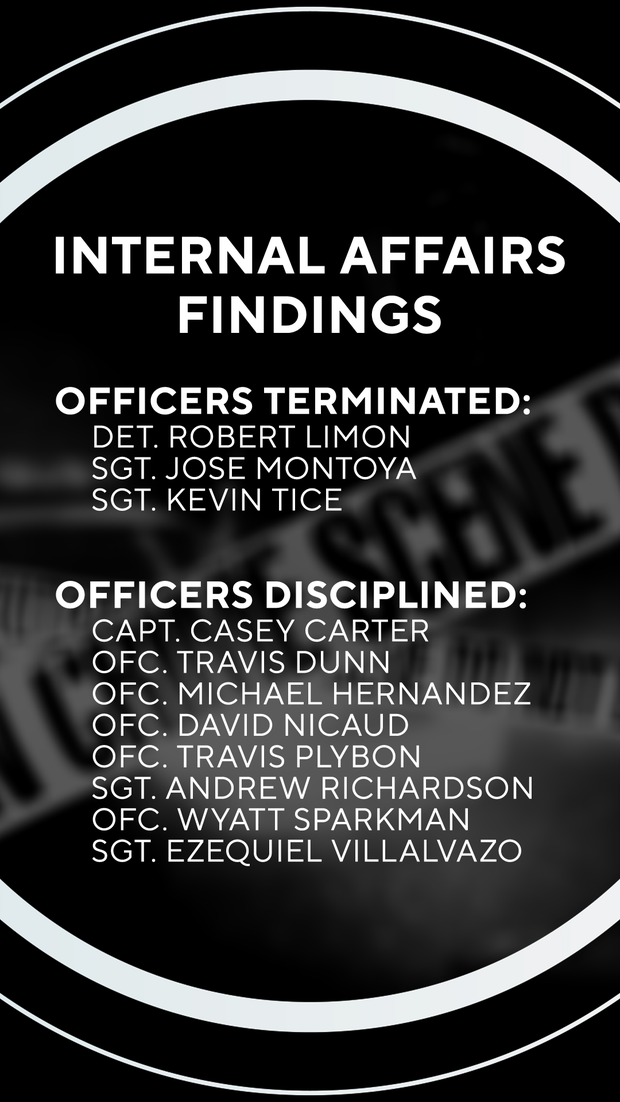
Two sergeants and a detective were fired; eight others were suspended or demoted. At least some of the officers have appealed those decisions and are awaiting hearings. All of them declined to comment for this story. The Texas Municipal Police Association, which represents the men, also declined to comment on their behalf.
Police Chief Brook Rollins removed most of the members of the Street Crimes Unit. He told the I-Team he is rebuilding it as a new unit, called Covert Operations, and is in the process of writing up a policy on undercover operations. He also referred the officers' cases to the Texas Rangers to see if they should face criminal charges.
The I-Team repeatedly asked DPS about its investigation but the agency would only refer to Lewisville's original press release (see below).
Rollins declined to be interviewed for this report. Here is the statement he originally released in October 2024.
"In late June 2024, the Lewisville Police Department initiated an internal investigation involving the Department's Street Crimes Unit. That investigation related to the Street Crimes Unit's efforts to identify and eliminate alleged prostitution at local massage establishments.
The investigation started after the Denton County District Attorney's Office brought to my attention some concerning aspects of 23 prostitution cases that our department had filed with his office. The 23 cases included 32 criminal charges against 28 suspects. The DA chose not to prosecute those cases.
LPD obtained the list of cases from the DA, and we immediately began an administrative review of the declined cases. During the review of these cases, it was apparent that possible misconduct was occurring.
I directed the Internal Affairs Unit to investigate these declined cases. Internal Affairs is the administrative investigative arm of the Chief of Police. Its job is to determine whether an employee has violated City or Department directives or protocols. Internal Affairs does not conduct criminal investigations.
Given the nature of the possible misconduct, I referred these cases to the Texas Department of Public Safety and the Texas Rangers for a concurrent yet separate criminal investigation. As of today, no criminal charges have been filed.
The investigation was substantial. Accurate reporting of the facts was critical, so while time was of the essence, it was essential to methodically analyze all available information to help determine what happened and whether misconduct occurred.
The Internal Affairs investigation concluded that there had been inappropriate contact between some officers and alleged prostitutes, and that 13 LPD members had violated one or more Department directives or protocols.
Once probable cause has been established for a prostitution arrest, any further physical contact is deemed inappropriate. There is no evidence that any officer had sex with any of the alleged prostitutes. Not all of the employees receiving discipline were found to have engaged in inappropriate contact; some were disciplined for ineffective supervision or communication that facilitated those incidents.
In late September, the report was handed over to the Command Staff for review. Internal Affairs does not recommend, comment on, or impose discipline. That is the responsibility of the Chief of Police.
This week, I imposed discipline and notified the affected employees. Three employees were terminated, one was demoted, and seven were issued suspensions without pay for various periods and will return to duty when their suspensions are served.
Two employees were given counseling entries, which is not a form of discipline. All members of the Department were notified about the investigatory findings and the disciplinary actions that were taken.
Terminating, demoting, and suspending officers is a challenging aspect of the job. It is not something I enjoy doing. But, as the Chief of Police, I must hold all of us accountable. These outcomes weigh heavily, and the aftermath is tough for all of us in the Department.
As we look ahead, the Lewisville Police Department must have a covert operations presence in this city. Narcotics, vice, and other covert criminal activity will continue, and we are responsible for mitigating it. We will conduct a hard reset and strategically approach the full resumption of this unit.
The Lewisville Police Department takes any allegation of wrongdoing seriously. We strive for the utmost in service, integrity, and professionalism in our daily duties. We fell short of that standard in this situation.
We are also deeply dedicated to fairness, impartiality, and transparency. Employees receiving discipline have access to an appeals process. All members of the Department were made aware of the investigation results by email this morning (Nov. 1).
In the meantime, I pledge to remain as transparent and forthcoming as possible about this investigatory process and its outcome."