North Texas woman accuses police of bungling her sexual assault case from the start
The first few hours of March 9, 2025, exist only in bits and pieces for one North Texas woman.
"I don't even remember leaving the club, is what's crazy," said the woman, whom the CBS News Texas I-Team is identifying only as Ashley.
After several rounds of shots, the Balch Springs woman said all she remembers is getting a ride home from Derek, her best friend's boyfriend. She had known Derek for more than a decade and trusted him. But that trust was shattered when they arrived at her apartment, she said.
"I was throwing up in the bathroom," Ashley recalled. "And I remember him trying to touch me and I remember pushing him off."
The rest of the night remains a blank, she said. But the next morning, her boyfriend began filling in some of the details. He told her she had called him hours earlier and claimed she had sex with Derek.
"I said it for a reason," Ashley said. "Something made me say that to him."
But when she asked Derek about it, he denied any sexual contact, she said.
What the doorbell camera video showed
Looking for answers, Ashley turned to her doorbell camera footage.
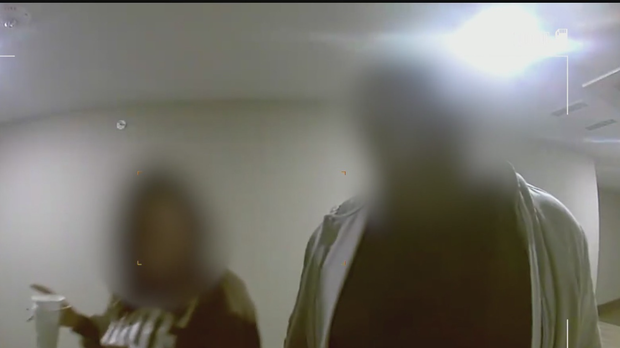
In the first video, timestamped at 4:04 a.m., Ashley and Derek can be seen walking up to her door. She is stumbling and appears heavily intoxicated.
About 32 minutes later, the camera was activated again as Derek left the apartment. Five minutes later, the camera captured Ashley leaving her apartment and wandering down the hall nude from the waist down.
Ashley spent the following week trying to piece together what happened.
"That happened Sunday. So the whole time I'm thinking about it, I'm like, 'something happened. Something happened,'" she recalled. "So, that Thursday I tell my big brother. First thing he said is, 'you need to press charges!'"
Ashley said even her best friend — Derek's girlfriend — encouraged her to file a police report.
She contacted Balch Springs police, and Officer Daniel Edwards responded to her apartment to take the report.
According to the police report, Edwards wrote that while Ashley "did not feel like there was any type of penetration to her vagina," she "believed something sexual happened" between her and Derek, something to which she "never" would have consented.
"When [Officer Edwards] left my apartment, he said the detective was going to contact me," Ashley said. "The detective never contacted me."
Ashley later learned why: Edwards had classified her sexual assault report as an information call, indicating that the incident did not meet the legal elements of a crime. As a result, no detective was assigned to investigate.
"The point of me calling police was for them to do an investigation," Ashley said. "I thought they would get my story, get his story, and see what didn't add up. But they never did that. So, it's like, what did I even call the police for?"
Why trauma-informed training matters
Victims of sexual violence often face challenges getting police to take their allegations seriously, according to law professor Demetrice Lopez-Loftis. A former Tarrant County prosecutor, she now helps lead Southern Methodist University's legal center for victims of crimes against women.
"I know that I can't have one conversation with a survivor and expect to get all the information in that one conversation," Lopez-Loftis said. "It's more like a flash of memory here, a little piece of information over here, some addition and division here, to try to get to what actually happened."
Lopez-Loftis said trauma-informed training is crucial at every level of the legal system because victims' accounts may be incomplete or inconsistent as they process what happened.
"I have to understand that so that what I'm hearing makes sense to me, and then I can translate that into what the legal framework is."
Without that understanding, police and prosecutors may mistakenly question a victim's credibility or truthfulness, she said.
Texas law requires police officers to complete a course called Trauma-Informed Approach to Sexual Assault Investigations. Previously an eight-hour online course, the training requirement doubled to 16 hours under a law passed in 2025. Officers can take the course online or in person.
Records from the Texas Commission on Law Enforcement show Edwards completed the eight-hour course in May 2024.
But as Ashley struggled to get answers about that night, she faced another complication: She was pregnant.
This is Part 1 of a two-part investigation. Part 2 will air on CBS News Texas at 10 p.m. Wednesday, Nov. 11.
If you or someone you know has experienced sexual assault, help is available 24/7. You can contact the RAINN National Sexual Assault Hotline at 800-656-4673 or the Dallas Area Rape Crisis Center at 972-641-7273. Both hotlines are available around the clock.