Recalling the resiliency of Dick Miyagawa, 1942 San Jose State boxing champ after Pearl Harbor

As we celebrate and honor Bay Area Asian Americans during Asian American and Pacific Islander Heritage Month, we want to highlight the life and legacy of Japanese American Takayoshi "Dick" Miyagawa.
Just a few months after the Japanese bombing of Pearl Harbor and the U.S. entry into World War II, the San Jose State Spartan became a national boxing champion in 1942, the same year that Executive Order 9066 was signed, authorizing the forced removal and incarceration of more than 120,000 Japanese Americans.
Urla Hill, San Jose State University guest curator, was flipping through San Jose State's old Spartan Daily newspaper when a particular headline and photo from 1942 caught her attention; something truly extraordinary for the times.
"Why would I think that I would see a picture of a Japanese person winning an NCAA title?" said HIll. "I was like, what? I mean, he wins an NCAA title and then he gets taken away to camp! It's unbelievable."
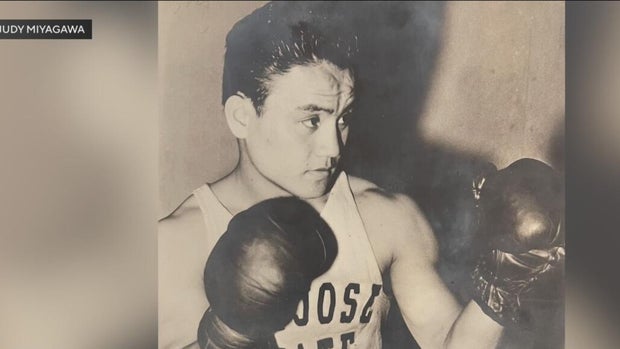
Hill had stumbled across the remarkable story of Miyagawa, who went by the nickname "Dick" from his American name Richard. Born and raised in Hawaii, Miyagawa was a student at San Jose State University when Pearl Harbor was attacked on December 7th, 1941. In March 1942, he competed and won both the Pacific Coast Championship and the National Collegiate Athletic Association boxing championship, wearing his last name "Miyagawa" proudly on his jersey.
"Pearl Harbor had already happened and then so here's someone going into the ring with Miyagawa on his back," said Hill. "How did that feel? How did that feel?"
Days later, Miyagawa went from a national boxing champion to a prisoner, forced to live in a horse stall at the temporary detention camp at the Santa Anita racetrack with thousands of Japanese Americans. Later, he was sent to the Gila River War Relocation Center in Arizona.
Miyagawa would not let that break him and taught boxing to the Japanese Americans also imprisoned there.
Hill did some digging and found Miyagawa's daughter Judy. For a decade, Urla and Judy have been working together to share his inspirational story and make sure his legacy isn't forgotten.
"He didn't let things get him down," said Judy. "You know, he had a saying that he used to have above his desk. It was all in Latin. I can't remember all of the words, but it basically translated to, 'Don't let the bastards get you down.'"
Judy recalled one particular incident during the Pacific Coast Championship in Sacramento right after Pearl Harbor. It was a time of intense anti-Japanese racism across the country.
"When they were leaving, walking through the lobby, of course one jerk yells, 'Kill the Jap,' and their coach was about ready to jump down his throat, and my dad put his hand on his shoulder and said, 'Coach, if I can take it, you can take it,'" said Judy. "This happened a couple of times. He knew this was going to happen, and he boxed his little heart out."
That resilience defined him. His technique and tenacity were undefeated. He went onto win that regional championship and then won nationals a week later.
Following the passing of Executive Order 9066 in February of 1942, Japanese students were prohibited from attending West Coast universities. Miyagawa's coach, DeWitt Portal, wrote letters to coaches of collegiate boxing teams in the Midwest and on the East Coast while Miyagawa was detained at Gila River.
The University of Wisconsin-Madison's boxing coach, John Walsh, whose team captured the NCAA title that year, wanted him. Miyagawa graduated with his bachelor's and master's degrees from the University of Wisconsin where he was recognized as one of their boxing elites.
Despite incarceration, Miyagawa volunteered to serve in the U.S. military during World War II along with more than 30,000 Japanese Americans, who bravely fought for a country that had imprisoned them.
"He was my hero and according to my older brother, and I quote, 'he was my god,'" said Judy. "I mean, he embraced everything that was good, right and honest and hard work will get you where you want to go and belief in yourself."
Dick Miyagawa did not fight just to survive; he fought to overcome. His life was proof he could rise above it all. Even in his final days up to his death in 2001 at age 81, he was a fighter to the end.
San Jose State University's exhibit "Fists of Fury," honoring the life and legacy of Dick Miyagawa will be on display until May 24th on the 5th Floor Special Collections Lobby at San Jose State's King Library.


