Scientists seek to rescue endangered plant found only in Santa Clara Valley

In the hills above Silicon Valley, CBS News Bay Area went on a ride with a couple of scientists. Once someone unlocked the gate, and off we went on a bumpy truck ride, in search for a rare plant: a one-of-a-kind dudleya only found in the Santa Clara Valley.
"Yes, the Santa Clara Valley Dudleya. That's the only kind of dudleya that we're talking about out here," said conservation ecologist Dr. Stuart Weiss.
In the back of the truck sat Dr. Justen Whittall of Santa Clara University. In the driver's seat was Weiss, who is the chief scientist for Creekside Science.
The Santa Clara Valley Dudleya is also known by its scientific name dudleya setchellii, or more commonly as the Santa Clara Valley "liveforever." The rosette succulent can live from 50 to 100 years.
It roots and grows in the crevices on the outcrops of prehistoric rocks known as serpentinite, which is found in the Coyote Valley region within Santa Clara County.
"You'll see the serpentine rocks. You'll notice the plants tend to be found in the fissures," Whittall said.
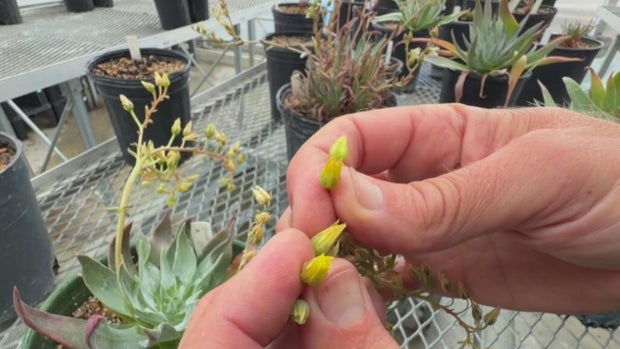
The plant is now dormant and in fact, when the team found them, CBS News Bay Area thought they looked kind of dead. But once it rains, they'll plump back to life, and in the spring, grow slender stalks that are bursting with pale yellow flowers.
The flowers serve as an essential food source for pollinators, which in this case are primarily bumblebees, and the pollinators help the plant create tiny new seeds.
"As soon as we get some rain and it gets wet, it's off to the races for the year," Weiss added.
Whittall was on hand to collect the dry stalks, so he can harvest some of the extraordinarily tiny seeds.
The goal of the scientists is to protect the plant and its fragile ecosystem from several serious threats, including climate change, habitat loss, and poaching.
"Within the last five years, we've seen a rapid increase in the number of missing plants from otherwise long-established populations," said Whittall.
He told CBS News Bay Area that the Santa Clara Valley dudleya is one of the most poached plants in California.
People poach the federally endangered plant to use in private landscaping, leaving behind gaping holes in the serpentine.
"It looks a little bit analogous to an empty grave," said Whittall.
At Santa Clara University, the plant biologist and his students are working on ways to prevent its extinction.
"First we are establishing new populations and in order to do that we want to ensure they can thrive," he said.
The strategy is to learn as much as one can about the rare plant.
Whittall set up video cameras to see what pollinators were seeking out the Santa Clara Valley dudleya. The students also did experiments with seeds, using butcher paper and a lawn blower to measure the area of seed dispersals.
The team is also extracting DNA from plant specimens and creating genetic profiles to help identify which ones are the most genetically diverse and possibly the most resilient as the planet continues to warm.
Some of these plants are grown in the campus greenhouse. They are earmarked to one day be transplanted in the wild in order to create and bolster new populations.
"The minimum is to prevent the extinction of a species and at best we might even improve its current status," explained Whittall.
The scientists are urging the public not to poach any kind of wild dudleya for the potential harmful impact it will have on the health of the existing populations and all the creatures that depend on the wild plants.
UC Santa Cruz Professor Stephen McCabe, the former research director at the schools arboretum, has preserved many of his dudleya seeds in seed banks. McCabe has also fought poaching by hybridizing a dudleya to create beautiful plants that are found in nurseries. His aim was to flood the market with these plants, lower the market value, and deter poaching.
Back in the hills, Whittall collected enough seeds, and the team departed, knowing that their efforts are raising awareness and germinating new approaches so that the Santa Clara Valley liveforever lives forever.


