What to know about California's Proposition 50 redistricting measure and the Nov. 4 special election
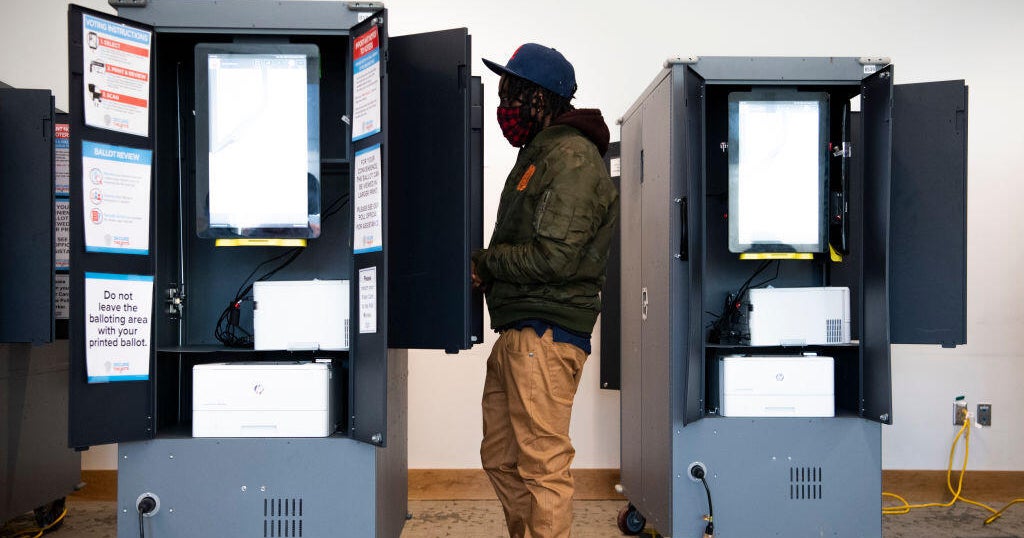
California voters are heading to the polls on Tuesday for the Nov. 4 special election on Proposition 50, a measure backed by legislative Democrats and Gov. Gavin Newsom that, if approved, would redraw the state's congressional districts.
Polling places and vote centers opened across the state at 7 a.m. Pacific and will close at 8 p.m.
Here's what voters should know about Proposition 50.
What is Proposition 50?
Proposition 50 would replace California's current congressional district maps that were drawn by the California Citizens Redistricting Commission based on the 2020 U.S. Census. If the proposition passes, it would shift five of California's U.S. House seats to be more favorable to Democrats in the 2026 midterm elections.
California Democratic leaders launched the effort to counter a move by Texas Republicans to redraw that state's congressional districts to create five GOP-friendly seats.
What does a "yes" or "no" vote on Proposition 50 mean?
A "yes" vote for Proposition 50 supports California's use of the new, legislatively drawn congressional district maps beginning in 2026. The maps would be used until the California Citizens Redistricting Commission draws new maps after the 2030 U.S. Census.
A "no" vote opposes implementation of the new maps and instead supports using current congressional district boundaries until new maps are drawn after the 2030 U.S. Census.
Which California congressional districts would change?
California has 52 congressional districts, with Democrats representing 43 of them and Republicans representing nine. The Proposition 50 effort seeks to redraw five districts held by GOP House members to make them more favorable to being won by Democrats, but there is no guarantee that Democrats will win the seats if voters approve the maps.
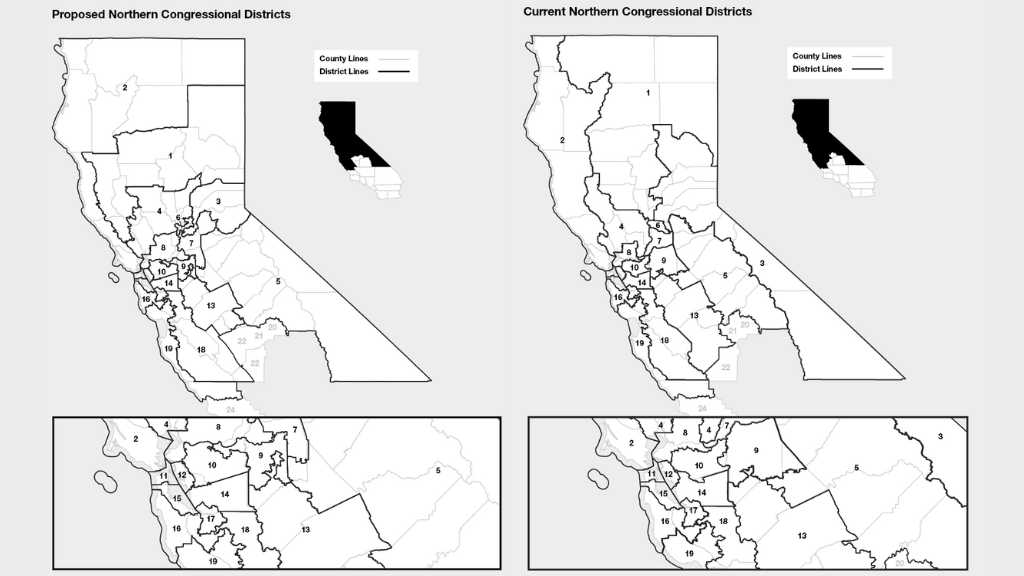
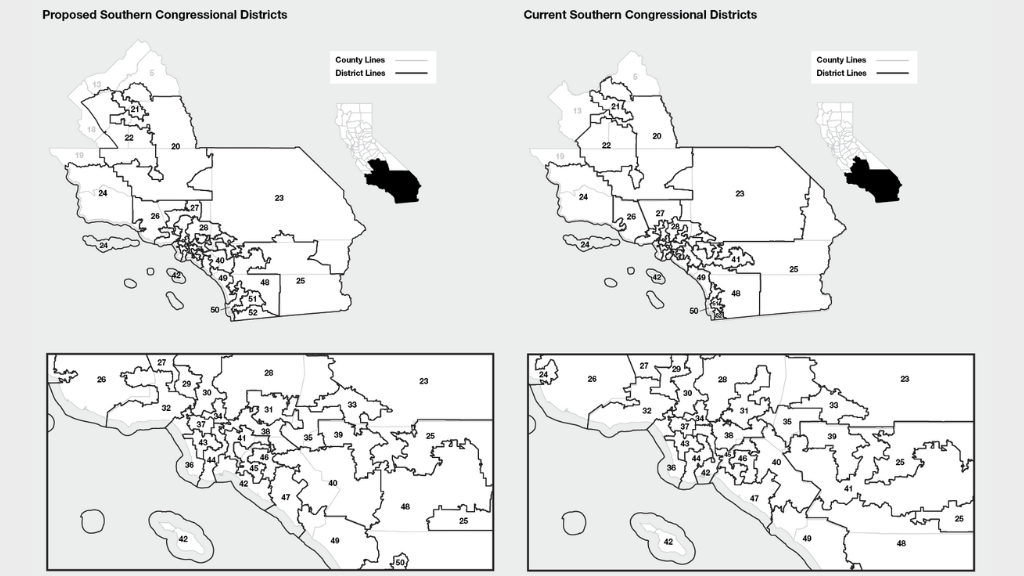
The five Republican-led districts most targeted under Proposition 50 are District 1, represented by Rep. Doug LaMalfa; District 3, represented by Rep. Kevin Kiley; District 22, represented by Rep. David Valadao; District 41, represented by Rep. Ken Calvert; and District 48, represented by Rep. Darrell Issa.
LaMalfa's district covers a broad area of Northern California, stretching from the Oregon border south through the Sacramento Valley to the northern end of Sacramento County. The new map would shift the district's boundaries southward, removing the more conservative areas in the northeast corner of the state to incorporate areas with a stronger Democratic presence.
Kiley's District 3 would undergo the most change if voters approve the new maps. Currently, the district covers parts of the Sacramento suburbs and Sierra foothills, stretching down the Eastern Sierra and through Death Valley. If Proposition 50 passes, the Eastern Sierra and everything below it — more conservative-leaning areas — would be removed from District 3.
A redrawn District 22 in Central California would be larger in size, stretching north to include parts of Fresno County and exclude parts of Kings County.
Further south, Calvert's district, which covers a large section of Riverside County, would shrink to become more centered on the urban areas of the county, cutting out Republican-leaning desert communities. Issa's District 48, which includes parts of San Diego, would see its boundaries moved further inland and as far north as Palm Springs in Riverside County.
Who are the major backers of Proposition 50?
Newsom has been a vocal champion of Proposition 50, along with the field of Democratic candidates vying to succeed him in 2026.
In total, more than $167.9 million has been raised in support of Proposition 50 as of Oct. 28, according to the California Secretary of State's office.
According to the Secretary of State's office, top donors in support include the House Majority PAC for Proposition 50 with $45.9 million in total contributions, and billionaire investor George Soros' Fund for Policy Reform with $10 million.
In early October, investor and 2020 presidential candidate Tom Steyer launched a multi-million dollar ad campaign in support of Proposition 50.
The Yes on 50 campaign has also debuted an ad featuring former President Barack Obama making a direct-to-camera plea to California voters.
Who are the major opponents of Proposition 50?
The top contributors to the committee against Proposition 50 as of Oct. 13 are the Congressional Leadership Fund Super PAC, with more than $43.5 million donated, and Republican political donor Charles Munger Jr., whose contributions total more than $32.7 million, according to the Secretary of State's Office.
Other major donors include former House Speaker Kevin McCarthy with $1 million and businessman Thomas M. Siebel — a second cousin of Jennifer Siebel Newsom — also with $1 million.
In total, the campaign opposing Proposition 50 has raised more than $83.5 million as of Oct. 28, according to the California Secretary of State's office.
Republican former California Gov. Arnold Schwarzenegger has also been critical of the redistricting initiative, with his remarks having featured prominently in ads opposing Proposition 50.
How do I vote in the Nov. 4 election? What are the dates and deadlines I need to know?
Election officials were required to mail out ballots to registered voters by Oct. 6. Voters who haven't returned those mail-in ballots can still mail them back, but the ballots need to be postmarked on or before election day and received by the county no later than a week after election day in order for them to count.
Vote-by-mail ballots can also be delivered to any polling place within the state or the office of your county elections official. A number of ballot drop-off locations are also open. Ballots must be deposited by 8 p.m. on Nov. 4.
Voters can authorize someone to return their ballot, but the authorization section on the outside of the ballot's envelope must be filled out.
The last day to register to vote was Oct. 20. People who haven't registered to vote or need to change their registration can do so at a county elections office, vote center or polling place.
You can check the California Secretary of State's website for information on same-day voter registration, and to find your polling place or vote center, if you're in a Voter's Choice Act county.
Polls are open from 7 a.m. to 8 p.m. on Election Day.
How do I find my vote center if I'm in a Voter's Choice Act county?
A number of counties across the state have had vote centers open as of Oct. 25 for early in-person voting. Only Voter's Choice Act counties have opened early voting centers: Alameda, Amador, Butte, Calaveras, El Dorado, Fresno, Humboldt, Kings, Los Angeles, Madera, Marin, Mariposa, Merced, Napa, Nevada, Orange, Placer, Riverside, Sacramento, San Benito, San Diego, San Mateo, Santa Clara, Santa Cruz, Sonoma, Stanislaus, Tuolumne, Ventura, and Yolo.
Check the California Secretary of State's website for information on where to find your vote center.
I've heard some of the California voter guides are inaccurate. What information was incorrect?
On page 11 of the 2025 voter information guide, a proposed congressional district was mislabeled on a map as District 22 instead of District 27. On page 15, the guide included a separate map that correctly identified District 27.
The California Office of the Secretary of State said a correction postcard was mailed to all voter households that received the mislabeled map.
The voter guide's website has also been updated.