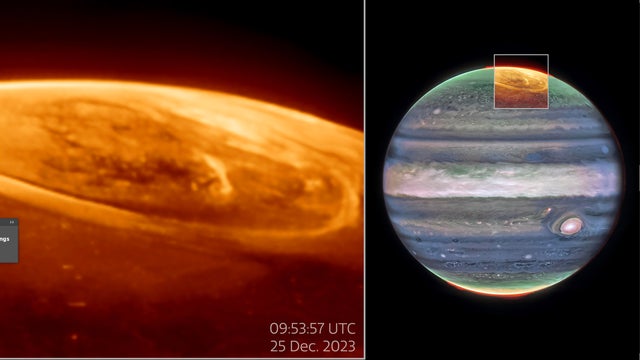
Webb telescope captures images of Jupiter's auroras in stunning detail
Jupiter's stunning auroras are hundreds of times brighter than those seen on Earth, as pictured in new images taken by the James Webb Space Telescope.
Watch CBS News
Jupiter's stunning auroras are hundreds of times brighter than those seen on Earth, as pictured in new images taken by the James Webb Space Telescope.
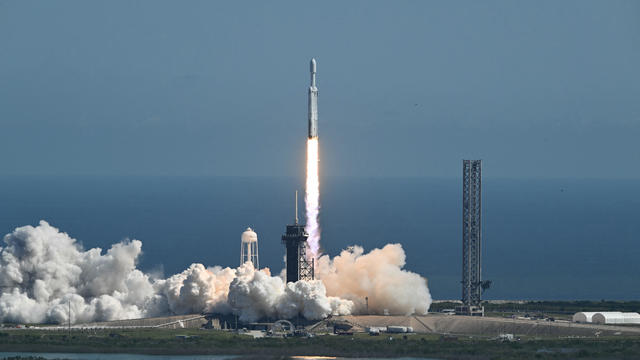
The ambitious mission won't actually look for life on Jupiter's moon Europa, but it should find out if the presumed ocean provides a habitable environment.

The European Space Agency's Jupiter Icy Moons Explorer flew past Earth on Aug. 20, capturing unique images along the way.
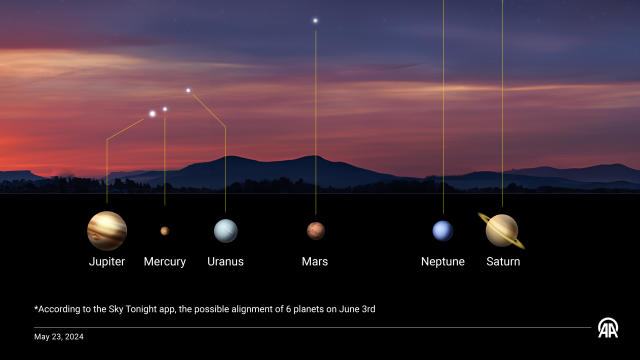
The orbits of six planets will bring them to the same side of the sun to create a "planetary parade" in early June.
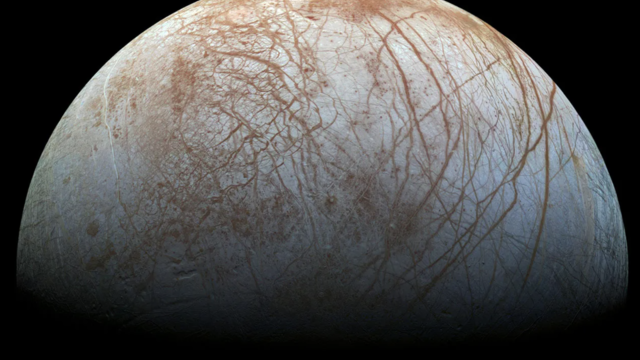
A new study suggests there is less oxygen on the icy surface of Jupiter's moon Europa than scientists previously thought.

NASA's spacecraft Juno did a flyby of Jupiter's moon Io to learn more about the lunar body's volcanic activity.

Lightning also occurs on other planets. Here's what we know about the lightning strike on Jupiter.

The green lightning bolt was seen inside one of the many vortices that cluster near Jupiter's north pole. Scientists are still trying to understand many facets of Jupiter, the largest planet in our solar system, including its massive storms and how lightning and lightning-like events occur on the gas giant.
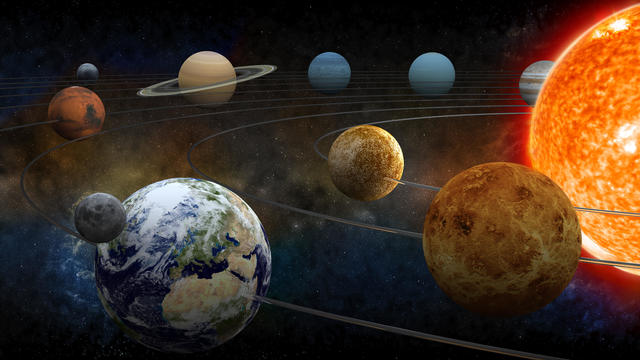
The planetary alignment will include Saturn, Neptune, Jupiter, Uranus and Mercury.

Europe's JUICE probe will study three of Jupiter's icy moons, looking for signs of habitable sub-surface oceans.

On Wednesday night (3/1/23) we were treated to a cosmic light show as Venus and Jupiter crossed paths shortly after sunset. Several CBS13 viewers called in to share their awe at the spectacle. However, NASA reports that this impressive sight doesn't have any real scientific significance - it's just nice to look at.

Jupiter and Venus will appear very close together in the night sky on Wednesday, with the two planets set to pass each other in what's known as a conjunction.

The new moons were discovered using telescopes in Hawaii and Chile, and their orbits were confirmed with follow-up observations.

Stargazers can get the view of a lifetime on Monday night as Jupiter makes its closest approach to Earth since 1963.