NOAA says its new AI-driven weather models improve forecast speed and accuracy
The National Oceanic and Atmospheric Administration has introduced a new suite of weather forecasting models that are driven by Artificial Intelligence and are expected to deliver faster and more accurate predictions, the agency announced on Wednesday.
"NOAA's strategic application of AI is a significant leap forward in American weather model innovation," said Neil Jacobs, NOAA's administrator, in a statement. "These AI models reflect a new paradigm for NOAA in providing improved accuracy for large-scale weather and tropical tracks, and faster delivery of forecast products to meteorologists and the public at a lower cost through drastically reduced computational expenses."
The AI technology became operational and available to forecasters early Wednesday morning. Erica Grow Cei, a spokesperson for the National Weather Service, which is the branch of NOAA responsible for forecasts, told CBS News that the latest models do not intend to replace the traditional ones that rely on complex mathematical equations, instead of machine learning, in order to run. In fact, the traditional system is one of the sources from which the AI program pulls information, said Cei.
Until now, scientists at NOAA and its National Weather Service have mainly relied on the Global Forecast System to help them anticipate the conditions to come. Also called the GFS, this system is a physics-based weather model that uses a set of equations to represent the physical atmosphere and generate data for different weather scenarios, like temperature, wind, rainfall, ozone concentration and soil moisture. Individual models within the system are dedicated to conditions on land, in the ocean and in the atmosphere, which collectively help predict weather.
The Global Ensemble Forecast System, or GEFS, is another equations-based model, which was created to address certain limitations or biases in the original system.
NOAA is using those traditional forecasting models as frameworks for its new AI systems, which "learn to predict patterns and behaviors of the atmosphere by being trained upon decades of historical data," said Daryl Kleist, the deputy director of NOAA's Environmental Modeling Center.
"For these AI models, much of the gain in skill is owed to the fact that they were trained on analysis data," much of which came from the older numerical modeling systems, Kleist told CBS News.
The agency has estimated that the AI programs will require between 91% and 99% less computing power than traditional models, while at the same time extending the life of a particular forecast, potentially by as much as 18 or 24 hours. However, while the new models require fewer units of energy to build a real-time forecast than the traditional ones, those percentages ignore the cost of training the models, Kleist said. Training AI is a notoriously energy-intensive process.
AI modeling will be applied in three specific areas, said NOAA.
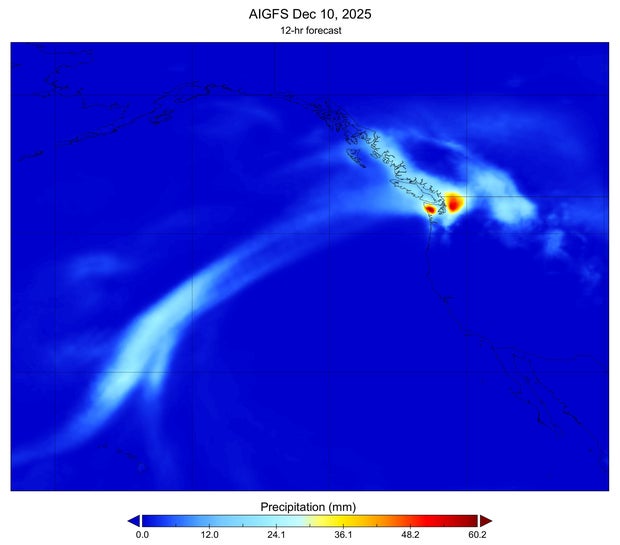
The first, called the Artificial Intelligence Global Forecast System, or AIGFS, is described as a "weather forecast model that implements AI to deliver improved weather forecasts more quickly and efficiently" than its traditional counterpart, according to the agency.
"A single 16-day forecast uses only 0.3% of the computing resources of the operational GFS and finishes in approximately 40 minutes," said NOAA. "This reduced latency means forecasters get critical data more quickly than they do from the traditional GFS."
The second, called the Artificial Intelligence Global Ensemble Forecast System, or AIGEFS, is a somewhat more advanced version of that system and is designed to provide weather forecasters with a range of forecast possibilities instead of just one. A Hybrid-GEFS is the third, in which the new AI forecasting technology and traditional GEFS work together to develop predictions that account for forecast uncertainty.
Scientists have identified areas in each of the AI models that need improvement. According to NOAA, there is still work underway to refine the systems' hurricane forecasts, as well as the diversity of variable outcomes produced by the AIGEFS.