Retrial underway in Davis stabbing spree as prosecutors center case on "cannabis-induced psychosis"
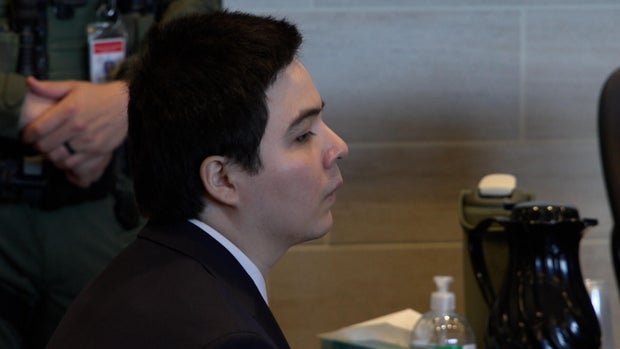
The retrial of former UC Davis student Carlos Reales Dominguez, 24, started this week in Yolo County Superior Court following his 2025 mistrial on murder and attempted murder charges.
In the first trial, a jury found Dominguez not guilty on the charge of first-degree murder in a series of fatal stabbings in Davis that he is accused of committing over the span of a week in late April and early May of 2023.
The jury deadlocked on the charge of second-degree murder, which resulted in a mistrial being declared by the judge and a new trial date being set.
David Breaux, the first victim known as the "compassion guy" in Davis, was stabbed to death while he slept on a bench in Central Park. Two days later, Karim Abou Najm, set to graduate from UC Davis, was killed when he was stabbed more than 50 times while riding his bike through Sycamore Park.
The third and final victim, Kimberlee Guillory, was stabbed two days after Najm while she slept in a tent at a homeless encampment in Davis. She is the lone survivor and has shared her story exclusively with CBS Sacramento.
Opening statements in Dominguez's retrial began on Thursday, May 28. For a recap of the case up to this point, watch this story breaking down how we got here.
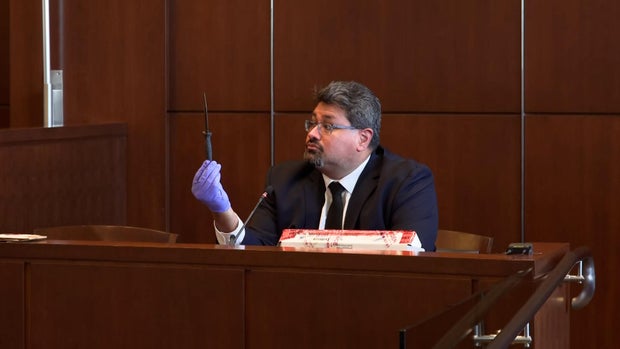
Thursday and Friday in court, the prosecution started to call witnesses to the stand to give testimony, with Friday's testimony centering on lead Davis Police investigator Detective Alex Torres, who showed jurors the large knife that police say was pulled from Dominguez's backpack when he was arrested in 2023.
The People's case: stabbings done with intent under cannabis-induced psychosis
In opening statements at the retrial, it was clear that prosecutors with the Yolo County District Attorney's Office have refined their case to include a new strategy.
In the first trial in 2025, the State's case leaned heavily on emotional testimony from the families of the stabbing victims and Guillory, the sole survivor, herself. They also interviewed family, friends and UC Davis colleagues of Dominguez, whose testimony was used by the prosecution to paint a picture of Dominguez as an angry, failing UC Davis student who was acting out with malice during the stabbing spree.
This time around, prosecutors are not denying that Dominguez is schizophrenic and was experiencing symptoms of the condition at the time of the crimes. This is a major point of the defense when arguing his state of mind at the time of the stabbings and the reason for Dominguez's plea of 'not guilty by reason of insanity.'
"These violent, unprovoked, yet intentional attacks brought the city of Davis to a state of panic and fear," said deputy district attorney Matt DeMoura in opening statements.
The prosecution alleged in both trials that Dominguez committed the stabbings with intent. This time, their strategy has evolved to introduce a theory blaming highly potent THC and Dominguez's alleged heavy use of marijuana products that they say worsened his undiagnosed schizophrenia and sent him into a cannabis-induced psychosis that drove him to murder.
"Cannabis can reveal schizophrenia or it can exacerbate symptoms, push someone over the edge," DeMoura said as he addressed the jury Thursday. "Even in psychosis, he intended to kill Kimberlee Guillory, Karim Abou Najm, and David Breaux."
The State says it will call health experts to the stand who will speak specifically about cannabis-induced psychosis and argue he knew what he was doing at the time of the stabbings.
"All of this death, this despair, this destruction was due to one individual. One individual who is responsible for this and that is Carlos Reales Dominguez, who sits before you today," said DeMoura.
Prosecutors also plan to call friends of Dominguez to the witness stand to give testimony about how heavily he was using cannabis products leading up to the stabbings and that he had become much more secretive and aloof.
Defending Dominguez: a deteriorating mind and a 'not guilty' plea
In both the first trial and the retrial, Dominguez's public defender, Daniel Hutchinson, has never denied the fact that Dominguez himself committed the three stabbings.
In his first trial, Dominguez took to the stand and gave testimony that he thought he was attacking "shadow shapeshifters" that the voices in his head were telling him to kill. Dominguez testified that it was only after he was treated in state custody, following his arrest, for undiagnosed schizophrenia that he realized he had stabbed his three victims, whom he now realizes were people, not "shadow figures."
In 2025, Hutchinson based his defense of Dominguez around the fact that this was the result of his first psychotic break and used testimony by friends and family of Dominguez to paint the picture that his mental state right before the attacks was deteriorating and that he was becoming more paranoid.
Testimony from Dominguez's sister was that he had stopped taking care of himself entirely.
Health experts in the first trial testified that this behavior was consistent with schizophrenia and Hutchinson also cited Dominguez's childhood trauma and sexual abuse.
In both trials, Hutchinson has maintained that the question before the jury is not whether or not Dominguez committed these stabbings, but rather his intent and mental state at the time.
On the prosecution's cannabis theory, Hutchinson said in opening arguments on Thursday that doctors have closely examined Dominguez and diagnosed him definitively with schizophrenia.
Hutchinson plans to call multiple health experts to the stand, who he says will reject the idea of a cannabis-induced psychosis being to blame for the stabbings. He will also call attention, again, to the fact that Dominguez's behavior had become much more erratic and unpredictable in the days and weeks leading up to the attacks.
"The question that we presented to you in this phase of the trial is what was Carlos Reales Dominguez's specific intent and mental state when he did those physical attacks? What was happening in his mind? Evidence will show it was a mind that had been devastated by a severe, progressive, debilitating and cruel mental disease," Hutchinson said to the jury on Thursday.
Hutchinson said Dominguez was suffering from this undiagnosed condition and he plans to argue that he began to show symptoms of mental health issues as a child when he lived in El Salvador.