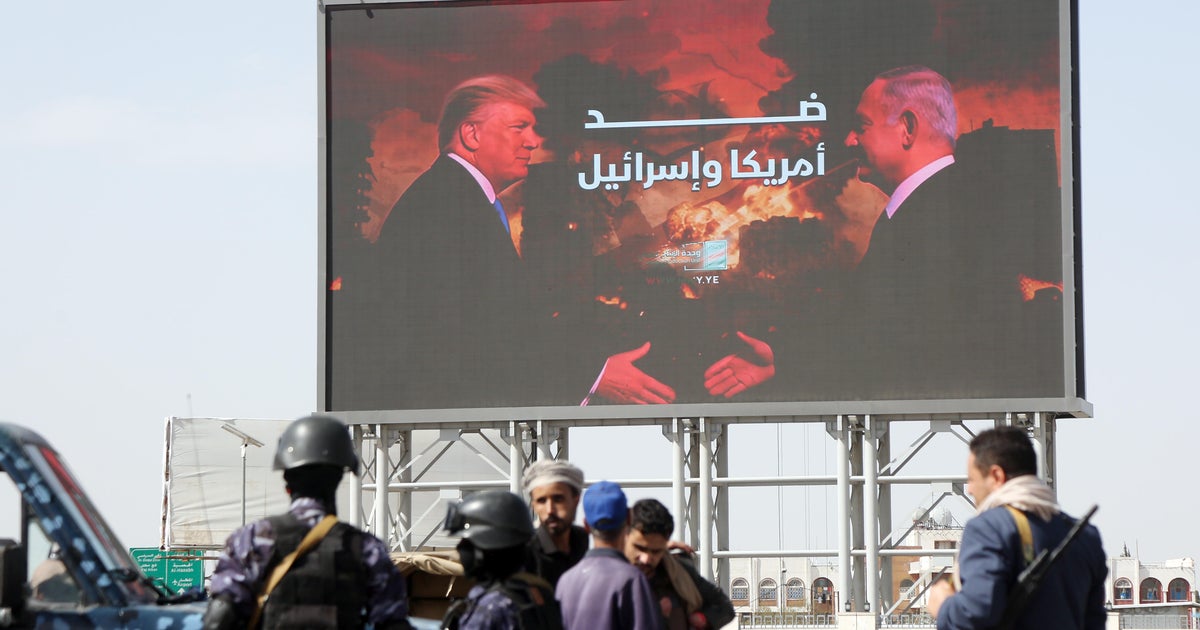
Live Updates: Trump's threat to blow "everything up" if Iran won't make a deal hangs over new ceasefire bid
What to know about the Iran war today:
- A diplomatic effort is underway to avoid a major escalation in the Iran war, with President Trump considering a Pakistani proposal for a 45-day ceasefire to reopen the Strait of Hormuz, among other ideas. Hanging over the effort is President Trump's profanity-laced threat to destroy Iran's power plants and other civilian infrastructure if Tehran doesn't make a deal by Tuesday evening.
- Mr. Trump is scheduled to speak Monday afternoon about the U.S. operation that rescued the second member of an F-15 crew after the fighter jet was shot down in Iran Friday.
- U.S.-Israeli strikes continue, with the intelligence chief of Iran's powerful Revolutionary Guards Corps among dozens killed on Monday. Israel and America's Persian Gulf allies are bearing the brunt of Tehran's retaliatory fire. Four people were killed by an Iranian missile attack in Israel, the military confirmed Monday.
Top EU official says targeting civilian infrastructure, "namely energy facilities, is illegal and unacceptable"
The president of the European Union's governing body, the European Council, called for a diplomatic resolution to the Iran war Monday and warned that "any targeting of civilian infrastructure, namely energy facilities, is illegal and unacceptable."
President Trump has threatened to destroy Iran's civilian power plants and its bridges if it doesn't agree to a deal to end the war and reopen the Strait of Hormuz by Tuesday night.
"The Iranian civilian population is the main victim of the Iranian regime. It would also be the main victim of a widening of the military campaign," EC President Antonio Costa said in a social media post, adding a call from the European Union for Iran "to immediately put an end to its attacks against countries in the region and to allow for the reestablishment of full freedom of navigation through the Strait of Hormuz. Escalation will not achieve a ceasefire and peace. Only negotiations will, namely the ongoing efforts led by regional partners."
Pakistan has offered a 45-day ceasefire proposal which both the White House and Tehran are currently considering.
Iran's Foreign Minister Abbas Araghchi, in his own post on social media, condemned Costa's remark as "disgraceful" for not mentioning Israel's part in the joint war against his country, which Iran has retaliated for with its de facto blockade of the Strait of Hormuz.
"Forget international law, justice, and ethics, this is sheer absurdity. Europe's leadership has hit rock bottom," said Araghchi. "That's a shame."
Adviser to Iran's supreme leader warns strikes on power plants would draw reciprocal attacks on Gulf states
A senior adviser to Iran's supreme leader warned Monday that if President Trump makes good on his threat to order strikes on the country's civilian power plants, Tehran would retaliate by targeting energy infrastructure in U.S.-allied Persian Gulf states.
"The foolish President of the #United_States has threatened to strike Iran's electrical infrastructure! The rulers of #Arab_countries should, in order to prevent the region from going dark, make Trump understand that the #Persian_Gulf is not a place for gambling," said Aliakbar Velayati in his social media post.
Velayati is a former Iranian foreign minister and current senior advisor to the nation's supreme leader, Ayatollah Mojtaba Khamenei, who has not been seen or heard from directly since sustaining unspecified injuries in the same airstrike that killed his father, who was also his predecessor, on Feb. 28.
Iraqi militias say drones launched at U.S. consulate in Erbil, as State Dept. warns Iraq to crack down on Iranian proxies
The Iranian-backed Iraqi militia group known collectively as the Popular Mobilization Forces said its members were targeted Monday by multiple U.S. strikes, including one aimed at an intelligence headquarters and several that targeted a base near the Haliwa Airport in the southern part of Iraq.
The PMF said there were no human casualties from the strikes.
A pro-PMF media outlet later said members of the Iranian-backed umbrella group had launched a drone attack on the U.S. Consulate in Erbil, the capital of northern Iraq's semi-autonomous Kurdish region. There were no immediate reports of any impacts at the consulate, which has been targeted repeatedly during the Iran war.
A U.S. State Department spokesperson told CBS News' Margaret Brennan on Monday that Iranian-backed militias in Iraq had "conducted two more egregious attacks against U.S. diplomatic facilities in Iraq overnight in an attempt to kill American diplomats, adding to hundreds in recent weeks in and from Iraqi territory against U.S. citizens, Iraq's neighbors, and Iraqi state institutions and civilians, including in the Iraqi Kurdistan Region."
The spokesperson said the U.S. had "consistently urged the Iraqi government to immediately live up to its responsibility to stop attacks on U.S. facilities and to prevent terrorist militias from using Iraqi territory to launch attacks," adding that U.S. forces would "not hesitate to defend our personnel and facilities should the Iraqi government be unable to fulfill its obligations."
The State Department has offered a monetary reward for any information regarding planned or previous attacks against U.S. diplomatic facilities worldwide.
Iranian officials say situation "under control" after fire at huge petrochemical complex caused by Israeli strike
The operator of Iran's largest petrochemical complex said the situation was "under control" after Israel on Monday bombed the facility, with the extent of the damage being assessed.
"A fire has been brought under control. The situation is currently under control, and technical aspects, as well as the extent of the damage, are under investigation," state news agency IRNA cited the National Petrochemical Company as saying, adding that no injuries had been reported.
Israel claimed responsibility for the strikes on the South Pars petrochemical complex in Asaluyeh, a key site for Iran's energy sector, both for production of petroleum by-products and for joint work with Qatar on the world's largest natural gas field.
Israeli military says death of 4 people in Iran missile strike brings total toll during war to 21 civilians
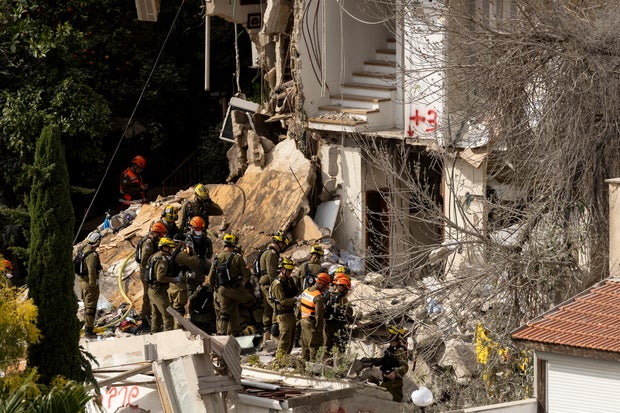
Israel Defense Forces international spokesperson Lt. Col. Nadav Shoshani acknowledged on Monday a "hard incident" in the northern city of Haifa, confirming that four Israeli civilians were killed when a residential building was hit by an Iranian ballistic missile the previous day.
Two of the victims were found amid the rubble after the strike on Sunday, while the two others were found Monday morning.
Shoshani said rescuers spent 18 hours using special equipment in "a highly complex rescue" operation complicated by the fact that, while part of the Iranian missile hit the building, there was no sign of an explosion, so crews had to be careful due to the possibility of an "active explosive device still in their arena."
"The Iranian regime with their attack killed 21 Israeli civilians. While the IDF and our American counterparts take every possible step to mitigate harm to civilians, Our enemies, Iranian regime, targets civilians purposely daily both in how they target and with the munitions they use," Shoshani said.
Iranian officials say some 2,000 people have been killed by the U.S. and Israeli strikes, which they say have hit at least one elementary school, and a university on Monday.
4 people wounded in UAE, 2 in Jordan as Iran continues hammering Gulf states with missiles and drones
The United Arab Emirates Ministry of Defense said Monday that it had "dealt with" 14 more Iranian missiles and 19 drones over the past 24 hours.
"These attacks have caused injuries to 4 people, ranging from minor to moderate and severe," the ministry's statement said, adding that since the U.S. and Israel launched their joint war on Iran, Tehran's retaliatory fire had wounded a total of 221 people of multiple nationalities and killed 13, including two Emirati military service members, a Moroccan civilian contractor and 10 civilians from Pakistan, Nepal, Bangladesh, the Palestinian Territories, India and Egypt.
It said the UAE's air defenses had intercepted a total of 519 ballistic missiles, 26 cruise missiles, and 2,210 drones launched by Iran.
Jordan's military said Monday that Iran had targeted the kingdom with missiles and drones over the last 24 hours, including one of each that were "not intercepted and fell within Jordanian territory."
"Two people were injured, both with moderate injuries; one was taken to a hospital for treatment, while the other received first aid on site," the military said in its statement, adding that some, unspecified "material damage was also reported."
U.S. Ambassador to Israel thanks country for "unprecedented assistance" in rescuing F-15 crew shot down in Iran
U.S. Ambassador to Israel Mike Huckabee said Monday that he had met personally with Prime Minister Benjamin Netanyahu to offer his thanks for Israel's "unprecedented assistance" with the operation over the weekend to rescue an American fighter jet crew member after Iran shot down an F-15 on Friday.
Huckabee said in a post on social media that he had met Netanyahu on behalf of the American people to thank him for his country's "unprecedented assistance" to the U.S. military and intelligence agencies "who conducted a historic rescue mission of our air crew in Iran."
Huckabee credited U.S. special forces for carrying out a "brilliant" operation, and said the Israel Defense Forces and Mossad intelligence agency "were helpful partners in the mission."
U.N. nuclear watchdog warns of radiological risk as U.S.-Israeli strikes hit near Iran's Bushehr nuclear plant
The International Atomic Energy Agency, the United Nations' nuclear watchdog agency, warned Monday of the potential for a "severe radiological accident with harmful consequences for people and the environment in Iran and beyond" after U.S.-Israeli strikes near an Iranian nuclear facility.
"Based on its independent analysis of new satellite imagery and detailed knowledge of the site, the IAEA can confirm recent impacts of military strikes close to Iran's Bushehr Nuclear Power Plant (BNPP), including one just 75 metres (yards) from the site perimeter," the agency said in a statement shared on social media, adding that the facility itself had not yet been damaged as of Sunday.
"Once again, IAEA Director General Rafael Grossi warns that continued military activity near the BNPP — an operating plant with large amounts of nuclear fuel — could cause a severe radiological accident with harmful consequences for people and the environment in Iran and beyond," the agency said.
It added a call from Grossi for all attacks near nuclear plants to stop, as they "pose a very real danger to nuclear safety."
Israel says it it is "striking with full force Iran's largest petrochemical facility"
"The IDF is currently striking with full force Iran's largest petrochemical facility, located in Eslamiyeh, a key target responsible for about 50% of the country's petrochemical production," Israeli Minister of Defense Israel Katz said Monday, touting it as "a severe economic blow, amounting to tens of billions of dollars for the Iranian regime."
Katz said in his video statement that he and Prime Minister Benjamin Netanyahu had instructed the Israeli military "to continue striking the Iranian regime's national infrastructure with full force."
Iranian state media reported explosions from attacks on several major petrochemical facilities across the country, including the South Pars facility in Asaluyeh, where smoke was reported rising after blasts explosions.
Trump "has not signed off" on Pakistani ceasefire proposal
A White House official told CBS News on Monday that a ceasefire proposal from Pakistan was "one of many ideas" being considered by the Trump administration, but that Mr. Trump "has not signed off on it."
"Operation Epic Fury continues," the official said, noting that Mr. Trump is due to speak at 1 p.m. on the war.
Iranian officials have not given any public indication of how they view the Pakistani proposal.
Iran says Trump's threat against civilian infrastructure "constitutes war crimes"
The spokesman for Iran's foreign ministry said Monday that President Trump's repeated threats to attack the country's civilian infrastructure amounted to war crimes, as he acknowledged ongoing diplomatic efforts to end the war but warned that "negotiation can in no way be compatible with ultimatums, crimes, or threats to commit war crimes.
As reports said Pakistan had handed Tehran and Washington a proposal for a 45-day ceasefire, foreign ministry spokesman Esmail Baqaei said it was "not unusual for intermediaries to convey the positions of the parties … and naturally, this process continues."
"However, negotiation can in no way be compatible with ultimatums, crimes, or threats to commit war crimes," Baqaei added in remarks conveyed by Iranian state media.
"Regarding threats against us, there is no doubt: issuing such threats constitutes war crimes, encourages war crimes, and normalizes war crimes. Repeatedly threatening a country with the destruction of energy and industrial infrastructure, while signaling to the Israeli regime to attack civilian targets either alone or with your cooperation, constitutes a war crime under both international humanitarian law and the Rome Statute of the International Criminal Court," Baqaei said.
Others have warned that attacking civilian infrastructure would constitute a war crime.
"Electrical generating plants power hospitals, they power schools, water sanitation facilities, the things that you need to sustain basic day-to-day living for a civilian population," Tess Bridgeman, who was a legal adviser to President Obama's National Security Council, told CBS News national security correspondent David Martin over the weekend. "Obliterating all power plants, threatening coercive actions against the civilian population to try to bring a government to the negotiating table, those kinds of things are flatly illegal."
Elliott Abrams, who served as special representative for Iran in the first Trump administration, told Martin punishing the Iranian population would undercut the U.S. cause. "We want the Iranian people on our side," he said. "I'd rather see us go after regime targets, assets they use to repress the Iranian people, not assets Iranians use to live their daily lives."
Trump to speak about rescue of F-15 crew at White House news conference on Monday
President Trump is scheduled to hold a news conference at the White House later Monday about the successful mission over the weekend to rescue the second member of a U.S. F-15E fighter jet crew from inside Iran, among other topics.
Mr. Trump said in a Truth Social post over the weekend that members of the military would join him to speak with the media at 1 p.m. Eastern on Monday afternoon.
The F-15's pilot was rescued Friday after the jet was shot down over a remote area of Iran, but the second crew member wasn't rescued by U.S. forces until early Sunday morning local time.
"We have rescued the seriously wounded, and really brave, F-15 Crew Member/Officer, from deep inside the mountains of Iran," Mr. Trump wrote in a Truth Social post on Sunday, calling him "a highly respected Colonel."
Iran's IRGC navy says "Strait of Hormuz will never return to its former state"
The naval command of Iran's powerful Islamic Revolutionary Guard Corps vowed Monday that shipping in "the Strait of Hormuz will never return to its former state, especially for America and Israel."
"The Navy of the IRGC is in the process of completing the operational preparations for the Announced Plan of Iran's officials for the new order in the Persian Gulf," the command said in a statement posted on social media.
It appeared to be a reference to a plan approved by Iran's parliament last week to charge a fee for all commercial vessels to transit the strait, a vital shipping lane on which Iran has enforced a de facto blockade in retaliation for the U.S.-Israeli strikes now in their fifth week.
Iran has allowed some ships to traverse the strait in recent days, but none belonging to the U.S. or Israel, and it is believed to be using its Larak Island as a "toll booth" to collect fees that other countries say amount to extortion.
Pakistan reportedly offers U.S. and Iran a last-ditch proposal for a ceasefire
Pakistan has presented the U.S. and Iran with a last-ditch proposal to immediately halt fighting and reopen the Strait of Hormuz, a source aware of the ongoing indirect negotiations told the Reuters news agency on Monday. Axios first reported on Sunday a bid for a potential 45-day ceasefire, intended to be the first part of a two-phase deal aimed at launching broader, direct negotiations to permanently end the war.
Pakistan drafted the framework to end the hostilities and presented it to Tehran and the Trump administration overnight, the source told Reuters.
"All elements need to be agreed today," the source told the news agency.
The source told Reuters that Pakistan's army chief, Field Marshal Asim Munir, was in contact "all night long" with Vice President JD Vance, U.S. special envoy Steve Witkoff and Iran's Foreign Minister Abbas Araghchi.
Reuters said the proposal by Islamabad calls for a ceasefire to take effect immediately so the Strait of Hormuz could reopen. There would then be 15–20 days for the two sides to finalize a broader settlement to end the war.
Neither the Trump administration nor Tehran offered any immediate response to the proposal.
Iranian officials have said previously that any ceasefire must come with guarantees that the country will not be attacked again by the U.S. or Israel, but Iranian officials have also indicated that they want the status quo in the Strait of Hormuz to change, with Tehran keeping a permanent level of control over the vital shipping lane. Some have even suggested Iran must be paid reparations for the damage done during the war, reparations that could come in the form of "tolls" charged by Iran to let ships through the strait.
Reuters said a final agreement under the proposal would be expected to include Iranian commitments not to pursue nuclear weapons in exchange for the U.S. and other countries lifting sanctions and releasing billions of dollars of frozen Iranian assets.
Iranian intel chief among 25 killed in new U.S.-Israeli strikes, as Iran's retaliatory fire kills 4 in Israel
Israel and the United States carried out a wave of attacks on Iran on Monday, killing more than 25 people, and Iran responded with missile fire on Israel and its Gulf Arab neighbors.
Explosions rang out in Tehran and low-flying jets could be heard for hours as the capital was pounded. Thick black smoke rose near the city's Azadi Square after one airstrike hit the grounds of the Sharif University of Technology.
Among those killed in one of the attacks was the head of intelligence for Iran's paramilitary Revolutionary Guard, Maj. Gen. Majid Khademi, Iranian state media and the Israeli military said.
In a statement, the Israel Defense Forces said Khademi, whose predecessor was killed in previous strikes last summer, was killed in an intelligence-based airstrike in Tehran.
The IDF said Khademi was "responsible for gathering intelligence and helping formulate a comprehensive situational assessment for the regime's senior leadership" during the current war, calling him a "key figure in the campaign."
"Additionally, Khademi worked to advance terrorist activities against the State of Israel and against Jewish targets worldwide. He also took part in attempts to target American individuals and was responsible for monitoring Iranian civilians as part of the regime's suppression of internal protests," the IDF said.
Iranian missiles hit the northern Israeli city of Haifa, meanwhile, where four people were found dead in the rubble of a residential building, the Israeli military said.
Kuwait, the United Arab Emirates and Saudi Arabia all activated their air defense systems to intercept incoming Iranian missiles and drones, as Tehran kept up the pressure on its Gulf neighbors. Iran's regular attacks on regional energy infrastructure and its stranglehold on the Strait of Hormuz, through which a fifth of the world's oil is shipped in peacetime, has sent global energy prices soaring.
CBS/AP
Iran warns of "much more devastating" response if civilian infrastructure is struck
Iran's central military command warned on Monday of "much more devastating" retaliation if its adversaries hit civilian targets.
"If attacks on civilian targets are repeated, the next stages of our offensive and retaliatory operations will be much more devastating and widespread," a spokesman for the Khatam al-Anbiya Central Headquarters said in a statement posted by state broadcaster IRIB on Telegram.
Trump tells Fox News deal with Iran possible after he threatens to blow "everything up" and take its oil
The president told Fox News in a phone interview that he thinks he can get a deal with Iran by Monday, acknowledging last ditch diplomatic efforts.
Trey Yingst, Fox News' chief foreign correspondent, said the president told him if Iran doesn't make a deal quickly, he's "considering blowing everything up and taking over the oil."
The interview came after Mr. Trump, in an Easter Sunday post on Truth Social, warned that without a deal, Tuesday would be "Power Plant Day, and Bridge Day, all wrapped up in one, in Iran," as he threatened to hit the country's electrical plants and other civilian infrastructure.
"There will be nothing like it!!!" the president wrote on Truth Social. "Open the F*****' Strait, you crazy bastards, or you'll be living in Hell — JUST WATCH!"
He later posted on Truth Social: "Tuesday, 8:00 P.M. Eastern Time," indicating his apparent deadline for Iran to make a deal.
He told The Wall Street Journal "if they don't do something by Tuesday evening, they won't have any power plants and they won't have any bridges standing."