Stephan Savoia/AP
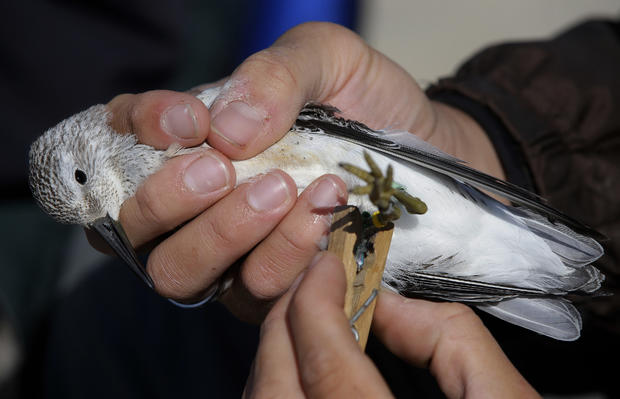
A researcher uses a clothes hanger to secure a geo-locator in place on the leg of a Red Knot shore bird while the glue dries on the north end of Nauset Beach in Eastham, Mass., Sept. 17, 2013.
The red knot is already on New Jersey's endangered species list and has been proposed for inclusion on the federal list. It's known for its South America-to-Arctic migration, a 10,000-mile flight.
The population has dropped by up to 75 percent since the 1980s in some areas, according to the U.S. Fish and Wildlife Service. The decrease is partly fueled by a drastic decline in the horseshoe crab population in Delaware Bay, a key refueling stop during their migration to the Arctic breeding grounds.
Stephan Savoia/AP
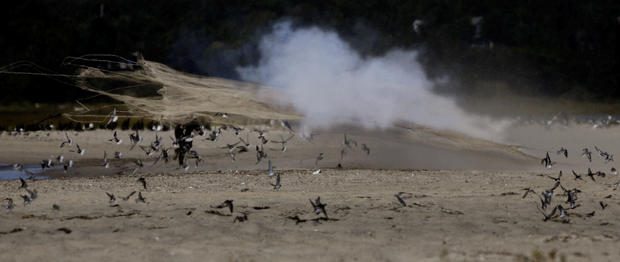
Shot into the air by cannons, propelled by black powder charges, a large bird net sores over a flock of shore birds on the north end of Nauset Beach in Eastham, Mass., Sept. 17, 2013.
Researchers are attempting to capture Red Knots so they may tag, measure, and take clippings before releasing the birds to continue their migration.
Red Knots are one of the longest-distance migrants in the animal kingdom.
Stephan Savoia/AP
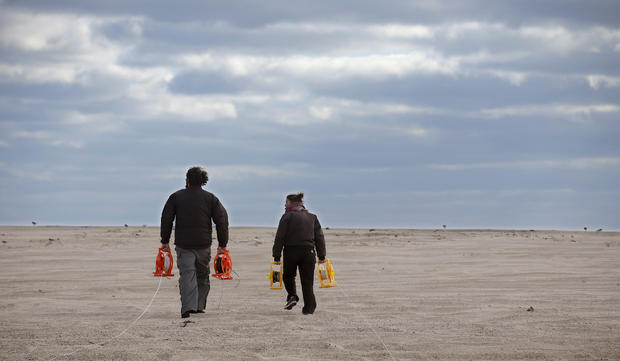
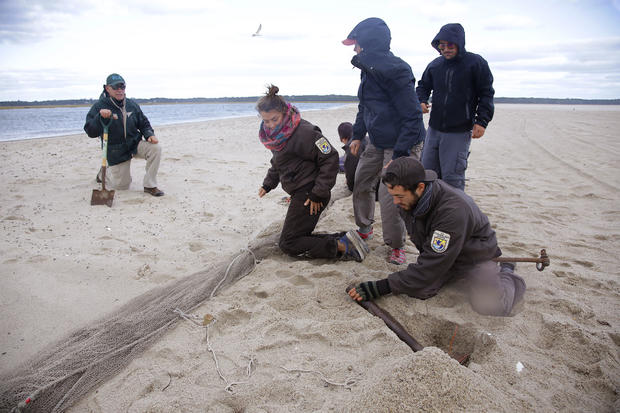
Kate Iaquinto, a U.S. Fish and Wildlife Service biologist at the Monomoy National Wildlife Refuge on Cape Cod, right, and Ellison Orcutt, with MassAudubon, lay out electrical wire which will be used to ignite the bird net cannons in an attempt to capture Red Knot shore birds in Eastham, Mass., Sept. 17, 2013.
Stephan Savoia/AP
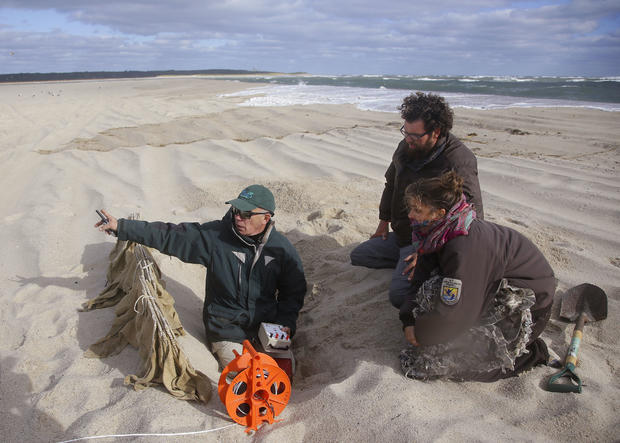
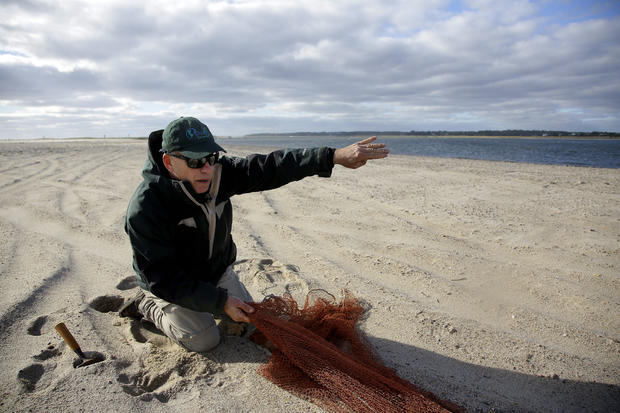
Larry Niles, a biologist with the Conserve Wildlife Foundation of New Jersey, holds the bird net cannon firing box as he describes to Ellison Orcutt, with MassAudubon, and Kate Iaquinto, a U.S. Fish and Wildlife Service biologist at the Monomoy National Wildlife Refuge, the sequence of events that will transpire on the north end of Nauset Beach once Niles gives Orcutt the order to fire in Eastham, Mass., Sept. 17, 2013.
Stephan Savoia/AP
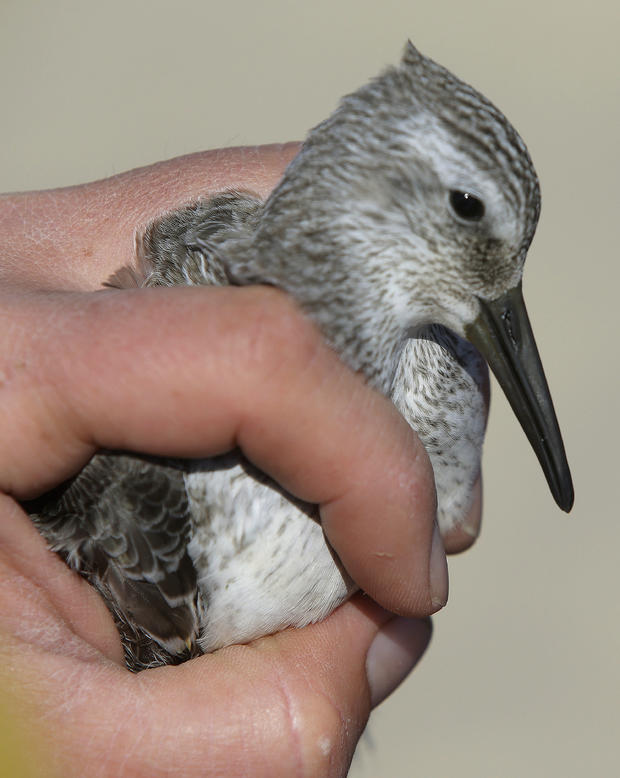
One of six Red Knot shore birds captured on Nauset Beach in Eastham, Mass., is held by a researcher, Sept. 17, 2013.
Stephan Savoia/AP
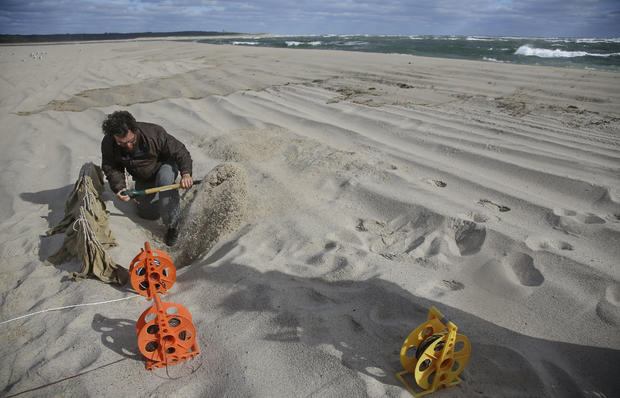
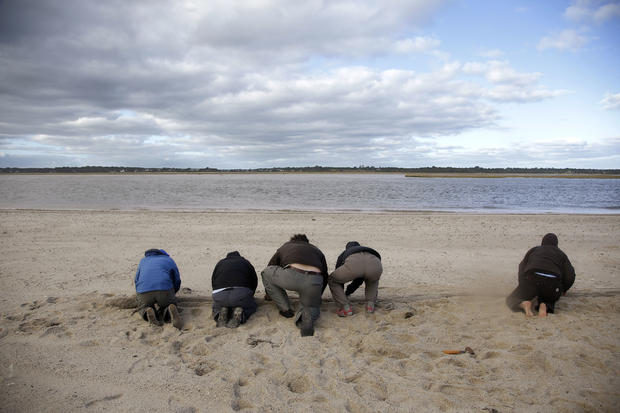
Ellison Orcutt, with MassAudubon, digs a firing blind on Nauset Beach from where he will ignite the bird net cannons in an attempt to capture Red Knot shore birds in Eastham, Mass., Sept. 17, 2013.
Stephan Savoia/AP
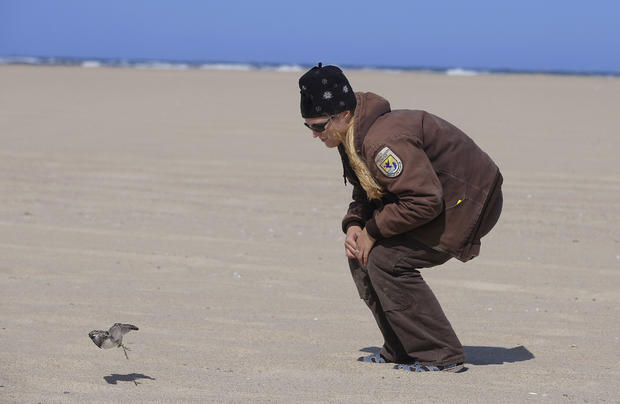
Kaiti Titherington, an employee of the U.S. Fish and Wildlife Service, releases a Red Knot on Nauset Beach in Eastham, Mass., Sept. 17, 2013.
Six Red Knots were caught, tagged and measured before being release to continue their long migration.
Stephan Savoia/AP
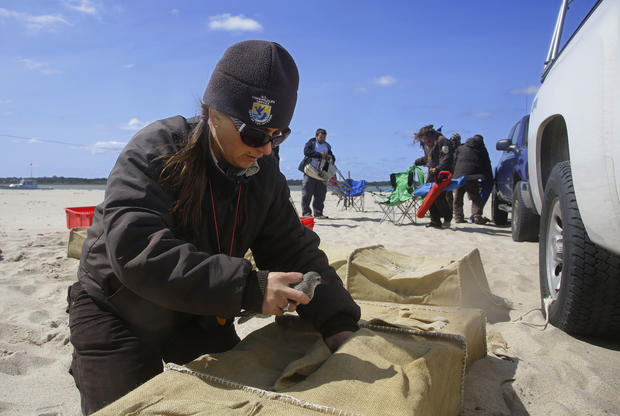
Stephanie Koch, a U.S. Fish and Wildlife Service biologist for Eastern Massachusetts National Wildlife Refuge, places a Red Knot shore bird into a roosting box on Nauset Beach in Eastham, Mass., Sept. 17, 2013.
Stephan Savoia/AP
Members of a joint research team roll up a large bird net used to capture Red Knot shore birds for research purposes on Nauset Beach in Eastham, Mass., Sept. 17, 2013.
Stephan Savoia/AP
Larry Niles, a biologist with the Conserve Wildlife Foundation of New Jersey, directs members of his research crew as he untangles a large bird net used to capture Red Knot shore birds on Nauset Beach in Eastham, Mass., Sept. 17, 2013.
Stephan Savoia/AP
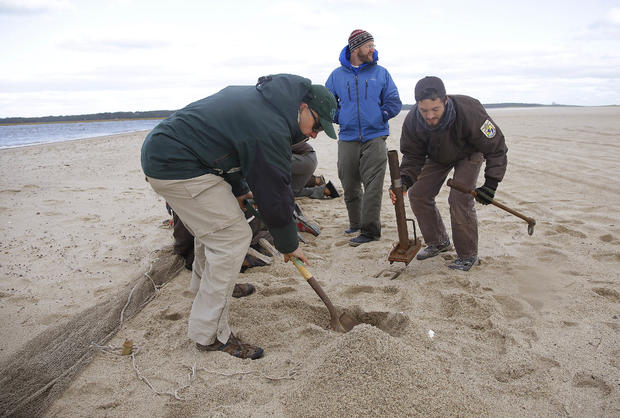
Larry Niles, a biologist with the Conserve Wildlife Foundation of New Jersey, left, guides Yianni Laskaris, right, of the U.S. Fish and Wildlife Service as he aligns a net cannon on Nauset Beach in Eastham, Mass., Sept. 17, 2013.
Stephan Savoia/AP
Larry Niles, a biologist with the Conserve Wildlife Foundation of New Jersey, digs a hole in the sand on the north end of Nauset Beach in Eastham, Mass., as Yianni Laskaris of the U.S. Fish and Wildlife Service lifts a net cannon to place in the hole, Sept. 17, 2013.
Stephan Savoia/AP
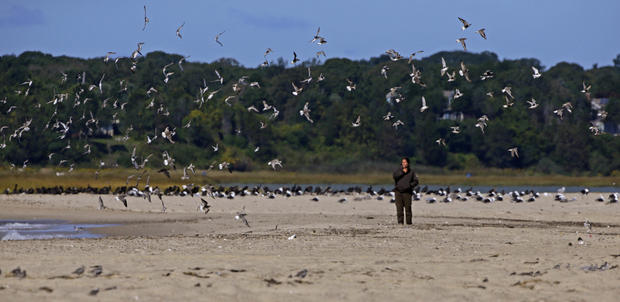
Kate Iaquinto, a U.S. Fish and Wildlife Service biologist at the Monomoy National Wildlife Refuge stands among a flock of shore birds, including Red Knots, while "twinkling" on the north end of Nauset Beach in Eastham, Mass., Sept. 17, 2013.
Twinkling is a process by which bird researchers approach a flock of birds very, very slowly in an effort to direct the flock in ways required by researchers to capture and study them.