NASA
Skylab, NASA's first space station, celebrates its 40-year anniversary on Tuesday.
The idea that ultimately became Skylab first surfaced in 1962 as a proposal to convert a spent Saturn upper stage (Saturn V S-II stage) into an orbital workshop.
Skylab became America's first space station. Launched in May 1973, the Skylab space station was occupied in succession by three teams of three crew members. These crews spent 28, 59, and 84 days respectively, orbiting the Earth and performing nearly 300 experiments.
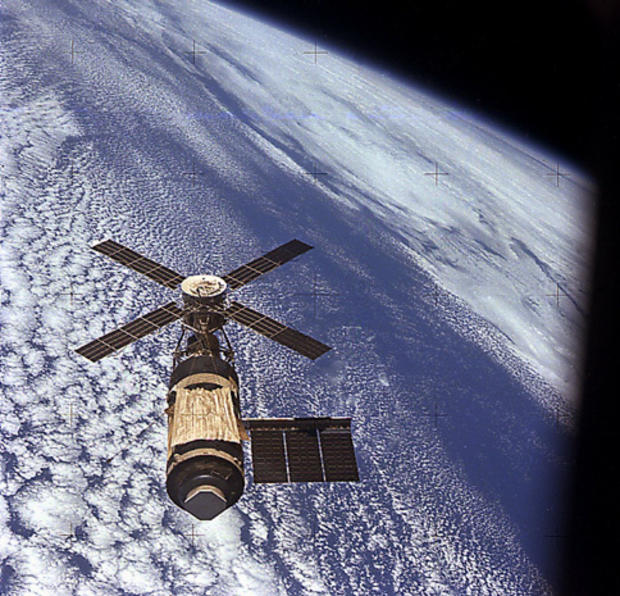
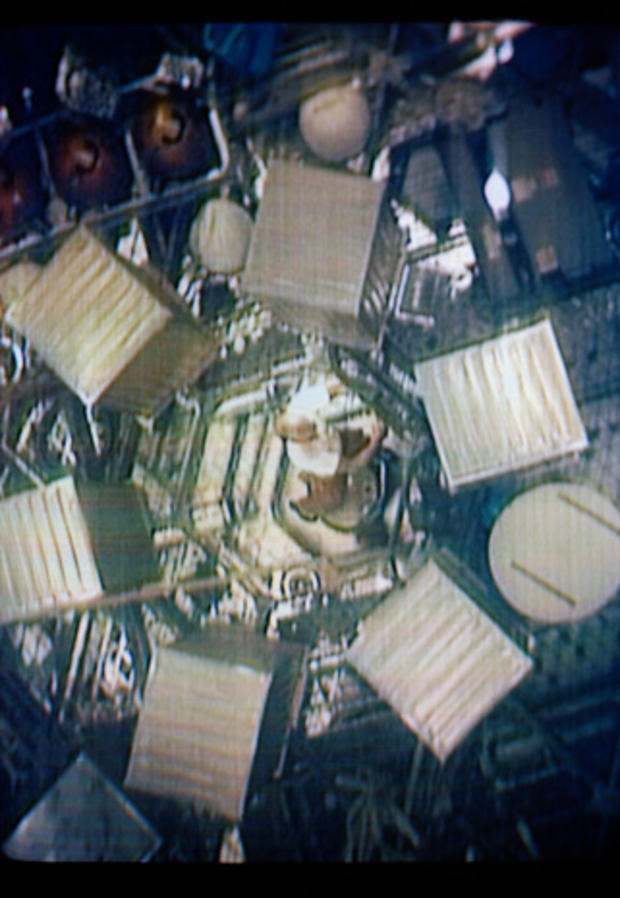
This view of Skylab in orbit was taken by the Skylab 4 (the last Skylab mission) crew.
NASA
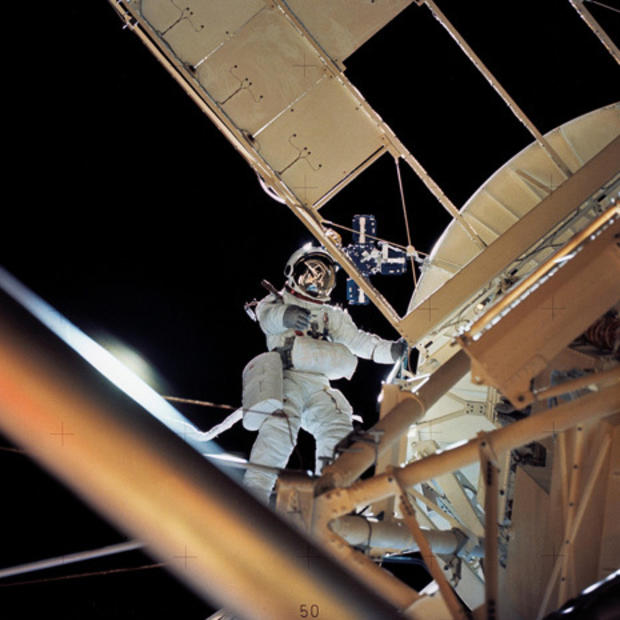
On a spacewalk, astronaut Owen K. Garriott, science pilot, retrieves an imagery experiment from the Apollo Telescope Mount attached to the Skylab in Earth orbit, Aug. 1973.
NASA
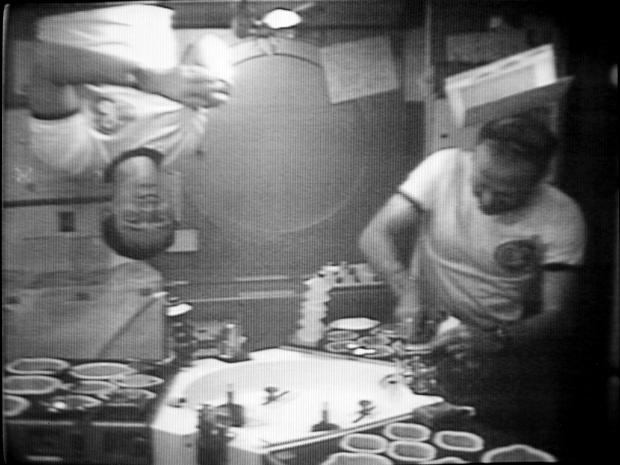
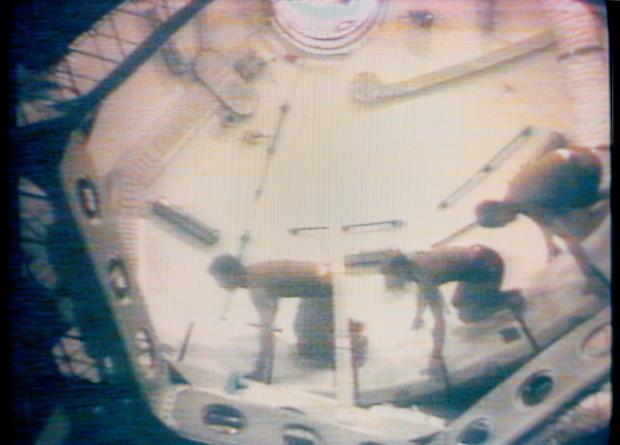
Astronaut and Skylab 4 Commander Gerald P. Carr, right, enjoys a meal aboard the orbiting Skylab Space Station in this still from a television transmission, Nov. 28, 1973. Scientist-Astronaut Edward G. Gibson, Science Pilot for the third manned Skylab flight, demonstrates the zero-gravity environment by turning upside down.
NASA
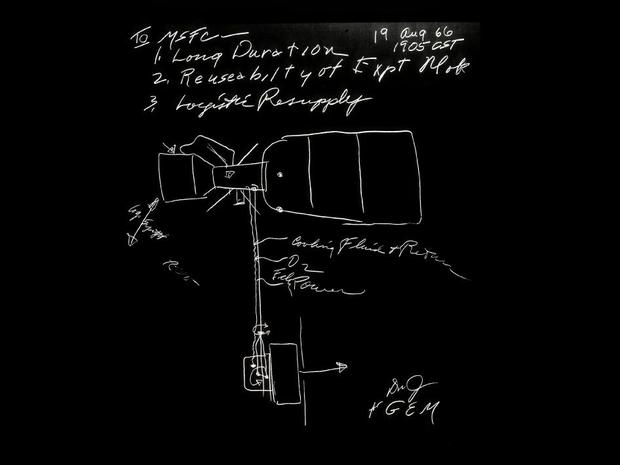
This sketch of Skylab was drawn by George E. Mueller, NASA associate administrator for Manned Space Flight. This concept drawing was created at a meeting at the Marshall Space Flight Center on Aug. 19, 1966. The image details the station's major elements. In 1970, the station became known as Skylab.
Three crewed Skylab missions (Skylab 2 in May 1973; Skylab 3 in July 1973; and Skylab 4 in Nov. 1973) were flown, on which experiments were conducted in space science, Earth resources, life sciences, space technology and student projects.
NASA
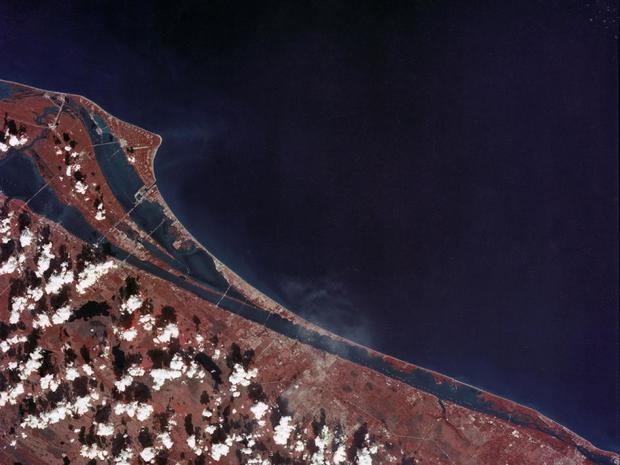
A view of the Kennedy Space Center and the Florida Atlantic coast area was taken as part of the Skylab 4 Earth Resources Experiments Package S190-B, a five-inch Earth terrain infrared camera. This photograph shows the major land-ocean features of the Florida coast near Vero Beach northward to Cape Canaveral and the KSC complex. The launch pads for the Skylab missions are clearly visible.
Identification of living vegetation is possible through the use of the color infrared film. Various shades of red portray differences in the vegetation such as shown in the patterns in the agricultural area near Vero Beach.
The Skylab 4 mission was in orbit from Nov. 16, 1973 - Feb. 8, 1974.
NASA
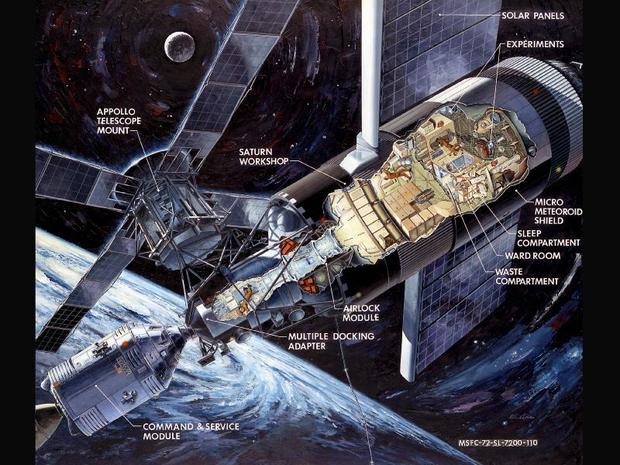
This artist's concept from 1972 is a cutaway illustration of Skylab with the Command/Service Module docked to the Multiple Docking Adapter.
NASA
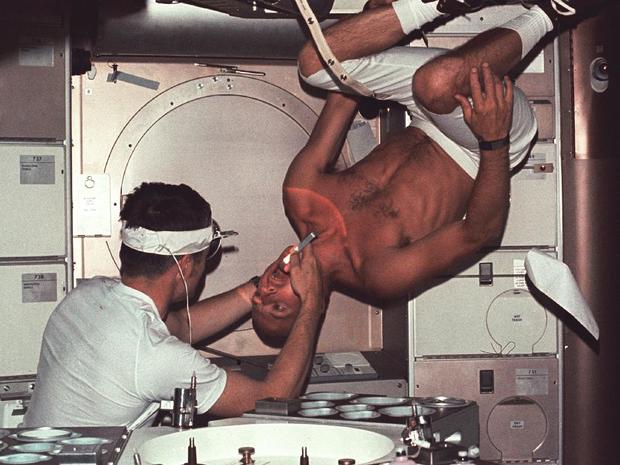
Skylab 2 commander Pete Conrad undergoes a dental examination by medical officer Joseph Kerwin in the Skylab Medical Facility. In the absence of an examination chair, Conrad simply rotated his body to an upside down position to facilitate the procedure.
Skylab 2 was in orbit from May 25, 1973 - June 22, 1973.
NASA
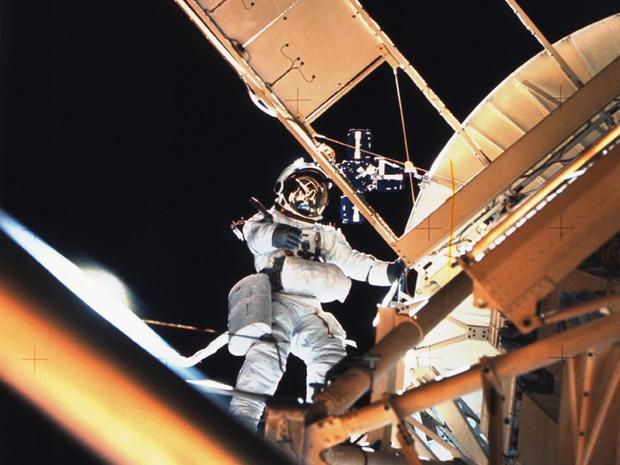
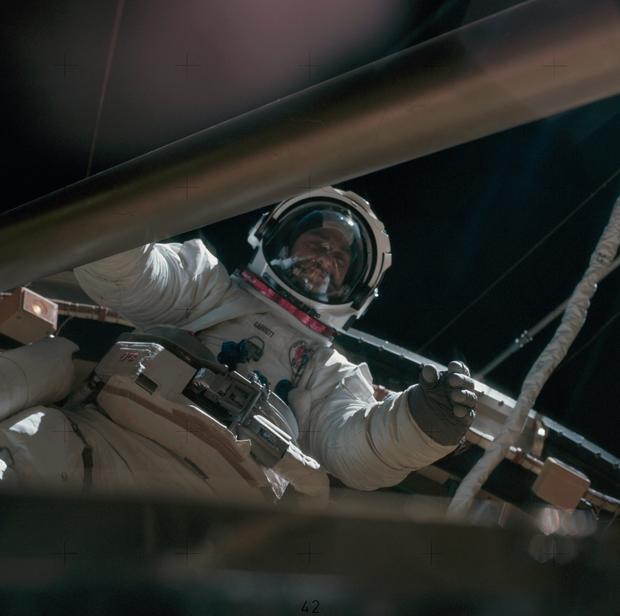
Astronaut Owen Garriott performs a spacewalk at the Apollo Telescope Mount (ATM) of the Skylab space station cluster in Earth orbit during Skylab 3.
Skylab 3 was in orbit from July 28, 1973 - Sept. 25, 1973.
NASA
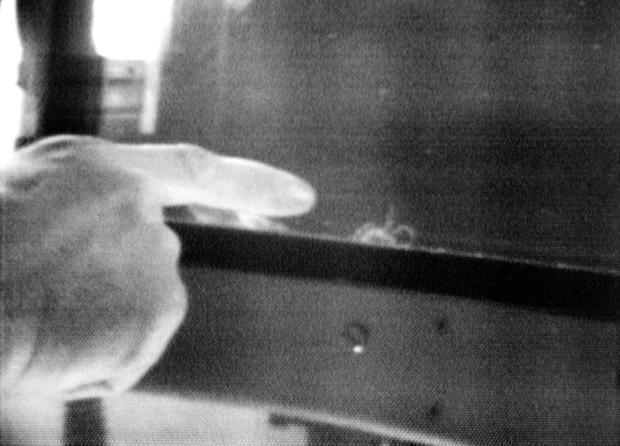
A finger of one of the Skylab 3 crewmen points one of the two common cross spiders "aranous diadematus," and the web it had spun in the zero gravity of space aboard the Skylab space station.
The spider experiment ED52 was one of 25 experiments selected by NASA for Skylab from more than 3,400 experiment proposals submitted by high school students throughout the nation.
Skylab 3 was in orbit from July 28, 1973 - Sept. 25, 1973.
NASA
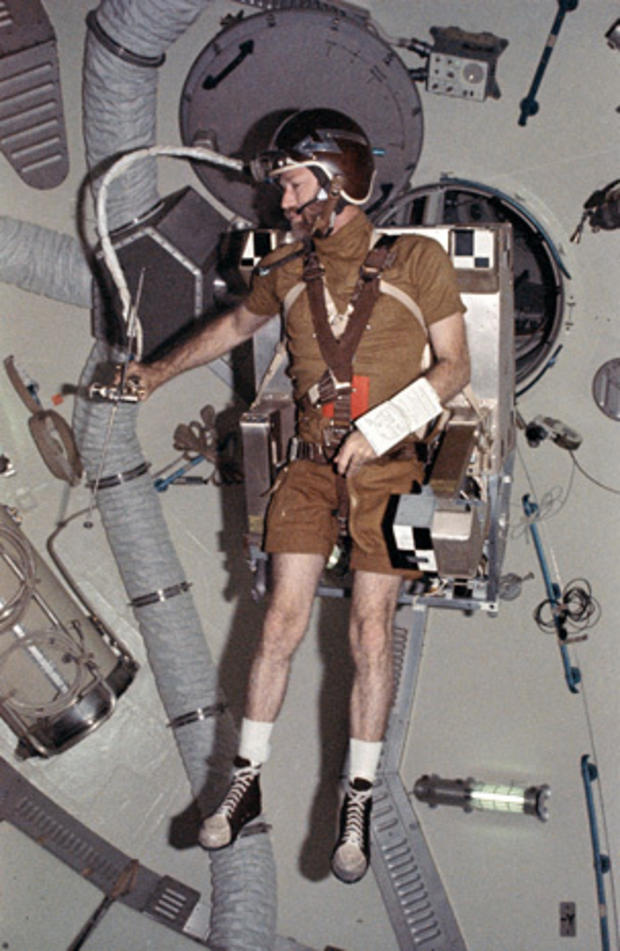
Skylab 4 commander, Astronaut Gerald P. Carr, flies the M509 Astronaut Maneuvering Equipment.
Skylab 4 was in orbit from Nov. 16, 1973 - Feb. 8, 1974
NASA
Astronaut Charles Conrad Jr., Skylab 2 commander, floats up through the hatch of the Orbital Workshop of the Skylab 1 space station. Food lockers are in the foreground.
Skylab 2 was in orbit from May 25, 1973 - June 22, 1973
NASA
Skylab 3 Astronaut Owen K. Garriott participates in Extravehicular Activity (EVA) during which he and Astronaut Jack R. Lousma, pilot, deployed a twin pole solar shield to help shade the Orbital Workshop, Aug. 6, 1973.
NASA
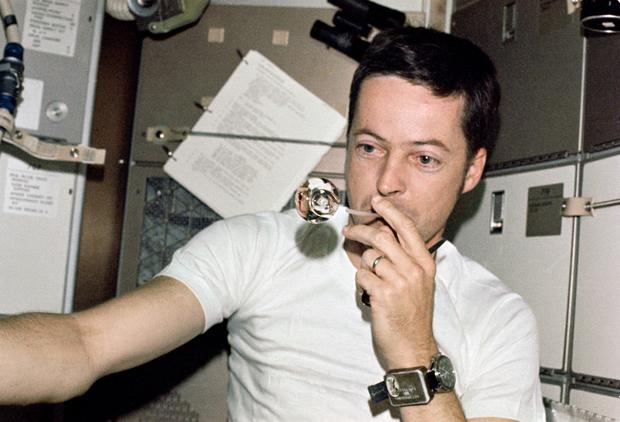
Scientist-Astronaut Joseph P. Kerwin, a Skylab 2 science pilot, forms a perfect sphere by blowing water droplets from a straw in zero gravity in the crew quarters of the Skylab Orbital Workshop.
Skylab 2 was in orbit from May 25, 1973 - June 22, 1973
NASA
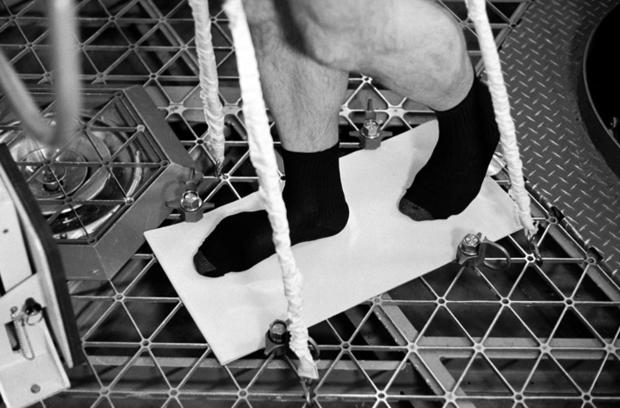
A close-up view of the foot of Scientist-Astronaut William E. Thornton as he demonstrates the use of a treadmill-like exercise device which was developed for maintaining the leg and back muscles of the Skylab 4 crewman.
Skylab 4 was in orbit from Nov. 16, 1973 - Feb. 8, 1974
NASA
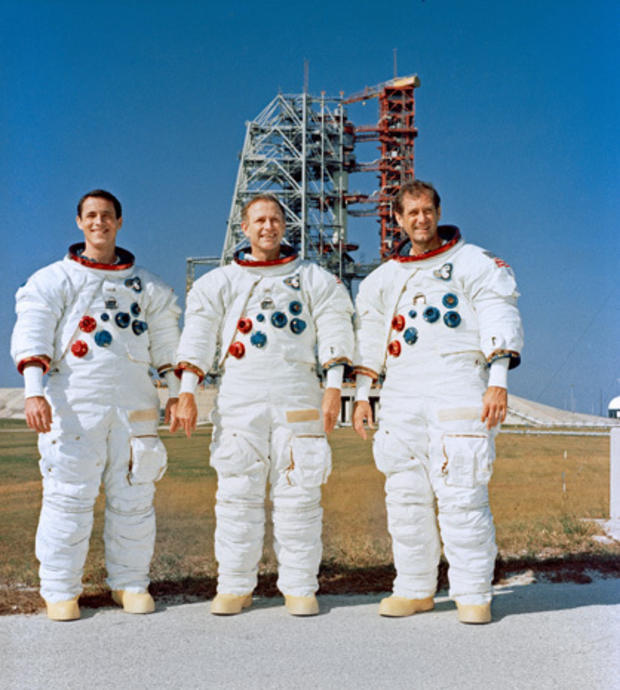
The three members of the Skylab 4 crew are photographed at Kennedy Space Center, Florida, during preflight activity. Left to right, Scientist-Astronaut Edward G. Gibson, science pilot; Astronaut Gerald P. Carr, commander; and Astronaut William R. Pogue, pilot. The Skylab 4/Saturn 1B space vehicle is on the pad in the background.
Skylab 4 was in orbit from Nov. 16, 1973 - Feb. 8, 1974
NASA
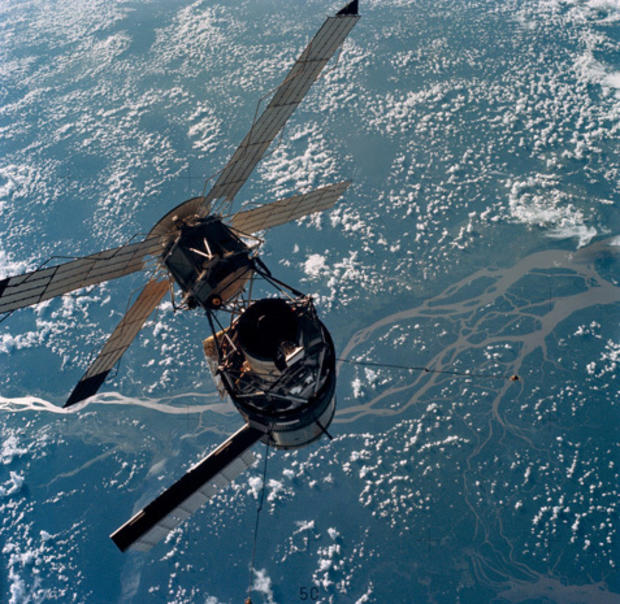
The Skylab Command Module moves in for docking. A view of South America's Amazon River can be seen in the background.
Skylab 3 was in orbit from July 28 - Sept. 25, 1973.
NASA
Crewmen exercise in the equipment storage area of the Orbital Workshop, June 1, 1973.
NASA
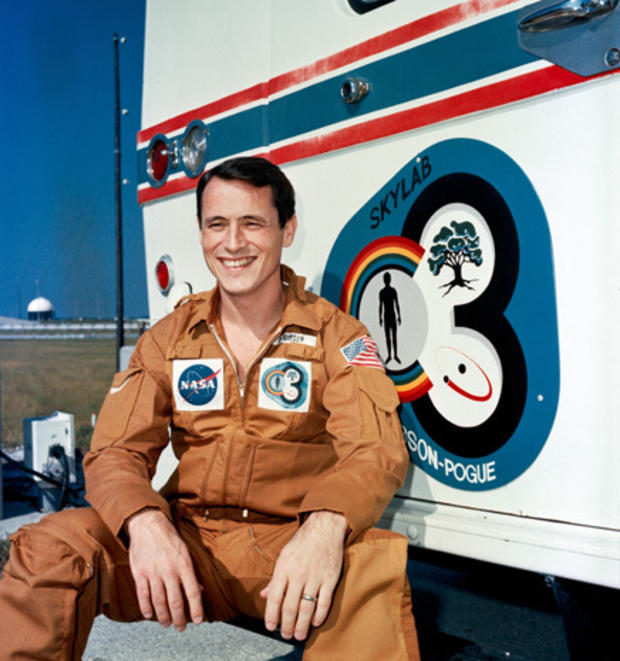
Scientist-Astronaut Edward G. Gibson, Skylab 4 science pilot, relaxes on the running board of the transfer van during a visit to the Skylab 4/Saturn 1B space vehicle at Kennedy Space Center, Fla.
Skylab 4 was in orbit from Nov. 16, 1973 - Feb. 8, 1974.
NASA
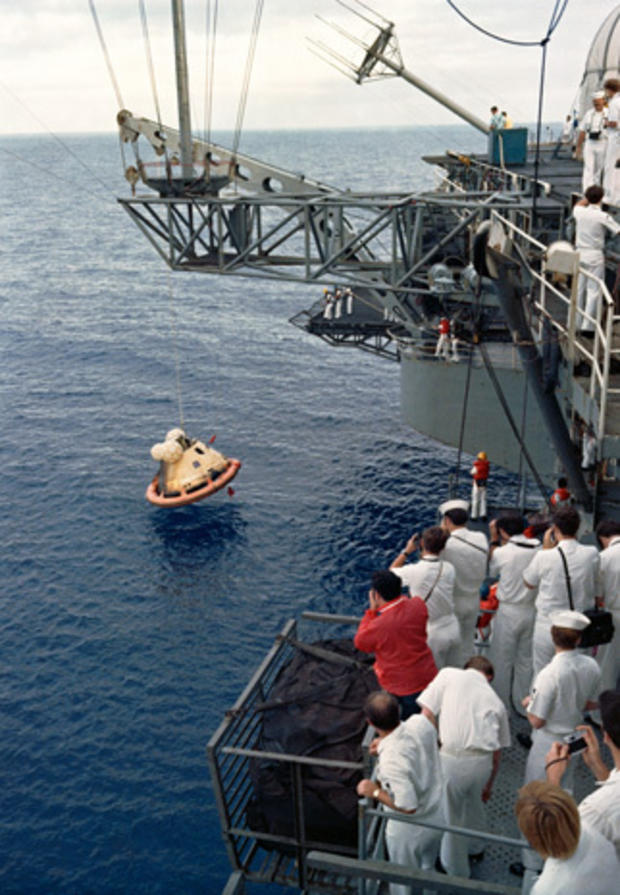
The Skylab 2 Command Module, with astronauts Charles Conrad Jr., Joseph P. Kerwin and Paul J. Weitz still inside, is hoisted aboard the prime recovery ship, U.S.S. Ticonderoga, following successful splashdown in the Pacific Ocean about 835 miles southwest of San Diego, Calif.
Skylab 2 was in orbit from May 25, 1973 - June 22, 1973.
NASA
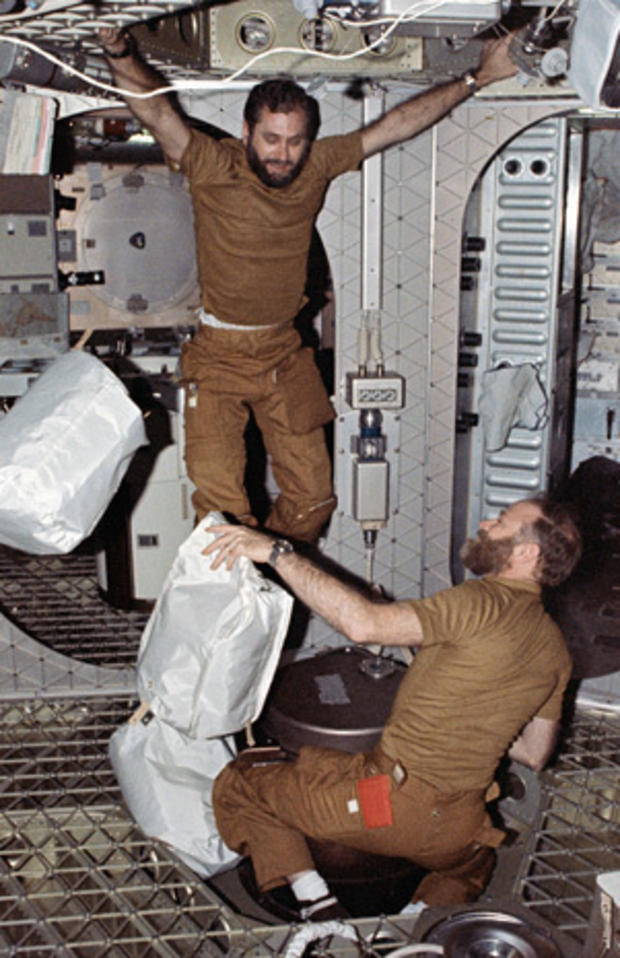
Two Skylab 4 crewmen are seen passing trash bags through the trash airlock of the Orbital Workshop OWS of the Skylab space station in Earth orbit.
Skylab 4 was in orbit from Nov. 16, 1973 - Feb. 8, 1974.
NASA
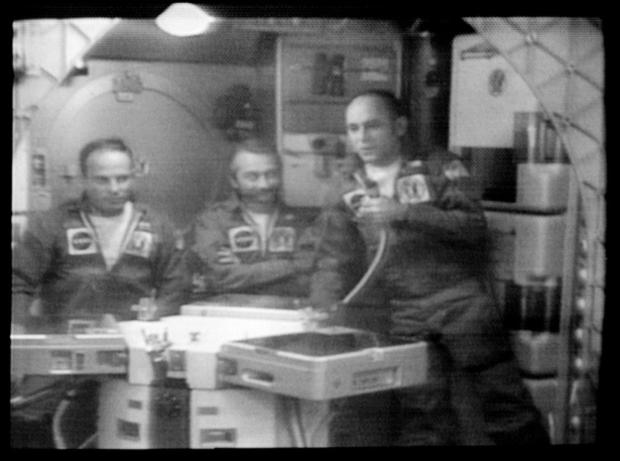
Astronaut Alan L. Bean, right, Skylab 3 Commander, answers a question during a press conference from the Skylab Space Station in Earth orbit, Sept. 21, 1973. Scientist-Astronaut Owen K. Garriott, center, Science Pilot; and Astronaut Jack R. Lousma, left, Pilot, await questions from newsmen on the ground to be sent up by Scientist-Astronaut Story Musgrave, CAPCOM for this shift of Skylab 3.
NASA
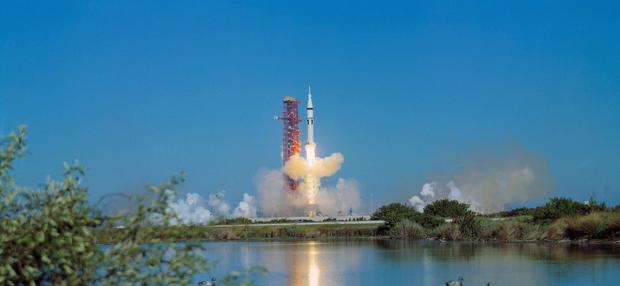
The Skylab 4/Saturn 1B space vehicle is launched from Kennedy Space Center, Fla., Nov. 16, 1973.
NASA
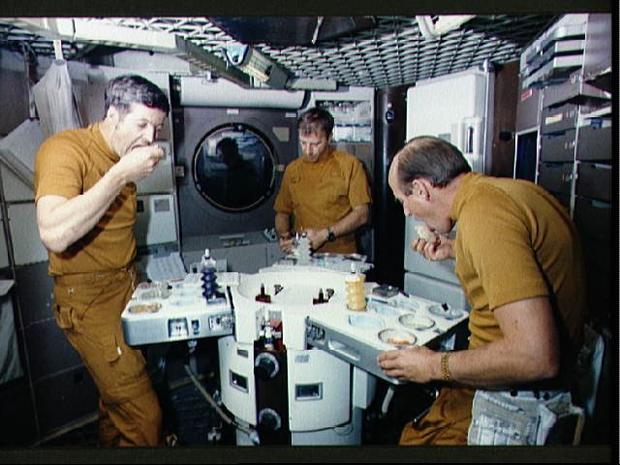
The three members of the prime crew of the first manned Skylab mission dine on specially prepared Skylab space food in the wardroom of the crew quarters of the Skylab Orbital Workshop (OWS) trainer during Skylab training at the Johnson Space Center. They are, left to right, Scientist-Astronaut Joseph P. Kerwin, science pilot; Astronaut Paul J. Weitz, pilot; and Astronaut Charles Conrad Jr., commander.
Skylab 2, the first manned mission, was in orbit from May 25, 1973 - June 22, 1973.
NASA
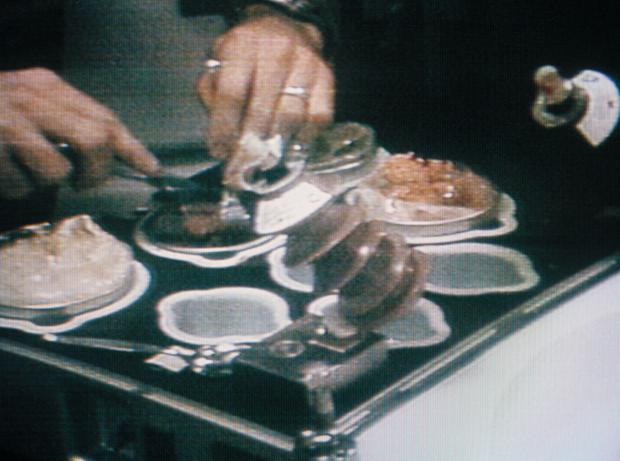
A close-up view of the hands of Astronaut Jack R. Lousma, Skylab 3 pilot, using a utensil to gather food at the food station.
Skylab 3 was in orbit from July 28 - Sept. 25, 1973.
NASA
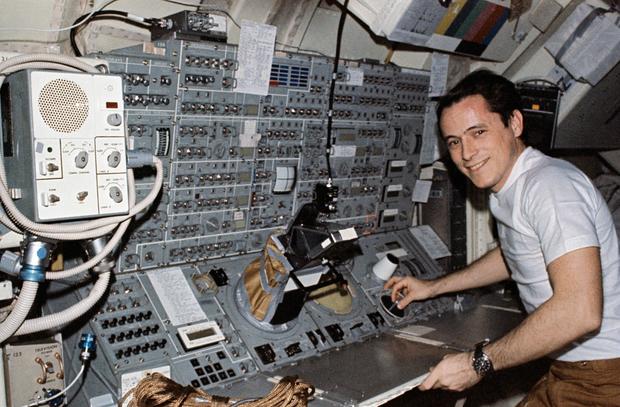
Scientist-Astronaut Edward G. Gibson, Skylab 4 science pilot, stands at the Apollo Telescope Mount ATM console in the Multiple Docking Adapter MDA of the Skylab space station cluster in Earth orbit.
Skylab 4 was in orbit from Nov. 16, 1973 - Feb. 8, 1974.
NASA
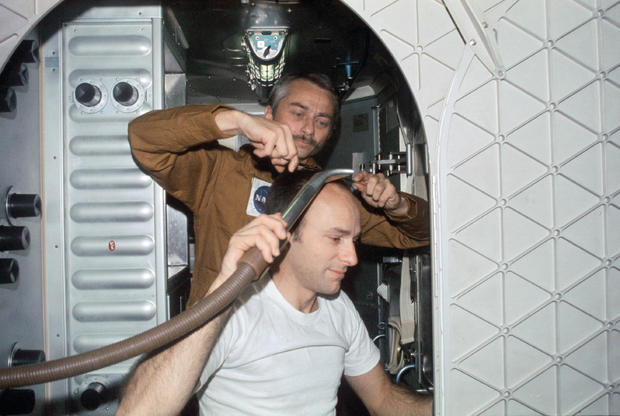
Scientist-Astronaut Owen K. Garriott, Skylab 3 science pilot, trims the hair of Astronaut Alan L. Bean, commander, in this on-board photograph from the Skylab Orbital Workshop (OWS). Bean holds a vacuum hose to gather in loose hair.
Skylab 3 was in orbit from July 28 - Sept. 25, 1973.
NASA
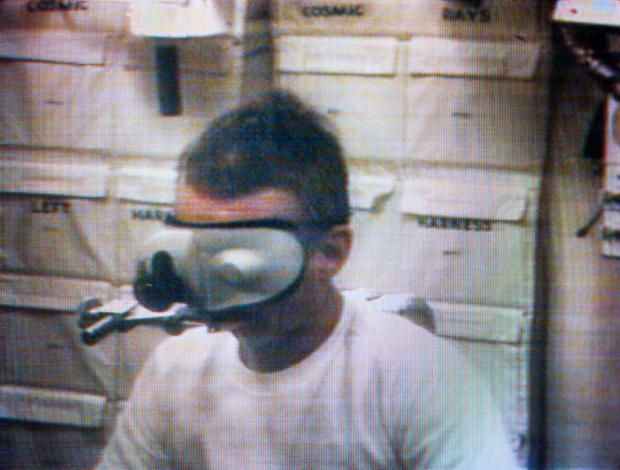
Astronaut Owen Garriott working with the Human Vestibular Function M 131 experiment during Skylab 3.
Skylab 3 was in orbit from July 28 - Sept. 25, 1973.
NASA
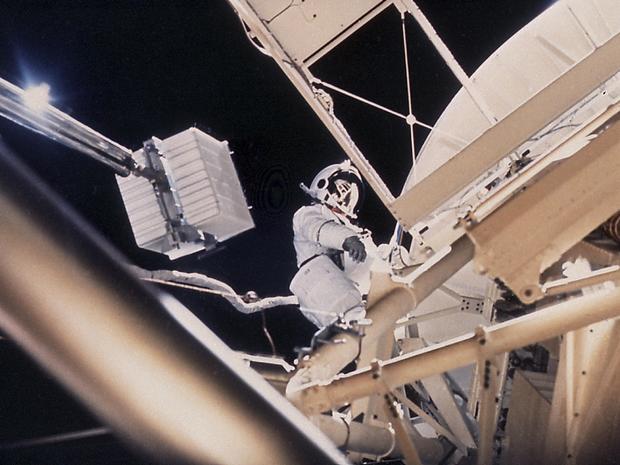
Skylab astronaut Owen Garriott works outside Skylab, America's first space station. Spacewalks on Skylab were the first time astronauts went outside to fix a problem with their spacecraft, 1973.
NASA
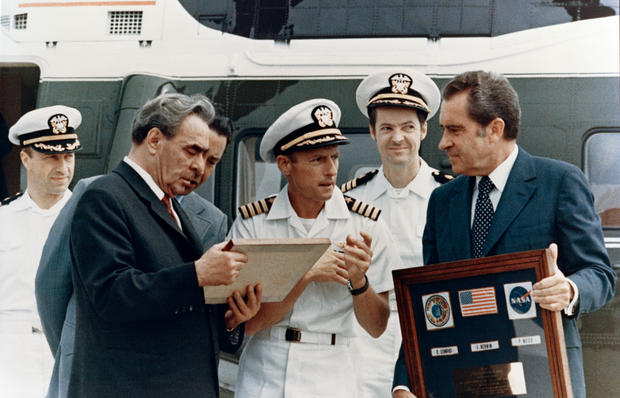
Following the end of Skylab 2 mission,Leonid I. Breznev, General Secretary of the Communist Party, Union of Soviet Socialist Republics, and President Richard M. Nixon, during ceremonies at the Western White House, San Clemente, Calif., examine plaques presented by Skylab Astronauts Charles Conrad Jr., center; Joseph P. Kerwin, second from right; and, Paul J. Weitz, left.
Skylab 2, the first manned mission, was in orbit from May 25, 1973 - June 22, 1973.
NASA
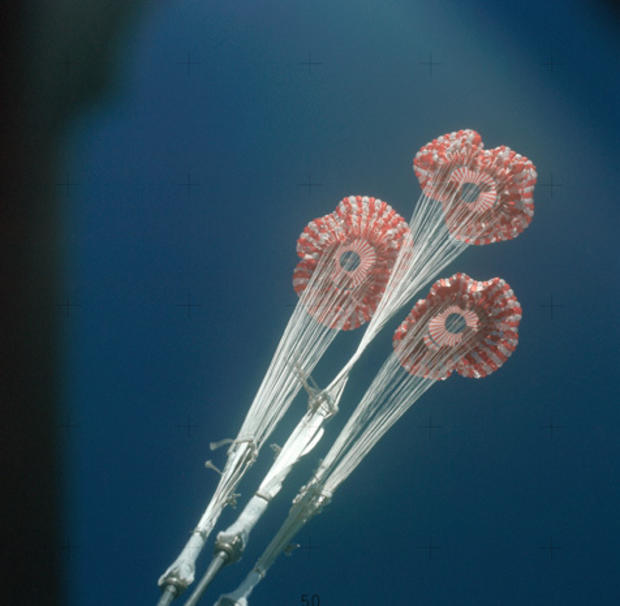
Parachutes deploy from the Skylab 3 Command Module.
Skylab 3 was in orbit from July 28 - Sept. 25, 1973.