AP
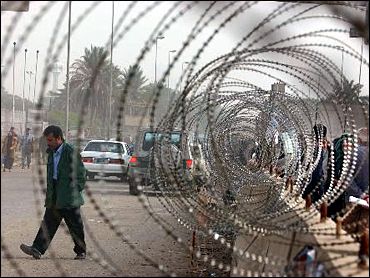
Iraqi residents walk past coils of razor wire used to protect a U.S. headquarters at the so-called "Green Zone" in central Baghdad Sunday, Jan. 25, 2004. Ravaged by three wars in quick succession and battered by an on-going campaign of violence, Baghdad has gone from bad to worse since its capture in April by U.S. forces.
AP
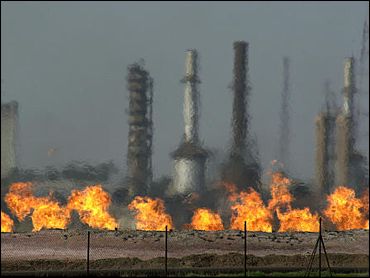
Fires flare off the gas from crude oil at Iraq's oldest oil- processing plant in the northern Iraqi town of Baba Gurgur, outside of Kirkuk, Saturday, Jan. 24, 2004. With security guards now deployed along Iraq's export pipeline to the Mediterranean, crude from one of the country's biggest oil fields could start flowing to overseas markets "in a matter of days," a senior Iraqi oil official says.
AP
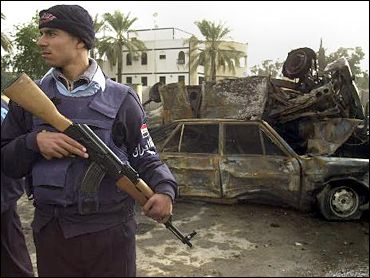
An Iraqi policeman guards the area where a truck bomb exploded in Samarra, Iraq, as a U.S. patrol passed by Saturday, Jan. 24, 2004. Three Iraqi civilians were killed and 33 people were injured in the blast, a U.S. military spokesman said. Three American soldiers were slightly wounded.
AP
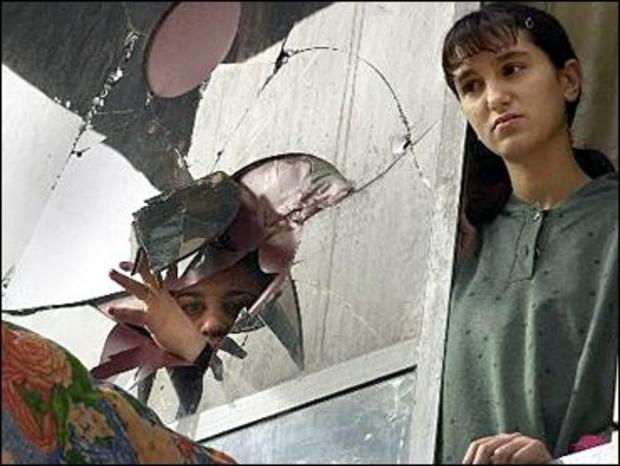
Iraqi women look down from their bomb-damaged apartment window in Baghdad after a roadside bomb exploded below, Sunday, Jan. 25, 2004. No one was injured in the explosion. Widespread violence in Iraq in the past few days underscores continued resistance to the American occupation despite the Dec. 13 capture of Saddam Hussein.
AP
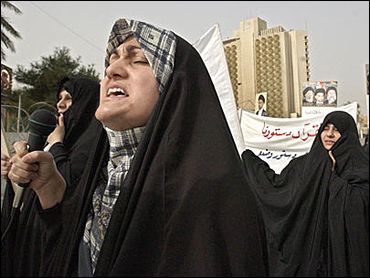
Alia Ahmed, an elementary school teacher, left, leads other muslim women in a chant during a demonstration march around Firdos Square, Sunday, Jan. 25, 2004, in Baghdad. About 100 women demonstrated in support of the governing council's decision to annul the civil family law weeks after it was passed.
AP
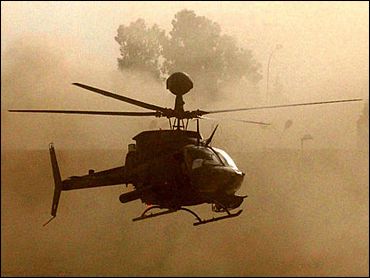
An OH-58D Kiowa Warrior helicopter flies in to land at the 101st Airborne Division (Air Assault) helicopter pad in Mosul, Iraq, during Operation Iraqi Freedom on Aug. 31, 2003. An U.S. Army OH-58 Kiowa Warrior helicopter attached to the 101st Airborne Division crashed Friday, Jan. 23, 2004, near Qayyarah, some 30 miles south of Mosul, in northern Iraq, killing the two pilots, the U.S. military said.
AP
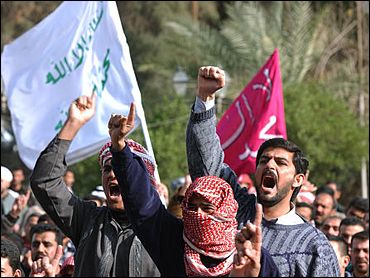
Iraqi Sunni Muslims rally outside Baghdad's Ibn Taimiyah mosque in this Friday Jan. 9, 2004, photo. Iraq's Sunni muslims fear the loss of the privileged place they once held under Saddam Hussein and face domination by communities it had once oppressed. The banner on the front of the mosque is the name of the mosque.
AP
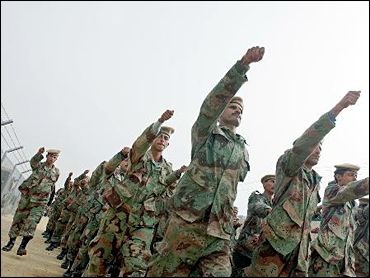
Iraqi Army soldiers of the 3rd Battalion march around the parade grounds at the end of their graduation ceremony in Kir Kush, northeast of Baghdad, Iraq, Saturday Jan. 24, 2004. More than 750 new Iraqi soldiers and officers graduated Saturday in this northern training camp, leaving the coalition forces with 24 more battalions to field before September.
AP
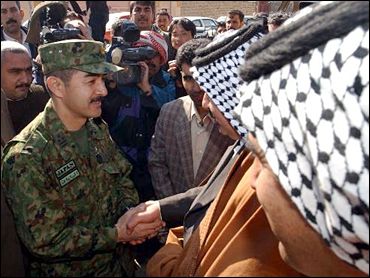
Col. Masahisa Sato, commander of the Japanese Forces advance team, left, shakes hands with Iraqi local sheiks in Samawa, southern Iraq, Thursday, Jan. 22, 2004. Japan's air force dispatched more than 100 pilots and other personnel to Kuwait on Thursday to help bring supplies to the country's forces going to southern Iraq to purify water and carry out other humanitarian tasks.
AP
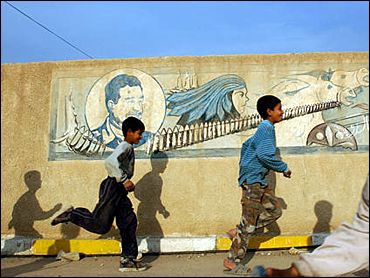
Iraqi youths run past a mural of captured former Iraqi leader Saddam Hussein in Baghdad, Iraq, Wednesday Jan. 21, 2004.
AP
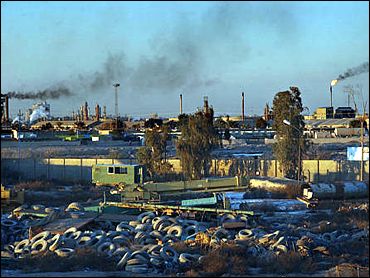
The Doura oil refinery is viewed from a guard tower where security oversee the area on the southern edge of Baghdad Tuesday, Jan. 20, 2004. Officials at Baghdad's Doura refinery told The Associated Press that four intruders were preparing two tons of explosives for an attack on the refinery's fuel depot or the boilers that help power the plant.
AP
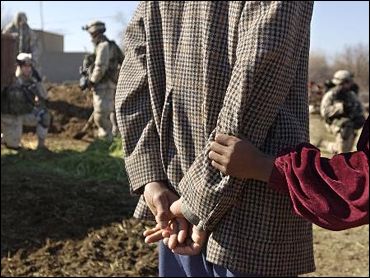
An Iraqi girl holds her brother's arm tight while soldiers with the 82nd Airborne and 1st Infantry Divisions pass through their yard while out searching for weapons caches, Tuesday, Jan. 20, 2004, near Fallujah, Iraq. Nearly 500 soldiers combed through farmland, pastures, gardens and some homes looking for weapons and bomb making materials.
AP
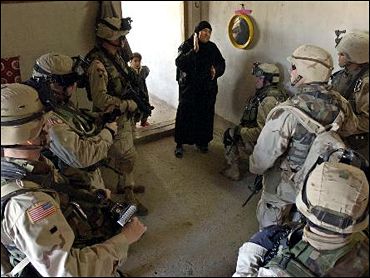
An Iraqi woman tries to explain to soldiers with the First Infantry Division and 82nd Airborne Division Tuesday, Jan. 20, 2004, near Fallujah, Iraq, that materials found in her home that could be used to make bombs and set them off, were found and brought to her home by her children.
AP
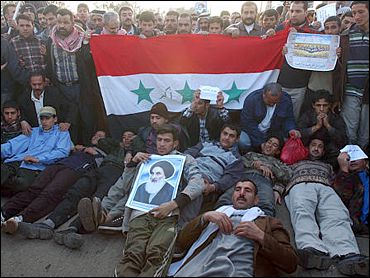
Iraqis lie down in the street of Baghdad with an Iraqi flag and portraits of Grand Ayatollah Ali al-Husseini al-Sistani and other Shiite clerics Monday, Jan. 19, 2004. Tens of thousands marched peacefully to demand an elected government, as U.S. and Iraqi officials prepared to seek the U.N. secretary-general's endorsement of American plans for transferring power in Iraq.
AP
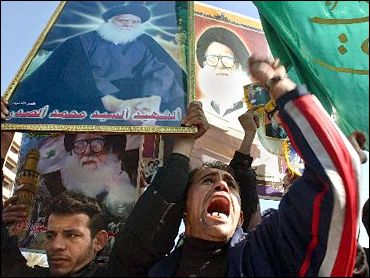
Iraqi Shiite Muslims demonstrate in Baghdad Tuesday, Jan. 20, 2004, carrying flags and posters of Shiite clerical leader Mohammed Sadiq al-Sadr and calling for Saddam Hussein's execution. Thousands of Shiite Muslims marched through Baghdad in the latest show of strength by a community repressed for decades by the former dictator.
AP
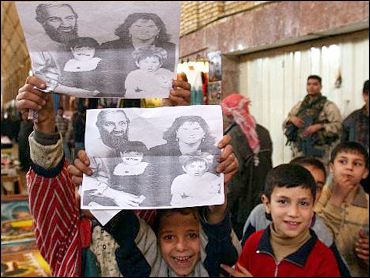
Iraqi children show mock pictures depicting Osama bin Laden and Saddam Hussein as father and son, inside the indoor market of Samawa, southern Iraq, Tuesday, Jan. 20, 2004.
AP
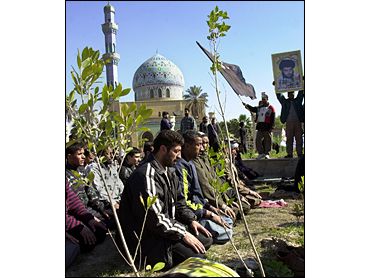
Iraqi Shiite Muslims pray during a demonstration in Baghdad Tuesday, Jan. 20, 2004, calling for Saddam Hussein's execution. In the foreground is a poster of Shiite clerical leader Moqtada Sadr. Thousands of Shiite Muslims marched through Baghdad in the latest show of strength by a community repressed for decades by the former dictator.
AP
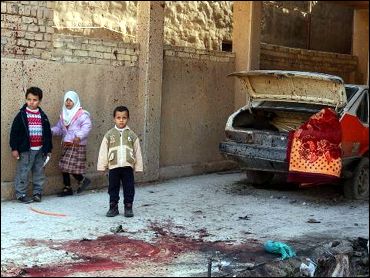
Children of three Arab fighters stand in the yard of the house where the fighters were killed by U.S troops in Al-Moalemeen district near Baghdad, Iraq, Monday Jan. 19, 2004. U.S. troops killed three Arab foreigners, two Yemenis and one Syrian, and seized weapons after a gun battle Monday at what Iraqi police described as a "terrorist safe house" in a southeastern suburb of Baghdad, Iraqi officials said.
AP
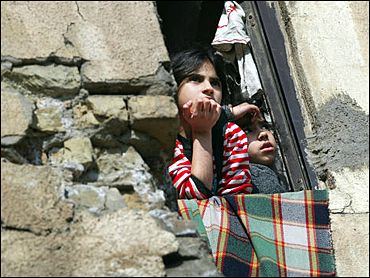
Two Iraqi children look out from a bomb-shattered window and apartment wall down to the scene below Monday, Jan. 19, 2004. A car bomb exploded the day before outside the main gate to the headquarters of the U.S.-led coalition in Baghdad, killing at least 20 and injuring more than 60. U.S. troops restricted access to the area Monday as they refortified the entrance and checkpoints around the headquarters.
AP
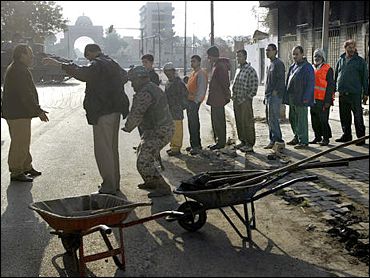
Iraqi workers are checked by an Iraqi soldier, Monday, Jan. 19, 2004, before entering the area where a car bomb exploded Sunday outside the headquarters of the U.S.-led coalition in Baghdad, killing 24 and injuring more than 60. U.S. troops restricted access to the area, moving back the checkpoints several hundred meters, as they refortified the entrance around the headquarters.