PHILIPPE BOUCHON/AFP/Getty Images
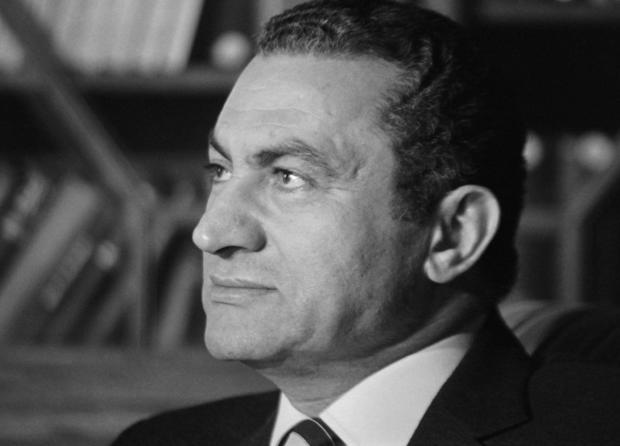
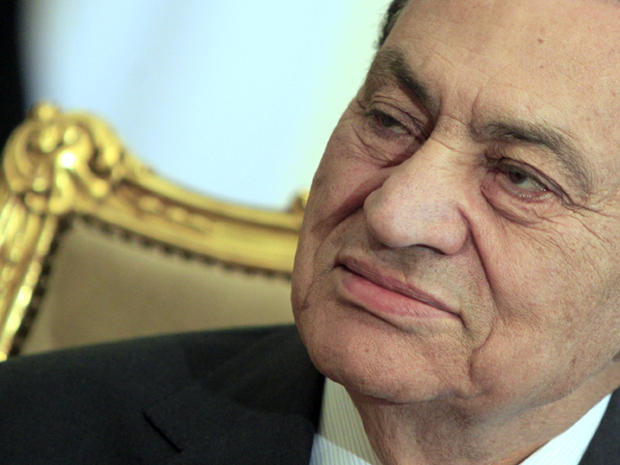
Egyptian President Hosni Mubarak is pictured, on November 24, 1982 in Cairo.
A former pilot and air force commander with a combative, stubborn streak, Mubarak assumed the presidency following the 1981 assassination of President Anwar Sadat. Though he took tentative steps toward democratic reform early in his presidency, Mubarak pulled back towards the dictatorial style that eventually stirred massive protests in Cairo and other cities beginning in January 2011. These Arab Spring demonstrations led to his downfall after nearly three decades in power.
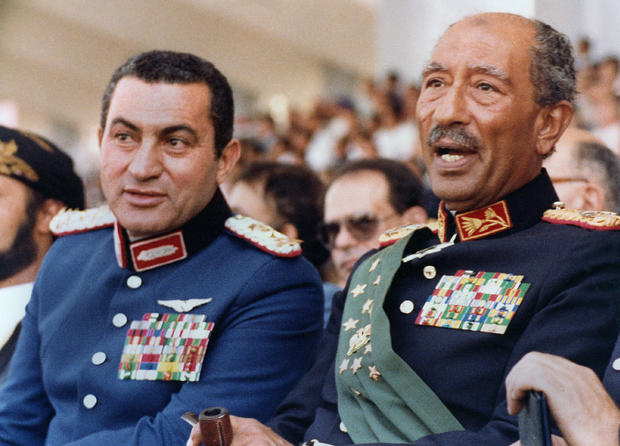
AFP PHOTO/AFP/Getty Images
Egyptian vice President Gen. Hosni Mubarak (left) and President Anwar Sadat, both dressed in military honor uniforms, attend a military parade commemorating Victory Day, October 6, 1981, in Cairo, just hours before assassins killed Sadat in a hail of gunfire.
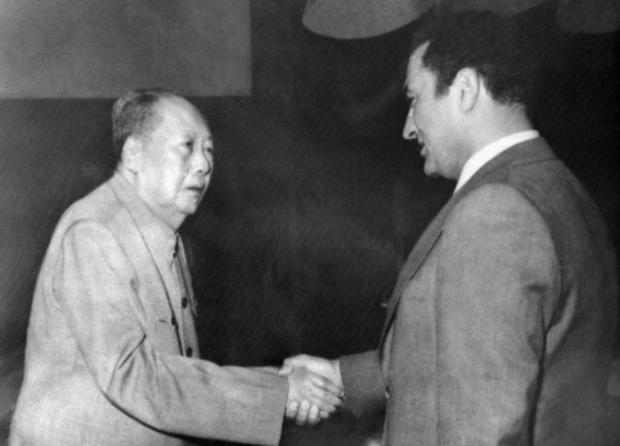
AFP PHOTO/AFP/Getty Images
Egyptian Vice-President Hosni Mubarak shakes hands with Chinese leader Mao Tse Tung in Peking, April 20, 1976.
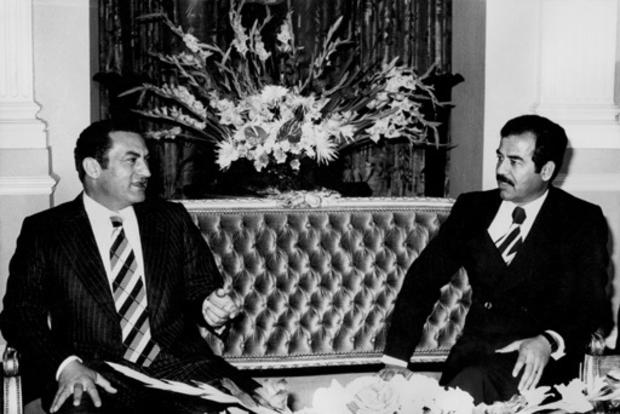
AFP/Getty Images
Egyptian Vice-President Mohammed Hosni Mubarak meets Iraqi president Saddam Hussein in November 1976, during an official visit in Bagdad.
A 2009 cable from the U.S. Embassy in Cairo, released by the whistleblower website WikiLeaks, referred to Mubarak as "a tried and true realist, innately cautious and conservative," and with "little time for idealistic goals." It noted that Mubarak disapproved of the 2003 U.S. invasion that toppled Saddam Hussein of Iraq, which he believed was in need of a "'tough, strong military officer who is fair'" as leader.
"This telling observation, we believe, describes Mubarak's own view of himself as someone who is tough but fair, who ensures the basic needs of his people," the diplomatic cable said. "In Mubarak's mind, it is far better to let a few individuals suffer than risk chaos for society as a whole."
AFP/Getty Images
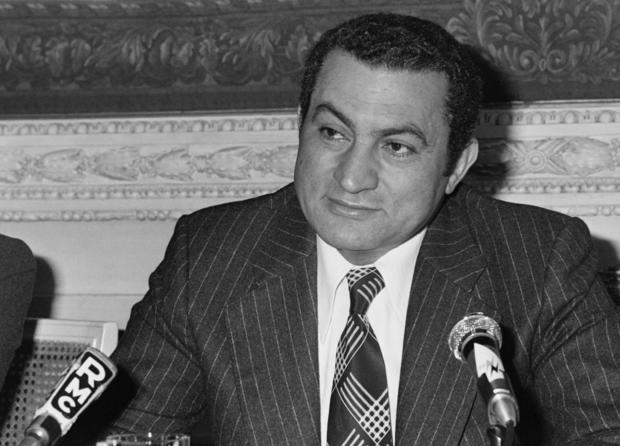
Egyptian Vice President Mohammed Hosni Mubarak gives a press conference, on April 25, 1977 in Paris.
Mohammed Hosni Mubarak was born on May 4, 1928, in the village of Kafr el-Moseilha in the Nile delta province of Menoufia. His family, like Sadat's and Nasser's, was lower middle class.
AFP PHOTO/AFP/Getty Images
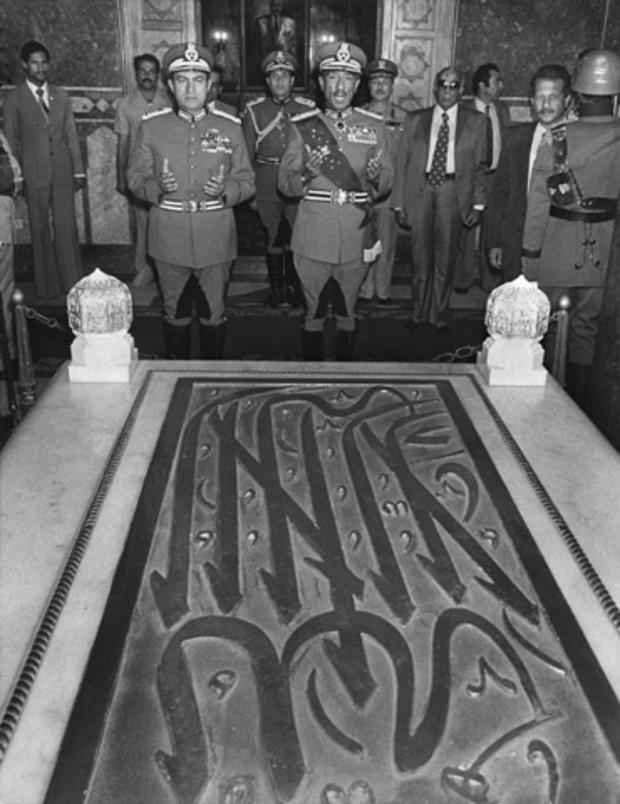
Egyptian Vice President, Gen. Hosni Mubarak (left) and President Anwar Sadat, both dressed in military honor uniforms, pray over the tomb of Egyptian revolution leader Gamal Abdel Nasser, October 6, 1981. Hours later, President Sadat was killed by a group of military Islamist fundamentalists with allegiance to the Al-Jihad group during a parade commemorating Victory Day. Mubarak, who was sitting beside Sadat in the reviewing stand, escaped with a minor hand injury.
Following Sadat's assassination, Mubarak was sworn in as Egypt's fourth president, a position of power he retained for three decades.
AFP/Getty Images
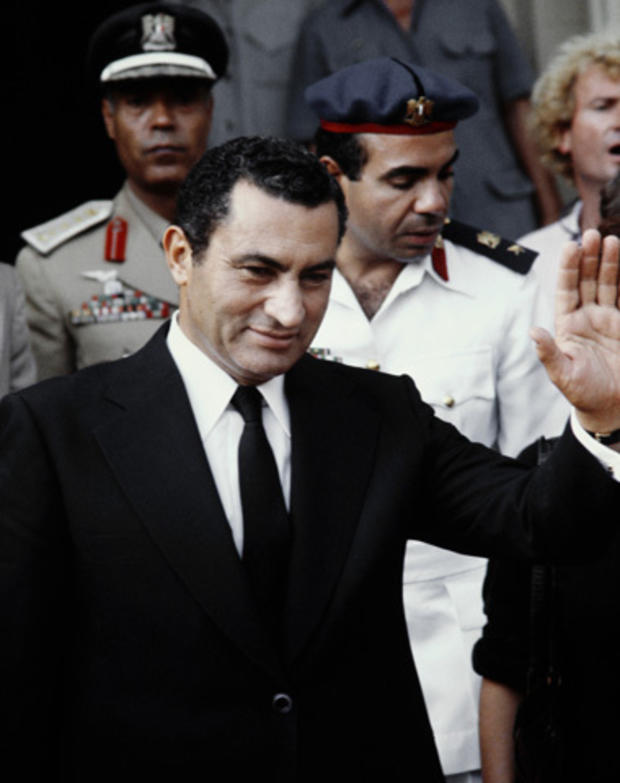
Egyptian Vice President Mohammed Hosni Mubarak waves during the funeral of Anwar el-Sadat, on October 10, 1981 at Cairo.
AL AHRAM/AFP/Getty Images
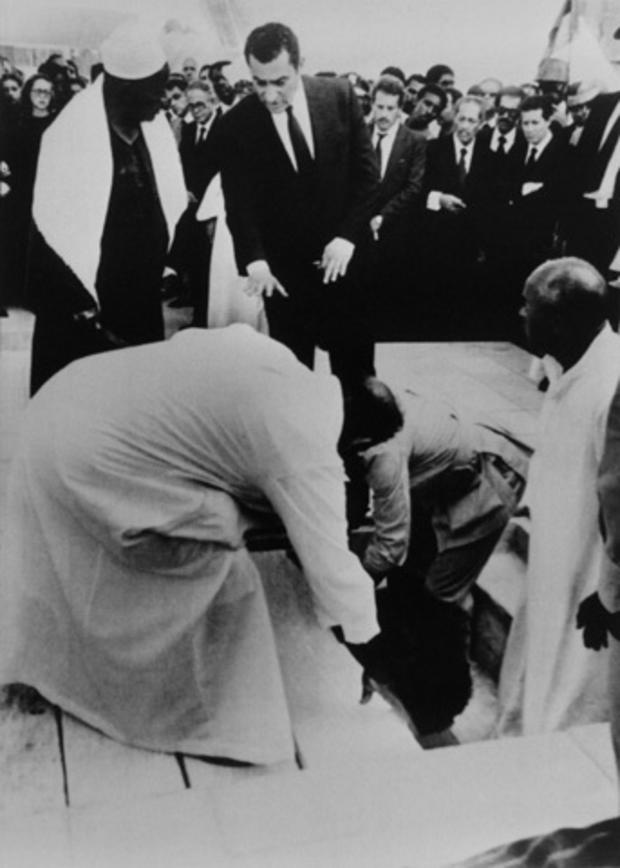
Egyptian Vice President Hosni Mubarak supervises as workers permanently seal the tomb of President Anwar el-Sadat, on October 10, 1981, at the Nasr City site in Cairo where he was laid to rest.
TOM HARTWELL/AFP/Getty Images
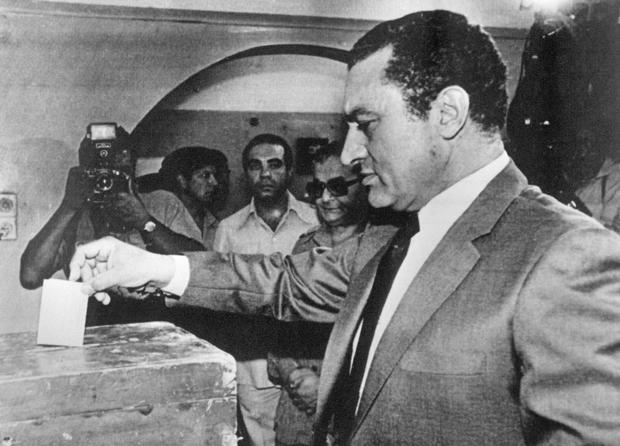
Vice President Hosni Mubarak casts his vote, October 13, 1981, during a national referendum to decide whether he would succeed the slain President Anwar Sadat as leader of Egypt.
Early on in his presidency, Mubarak crushed an insurgency by Muslim extremists, whose ranks had produced Sadat's assassins and some future al Qaeda leaders. In the 1990s, he fought hard against another resurgence of Muslim militants whose attacks included the slaughter of dozens of foreign tourists at the temple city of Luxor.
Mubarak also engineered Egypt's return to the Arab fold after nearly a decade in the cold over its 1979 peace treaty with Israel.
Eli Shaked, who served as Israel's ambassador to Egypt from 2003-2005, described Mubarak as "a strong presence, not charismatic but with a heavy body like a fighter bomber, and very levelheaded."
GENE FORTE/AFP/Getty Images
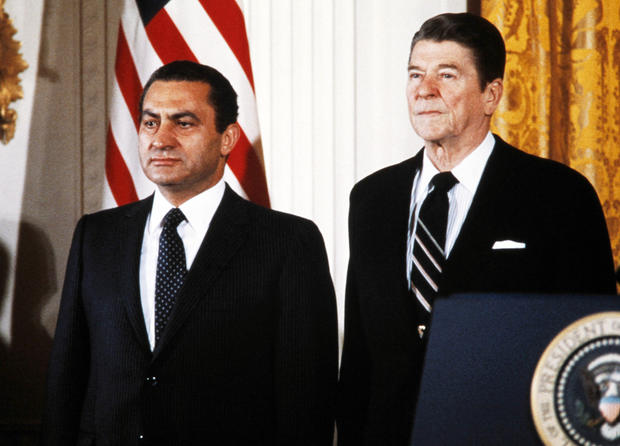
U.S. President Ronald Reagan and Egyptian President Hosni Mubarak attend arrival ceremonies in the East Room of the White House, February 3, 1982 in Washington, D.C.
AFP/Getty Images
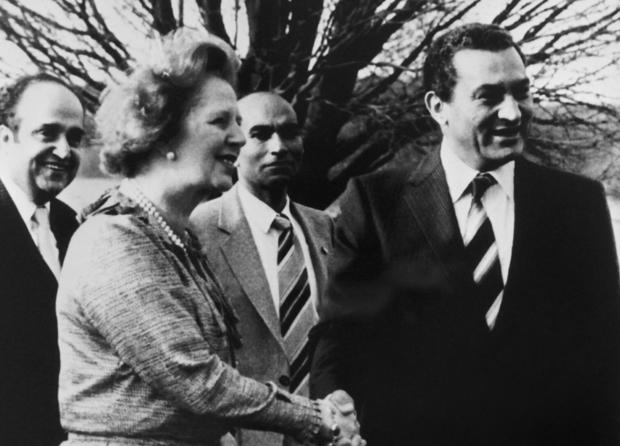
Egyptian President Hosni Mubarak shakes hands with British Prime Minister Margaret Thatcher, February 6, 1982, in London during his official visit to England.
AFP/Getty Images
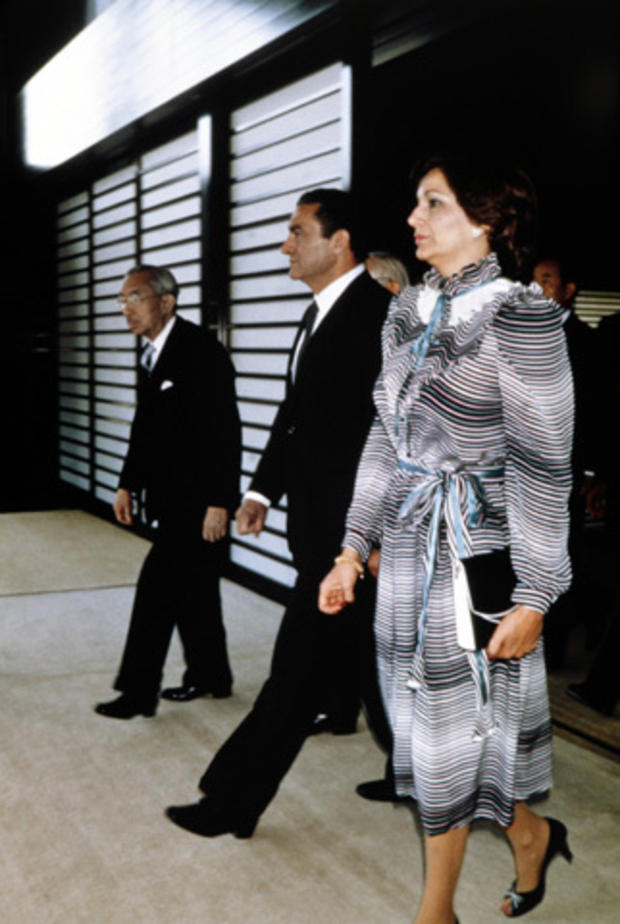
Emperor Hirohito (left) guides Egyptian President Hosni Mubarak and his wife, Suzanne Mubarak, into the Imperial Palace upon their arrival to attend the Imperial luncheon on April 6, 1983 in Tokyo.
MIKE NELSON/AFP/Getty Images
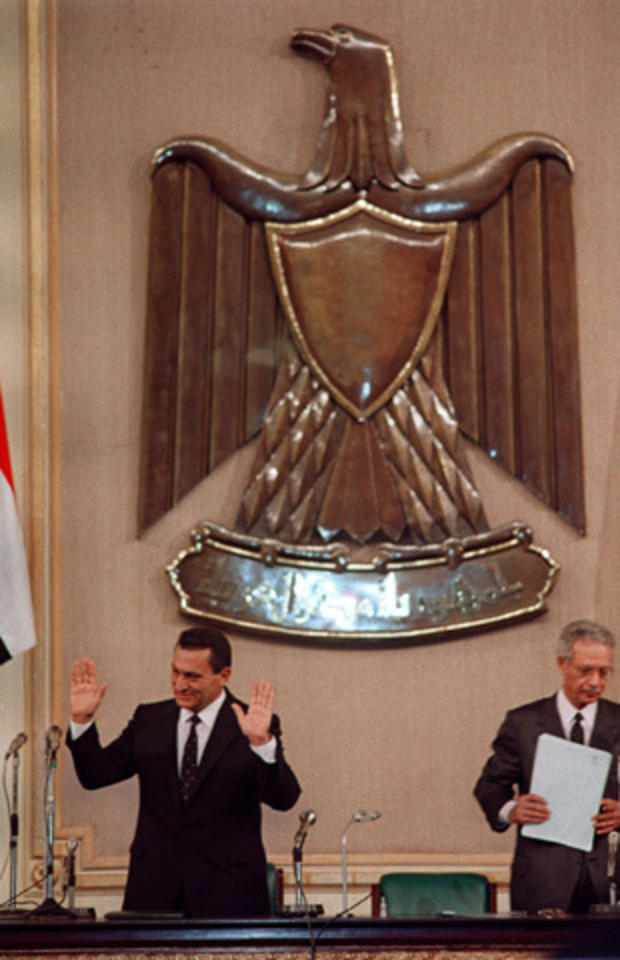
Newly re-elected Egyptian President Hosni Mubarak addresses the new government at the People's Assembly in Cairo, October 12, 1987, on the first day of his second term as President.
AFP/Getty Images
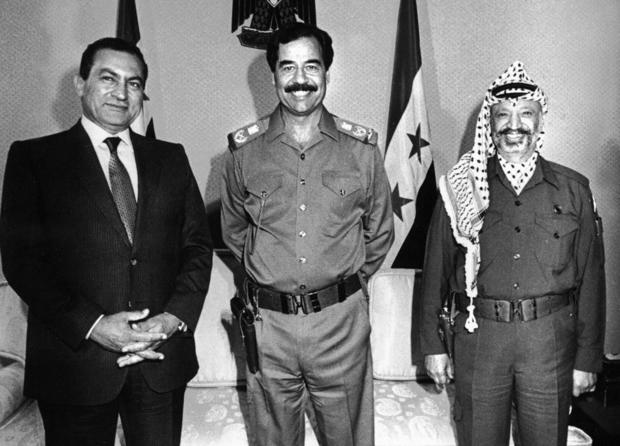
Egyptian President Hosni Mubarak (left), Iraqi President Saddam Hussein (center), and Yasser Arafat, chairman of Palestine Liberation Organization, are shown in Baghdad during a mini Arab-summit, October 23, 1988.
MIKE NELSON/AFP/Getty Images
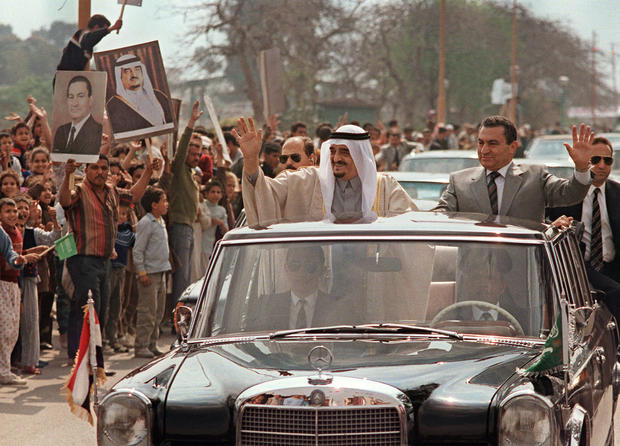
King Fahd bin Abdul Aziz of Saudi Arabia and Egyptian President Hosni Mubarak wave to crowds from an open Mercedes limousine during a tour of Ismailia, a Suez Canal city on March 28, 1989.
King Fahd, son of the founder of the modern Kingdom of Saudi Arabia, was on a four-day official visit to Egypt.
JEROME DELAY/AFP/Getty Images
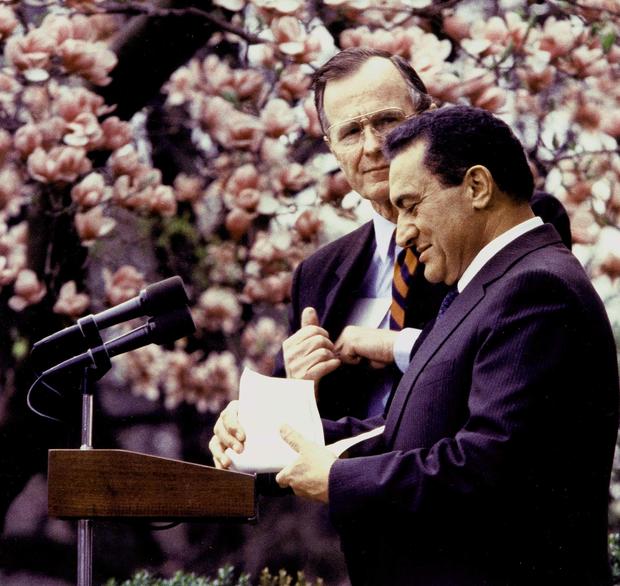
Egyptian President Hosni Mubarak prepares to makes a speech in the Rose Garden April 3, 1989, in Washington, D.C., as former U.S. President George Bush looks on.
MIKE NELSON/AFP/Getty Images
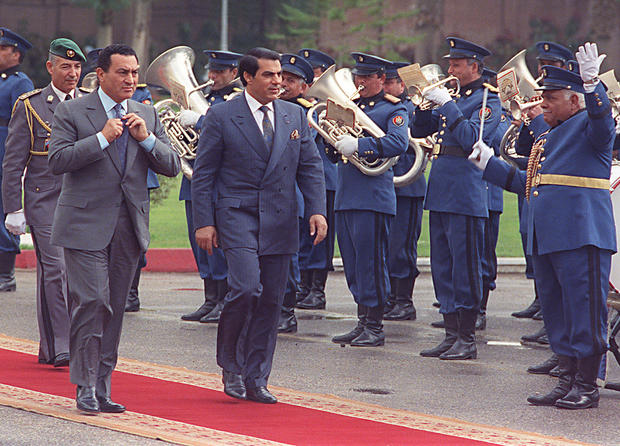
Egyptian President Hosni Mubarak adjusts his tie as Tunisian President Zine el-Abidine Ben Ali watches the honor guard band leader perform during his arrival in Cairo March 6, 1990 on a three-day official visit, the first of a Tunisian head-of-state to Egypt in 25 years.
Ben Ali was the first Middle Eastern ruler to fall in the wave of revolutions which became known as the Arab Spring.
MONA SHARAF/AFP/Getty Images
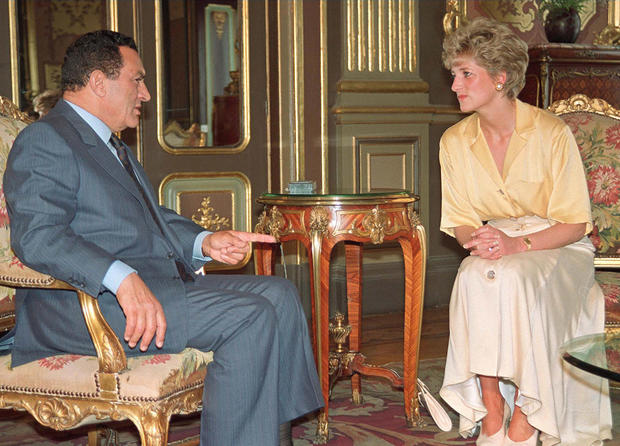
Diana, the Princess of Wales, listens to Egyptian President Hosni Mubarak during her visit in Egypt, May 12, 1992.
MIKE NELSON/AFP/Getty Images
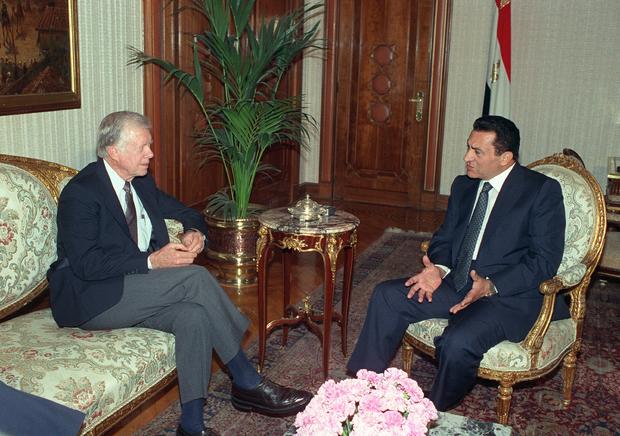
Former U.S. President Jimmy Carter holds talks with Egyptian President Hosni Mubarak March 13, 1990 in Cairo.
PATRICK BAZ/AFP/Getty Images
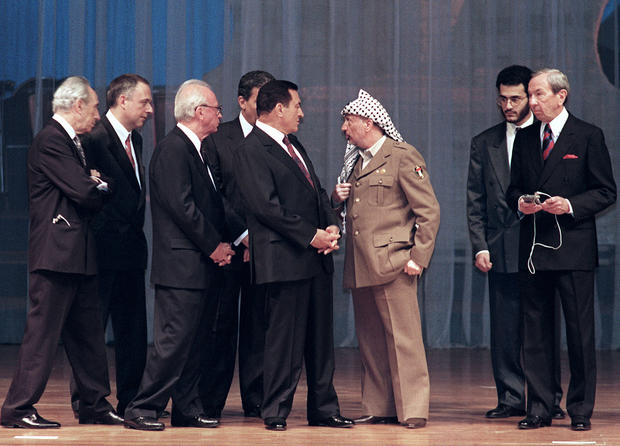
PLO President Yasser Arafat addresses, from left: Israeli Foreign Minister Shimon Peres; Russian Foreign Minister Vladimir Kosyrev; Israeli Premier Yitzhak Rabin; Egyptian Foreign Minister Amr Mussa; and Egyptian President Hosni Mubarak, as they pressure the PLO chairman who refused to sign a chapter of the Gaza-Jericho autonomy agreement, May 4, 1994 in Cairo. At right: U.S. Secretary of State Warren Christopher looks on.
TRAVIS HEYING, MOHAMED EL DAKHAKHNY/AFP/Getty Images
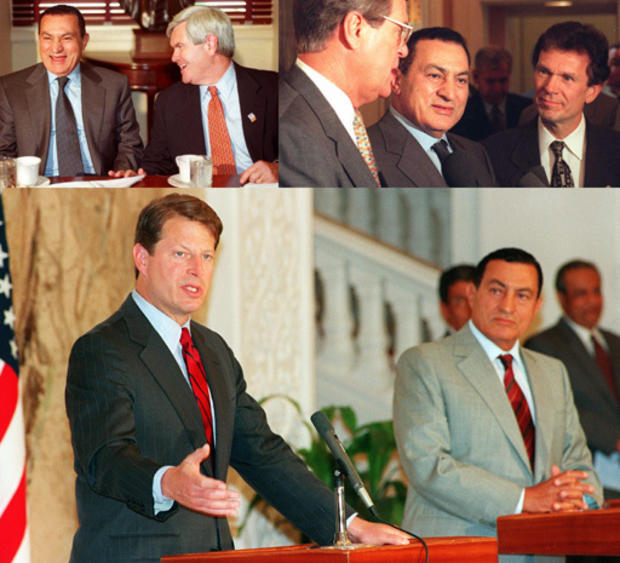
Hosni Mubarak is seen meeting with U.S. politicians on Capitol Hill, including Speaker of the House Newt Gingrich (top left), Senate Majority Leader Trent Lott, and Minority Leader Tom Daschle, July 31, 1994.
Bottom: U.S. Vice President Al Gore and Mubarak speak to reporters during a joint press conference, September 6, 1994, at the World Population Conference in Cairo.
ALEXANDER JOE/AFP/Getty Images
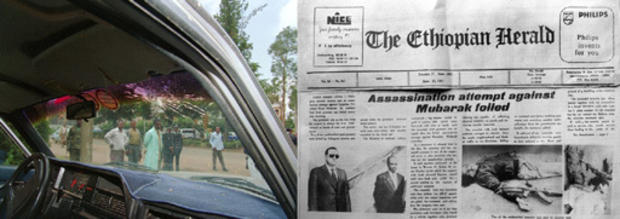
The windscreen of the car used by gunmen who tried to assassinate Egyptian President Hosni Mubarak is seen on June 26, 1995. The assault came as Mubarak's motorcade drove from Addis Ababa's airport on his way to the opening of the Organization of African Unity (OUA) summit in Ethiopia. Two of the gunmen were killed, and one was wounded. President Mubarak returned "safe and sound" to Cairo.
MONA SHARAF/AFP/Getty Images
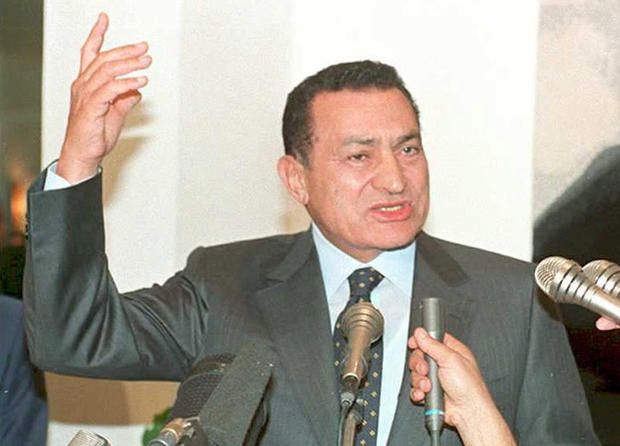
Egyptian President Hosni Mubarak speaks to reporters upon his arrival at Cairo's airport June 26, 1995, after an assassination attempt against him in Ethiopia in which his car was ambushed by unidentified gunmen.
Mubarak said, "It is possible the terrorists came to Ethiopia through Sudan."
STAFF/AFP/Getty Images
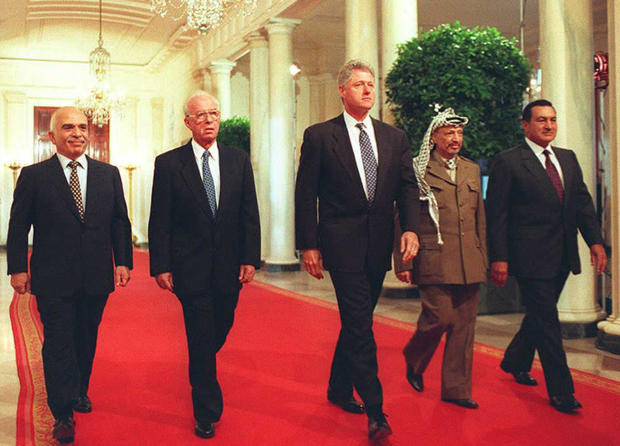
U.S. President Bill Clinton (center) accompanies (from left) King Hussein of Jordan, Israeli Prime Minister Yitzhak Rabin, PLO Chairman Yasser Arafat, and Egyptian President Hosni Mubarak, through the Great Hall at the White House September 28, 1995. At a ceremony in the East Room, Israel and the PLO signed a West Bank autonomy accord.
SVEN NACKSTRAND/AFP/Getty Images
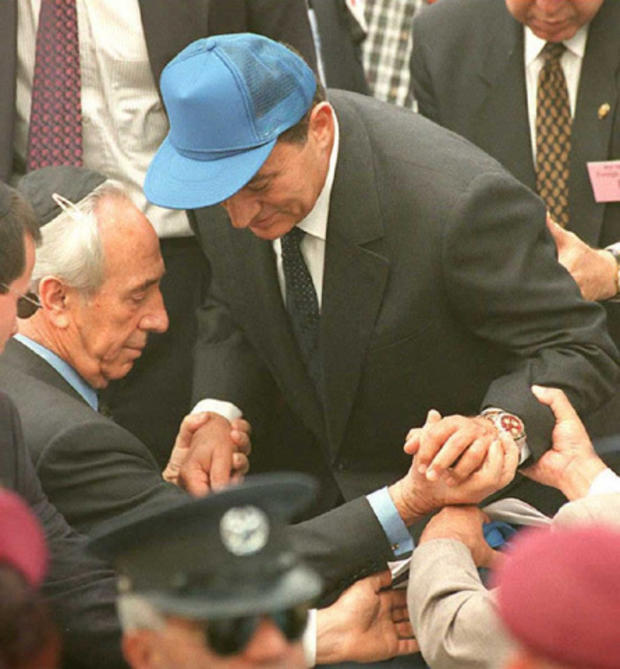
Israeli acting Prime Minister Shimon Peres helps Egyptian President Hosni Mubarak to step down as he presented his condolences to the late Israeli Prime Minister Yitzhak Rabin's family during the Israeli leader's funeral, at Jerusalem Mount Herzl military cemetery, November 6, 1995.
AMR NABIL/AFP/Getty Images
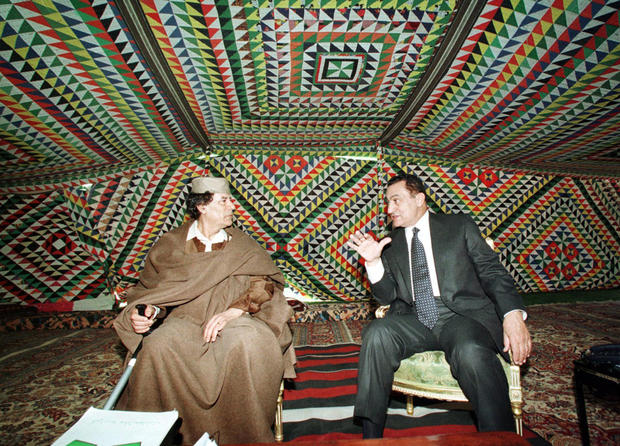
Egyptian President Hosni Mubarak confers with Muammar Qaddafi (left) within the Libyan leader's traditional colorful tent, in Cairo, March 6, 1999.
MARWAN NAAMANI/AFP/Getty Images
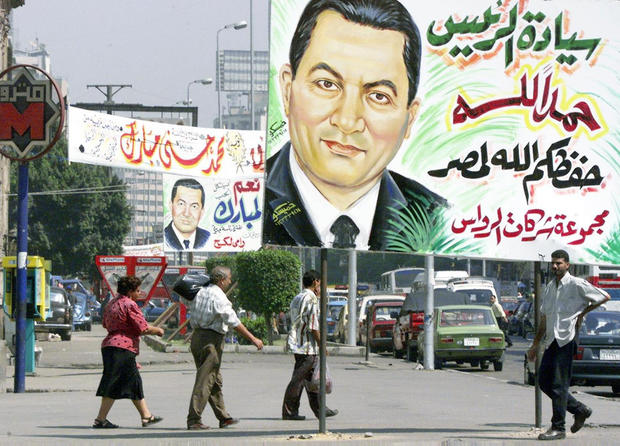
Posters of Egyptian President Hosni Mubarak decorate a street in Cairo September 24, 1999. The Egyptian capital turned into a blaze of bright banners and colorful posters backing Mubarak for a fourth, six-year term. Mubarak ran unopposed.
In his early days, Mubarak made popular moves that held up promise of a more open society, including freeing 1,500 politicians, journalists and clerics jailed during Sadat's last months in office. But hopes for broader reform dimmed.
Mubarak was re-elected in staged, one-man referendums in which he routinely won more than 90 percent approval. He became more aloof, carefully choreographing his public appearances, and his authoritarian governance - buttressed by harsh emergency laws - fueled resentment.
MARWAN NAAMANI/AFP/Getty Images
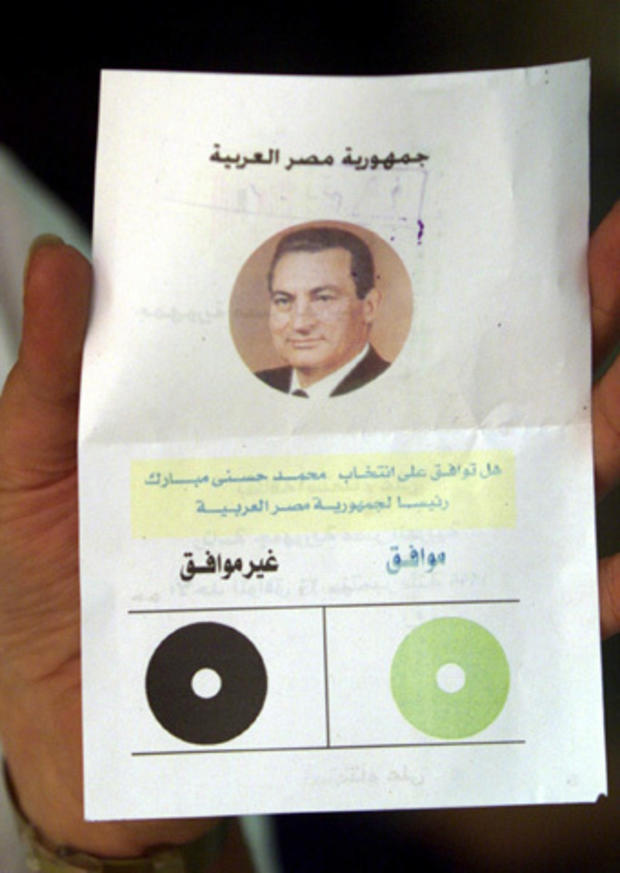
A ballot used during the Egyptian presidential referendum carries a picture of President Hosni Mubarak, with a green circle for "I agree," and a black circle, which says "I do not agree," is shown in Cairo September 26, 1999. Some 24 million Egyptians went to the polls to give Mubarak a popular stamp of support for a fourth six-year term in office.
GABRIEL BOUYS/AFP/Getty Images
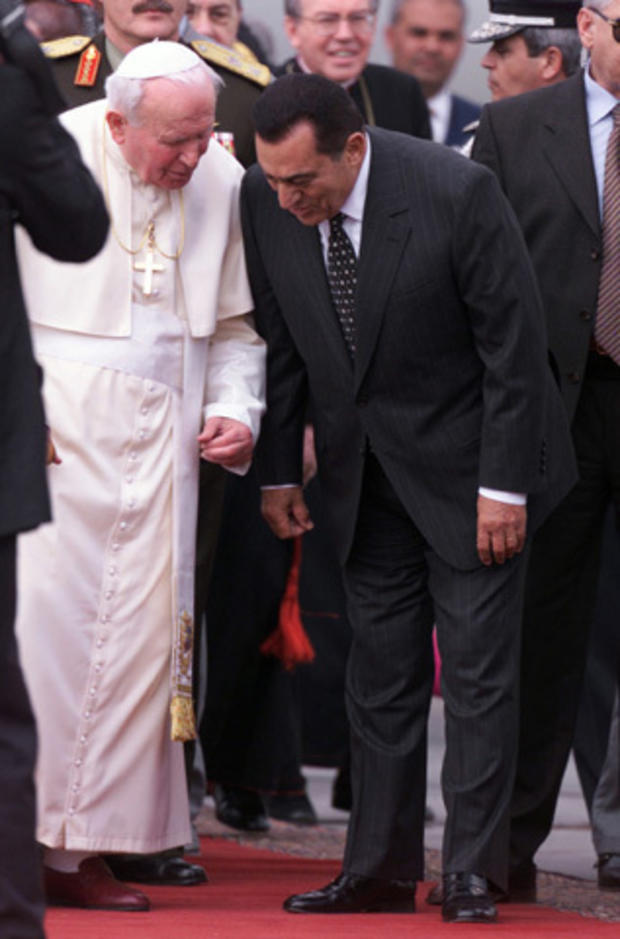
Egyptian President Hosni Mubarak bends to listen to Pope John Paul II upon the pontiff's arrival at Cairo International Airport February 24, 2000 for a three-day visit to Egypt, which will include a trip to St. Catherine's monastery at Mt. Sinai. Egypt's 300,000 Roman Catholics are the country's second largest minority after the Copts, out of a population of around 65 million.
MARWAN NAAMANI/AFP/Getty Images
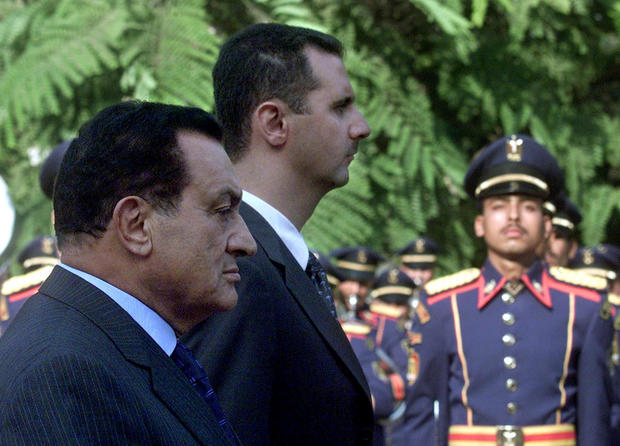
Egyptian President Hosni Mubarak (left) and Syrian President Bashar al-Assad stand before the honor guard at the presidential palace in Cairo October 1, 2000. It was Assad's first visit abroad since he took power following the death of his father in June.
MENAHEM KAHANA/AFP/Getty Images
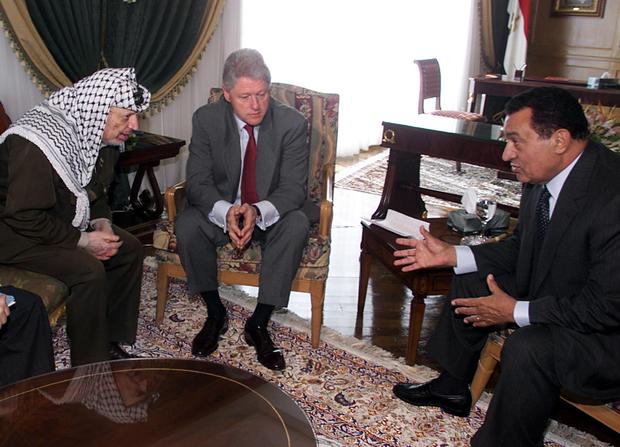
Palestinian Authority President Yasser Arafat (left), U.S. President Bill Clinton (center), and Egyptian President Hosni Mubarak meet in Sharm el-Sheikh October 17, 2000, on the second day of the summit aimed at finding a way to halt the violence threatening the Israeli-Palestinian peace process.
SHAWN THEW/AFP/Getty Images
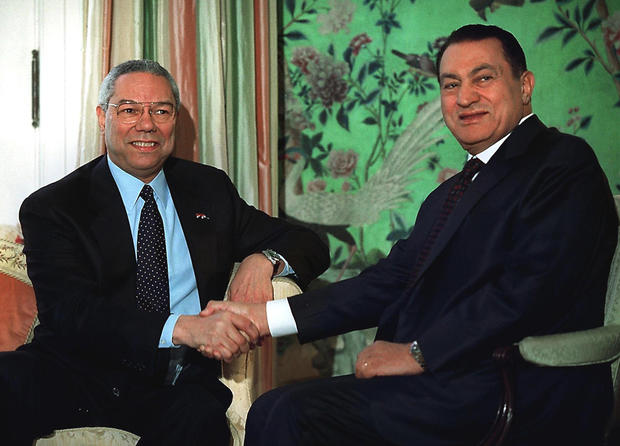
Egyptian President Hosni Mubarak meets with U.S. Secretary of State Colin Powell April 2, 2001, at Blair House in Washington, D.C.
Mubarak was in the U.S. for discussions on the Middle East Peace process and to urge the Bush administration not to back off from America's role in the peace process.
TIM SLOAN/AFP/Getty Images
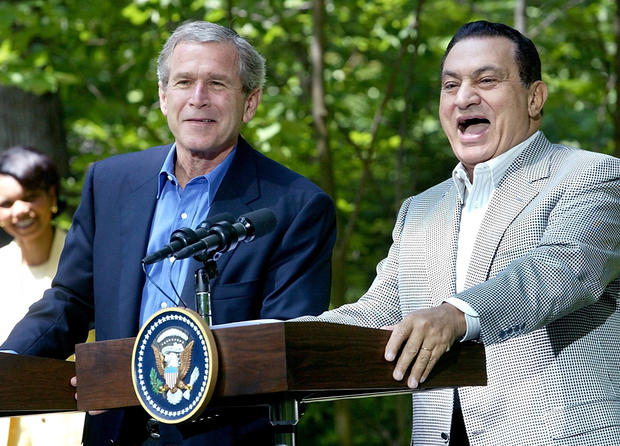
U.S. President George W. Bush holds a joint press conference with Egyptian President Hosni Mubarak after a morning meeting regarding Israel and the Palestinian Authority, on June 8, 2002 at Camp David in Maryland. National Security Advisor Condoleezza Rice stands at far left.
LUKE FRAZZA/AFP/Getty Images
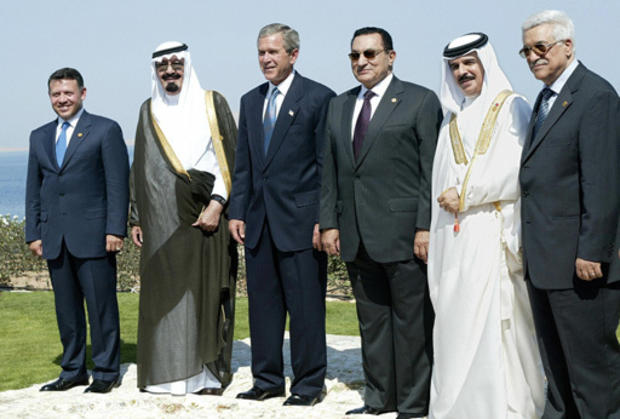
U.S. President George W. Bush poses with, from left, Saudi Crown Prince Abdullah, Jordan's King Abdullah II, Egyptian President Hosni Mubarak, Bahrain's King Hamad, and Palestinian Prime Minister Mahmoud Abbas, at the Four Seasons resort in Sharm el-Sheikh, Egypt, June 3, 2003. President Bush told the Palestinians to stop "terrorism" and Israel to give the Palestinians "continuous territory" for a state, at the end of a one-day summit in Egypt with Arab leaders.
Eric Draper/White House via Getty Images
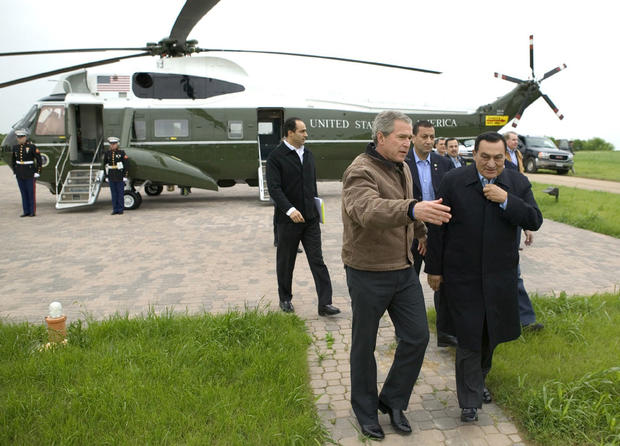
In this handout image provided by the White House, U.S. President George W. Bush gestures as he escorts Egyptian President Hosni Mubarak after his arrival at the Bush Ranch April 12, 2004 in Crawford, Texas. President Mubarak was on an official visit to the U.S.
IVAN SEKRETAREV/AFP/Getty Images
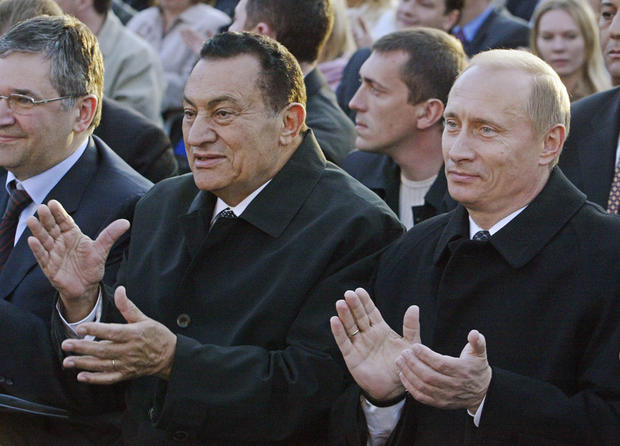
Russian President Vladimir Putin (right) and Egyptian President Hosni Mubarak applaud during a concert of Russian singer Dmitry Khvorostovsky on Red Square in Moscow, May 28, 2004.
CHRIS KLEPONIS/AFP/Getty Images
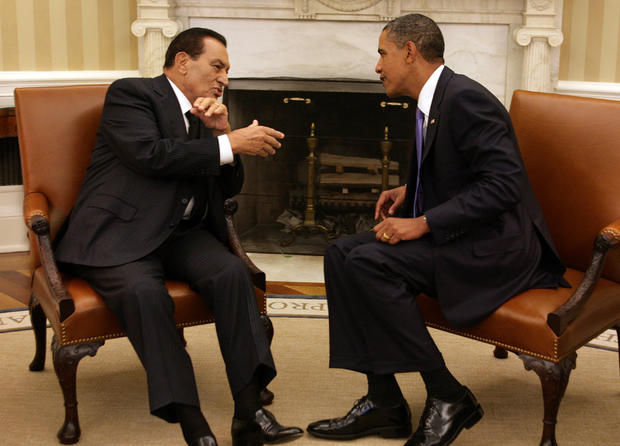
U.S. President Barack Obama speaks with Egyptian President Hosni Mubarak in the Oval Office in Washington, D.C., on September 1, 2010.
AP Photo/Nasser Nasser
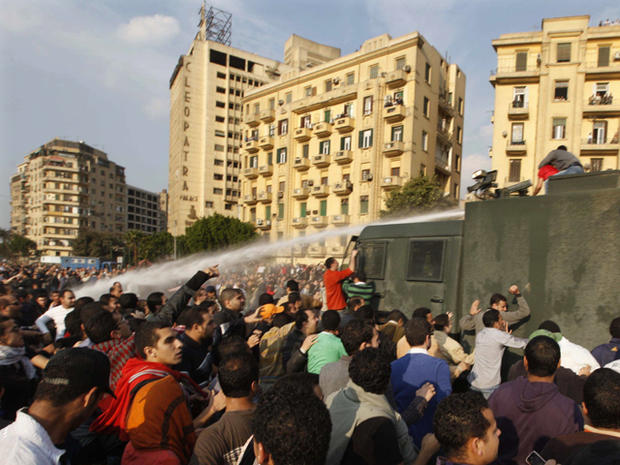
Police use a water cannon against protesters during a demonstration in downtown Cairo, Egypt Tuesday, Jan. 25, 2011. Thousands of anti-government protesters, some hurling rocks and climbing atop an armored police truck, clashed with riot police Tuesday in the center of Cairo in a Tunisia-inspired demonstration to demand the end of Hosni Mubarak's nearly 30 years in power.
AP Photo/Lefteris Pitarakis
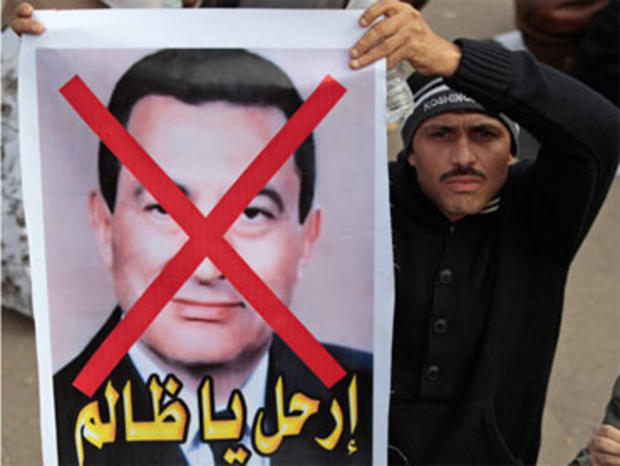
A demonstrator holds a poster showing Egyptian President Hosni Mubarak and reading "Leave oppressor" in Tahrir Square in Cairo, Tuesday, Feb. 1, 2011. More than a quarter-million people flooded into the heart of Cairo Tuesday, filling the city's main square, demonstrating for President Hosni Mubarak to leave after nearly 30 years in power.
AP Photo/Sebastian Scheiner
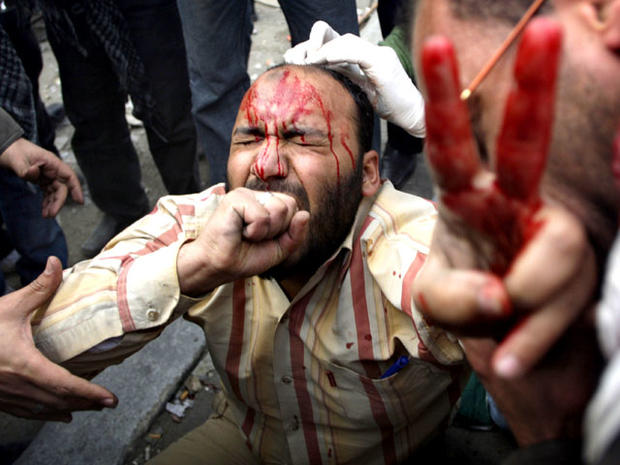
A wounded anti-government protester is attended to during clashes in Cairo, Thursday, Feb. 3, 2011. Another bout of heavy gunfire and clashes erupted around dusk in Cairo's Tahrir Square, the center of Egypt's anti-government chaos, while new looting and arson spread around the capital.
Gangs of thugs supporting President Hosni Mubarak attacked reporters, foreigners, and human rights workers and the army rounded up foreign journalists.
AP Photo
Ousted Egyptian President Hosni Mubarak looks on during a meeting at the presidential palace in Cairo, Feb. 8, 2011.
AP Photo/Ben Curtis
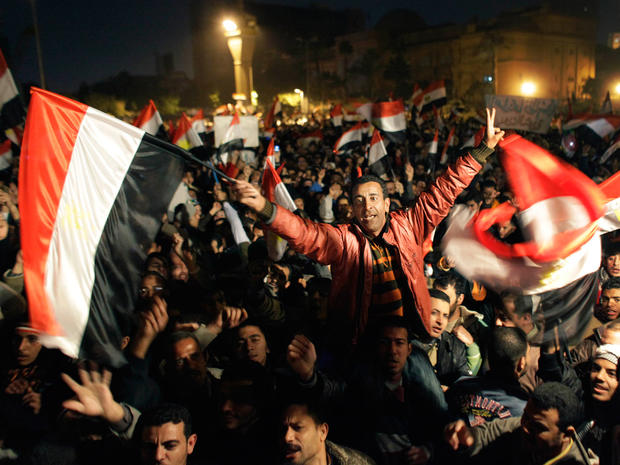
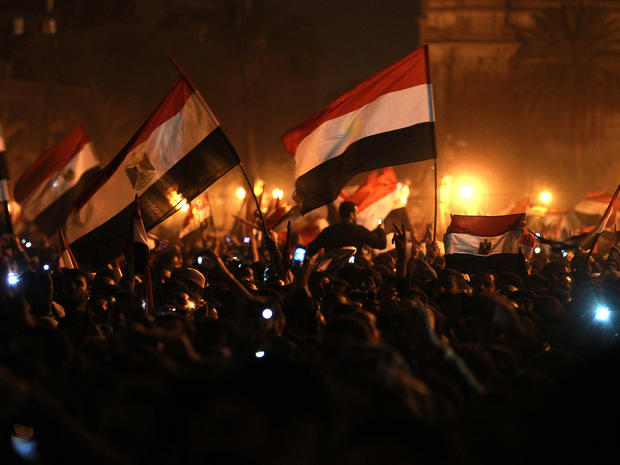
Egyptians celebrate the news of the resignation of President Hosni Mubarak, who handed control of the country to the military, in Cairo's Tahrir Square, Feb. 11, 2011.
Getty Images/Patrick Baz
Egyptian anti-government protesters celebrate at Cairo's Tahrir Square on Feb. 11, 2011, after President Hosni Mubarak stepped down from power. The city erupted with joyful dancing, singing and cries of triumph as Mubarak's 30-year rule came to an end following more than two weeks of mass protests.
-/AFP/Getty Images
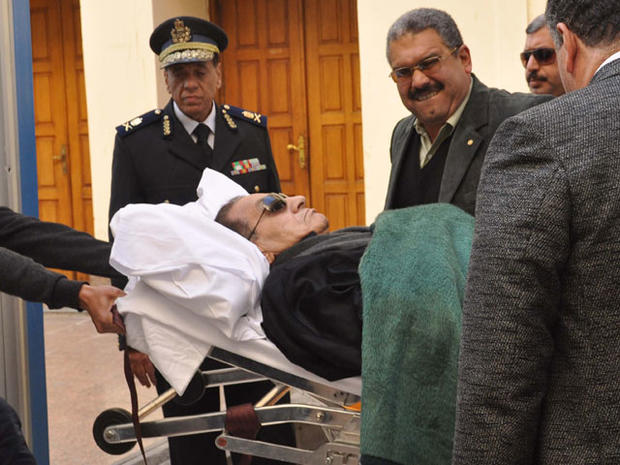
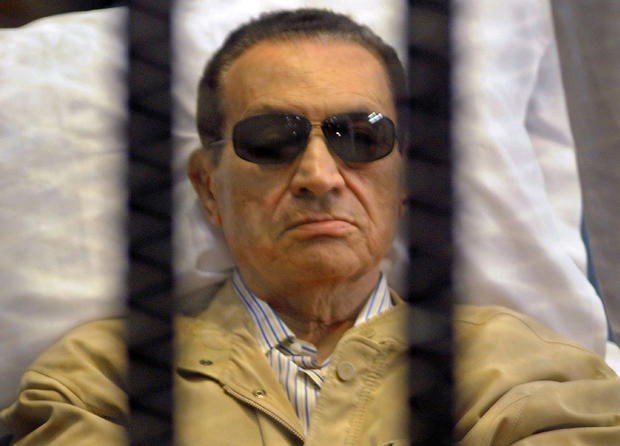
Ousted Egyptian president Hosni Mubarak is wheeled on a stretcher into the courtroom in Cairo on January 3, 2012, for the continuation of his trial. Egyptian prosecutors portrayed Mubarak as a "tyrannical leader," as they made their opening arguments in his murder trial.
STR
Ousted Egyptian president Hosni Mubarak sits inside a cage in a courtroom during his verdict hearing in Cairo on June 2, 2012.
Saying the 84-year-old former president's rule represented "the blackness of a chilly winter's night," a judge sentenced Mubarak to life in prison, after convicting him of involvement in the murder of protesters during the uprising that ousted him last year.
During the verdict, broadcast live on Egyptian television, the judge said those who had died while protesting for the overthrow of the Mubarak regime "were asking peacefully for freedom and justice against those who lived in corruption."