Penn Medicine testing new beanie to help reduce stressful hospital noise

Penn Medicine has a new way to reduce hospital noise, as monitors and alarms can be stressful for patients, especially premature babies: a new high-tech cap.
Reese Miller is one of Karli Miller's triplets, born prematurely in December at Penn Medicine, all within the same minute, the mother said.
One of the babies is at the Children's Hospital of Philadelphia with a heart problem. The other two are at Penn Medicine, testing a new high-tech beanie invented by recent graduates from Penn's School of Engineering and Nursing.
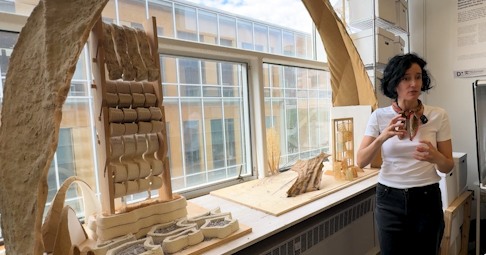
"When we went into the NICU, it was just, we were bombarded by a lot of noise, and just the environment was very overstimulating," inventor Sophie Ishiwari said.
The beanie mimics sounds in the womb and filters out high-frequency noises that are constant inside a hospital, which research has shown can also be harmful.
"Our device is called the Sonura Beanie," inventor Gabby Daltoso said. "The Latin roots for sound care are sonar and Cura, and so we put it together to make Sonura."
The beanie can also deliver audio messages recorded by parents.
"I was, 'Oh my god, that's so nice,' because I can't be with them all the time as much as I would love to be," Miller said.
The beanies are worn for 45 minutes three times a day.
"We know that both reduced noise exposure and access to a mother's voice can decrease stress levels," Ishiwari said. "We're looking at heart rate, respiratory rate and in the future, we're looking to meet to measure growth endpoints."
Miller, who's from Allentown, was happy to test the beanies on her babies.
"From the moment they put it on, they just get this like little peaceful look on their face," Miller said, "and it's just so sweet."
The research that is aiming for FDA approval will cover 30 premature babies at Penn and then move to Stanford.
"We've seen how powerful it can be in just our first 10 families," Daltoso said, "and we really look forward to helping those hundreds of thousands of infants born early every year."