Pennsylvania Supreme Court rules "skill games" are slot machines, leaving their future uncertain

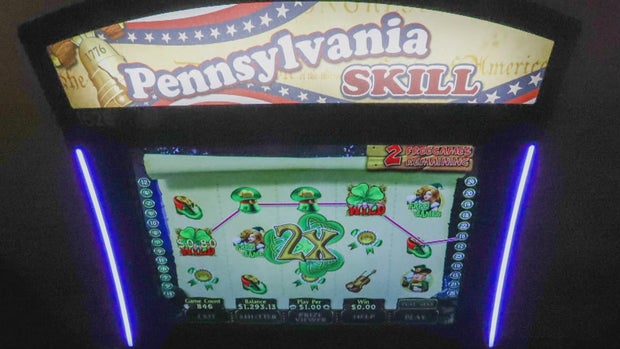
Changes are coming for "skill games" in Pennsylvania after the commonwealth's highest court ruled the loosely regulated machines found in bars, convenience stores and VFW halls are essentially slot machines.
Justice David Wecht wrote in his majority opinion that skill games are slot machines "several times over," meeting multiple legal definitions — therefore, they're subject to the same regulation as traditional slot machines.
Monday's 5-2 ruling sides with the arguments made by the state Office of the Attorney General in court. AG Dave Sunday said in a news release that skill games were operating as unlicensed and unregulated slot machines.
Sunday estimated there are 70,000 skill game machines in operation throughout the commonwealth, and said that number dwarfs the number of legal slot machines in Pennsylvania casinos.
"The Supreme Court recognized what our office has argued from the beginning — these machines operate as gambling devices and cannot legally exist without the same oversight, regulation and accountability as other forms of legalized gaming in the Commonwealth. Pennsylvanians deserve protections that ensure games are fair, transparent and operated within the bounds of the law," Sunday said in a news release.
What is a skill game? How the skill games case was decided
Justices considered several prior cases on skill games, attempting to determine the extent that a player's skill determines the outcome. They reasoned that a level of skill could help improve your outcome in the game (winning more money), but that skill alone can't determine the outcome: it's up to chance.
They said skill games have elements of gambling, including wagering, rewards and a result determined by chance over skill.
Proponents of the skill game machines mentioned a feature called "Follow Me," where players can memorize an increasingly lengthy series of inputs in order to win money. It's been compared to "Simon."
While the machines may include that game, state attorneys argued that few players play that game, instead opting for more risky games similar to slot machines. On top of that, "Follow Me" was not particularly rewarding, paying out only 105% of your bet — a maximum of 20 cents on a four-dollar bet, according to the court ruling.
"'Follow Me' isn't there for the players; it's there for the lawyers," state attorneys argued.
You can read the full majority opinion here.
What's next for skill games in Pennsylvania
Legislators have long considered adding more taxes on skill games to raise revenue for the state budget.
In a statement, House Republican Leader Rep. Jesse Topper said the decision will "hopefully force us to deal with an unregulated sector of the gaming industry that has both helped mom-and-pop operations, as well as local clubs and veterans organizations, while at the same time negatively impacting traditional gaming operations in Pennsylvania."
"It is long past time we enact meaningful reform to strengthen the entire industry, as well as ensuring our local establishments have the tools to remain viable in today's market; all the while protecting our most vulnerable population from falling into the throes of addiction," Topper's statement read.
Republican state Sen. Frank Farry of Bucks County has spent years working on the divisive issue.
"This was certainly something many of us thought was coming," Farry said. "The debate's going to be, where are they located? How many machines? What's the tax rate on the machines?"
You might find skill games in gas stations, VFWs, fire halls and charitable organizations around Pennsylvania.
Philadelphia Mayor Cherelle Parker wants her say, too. Speaking to local anti-violence advocates Tuesday, the mayor cited city data she claims shows the machines are concentrated in areas with high-crime and high-poverty rates. She drew a line on where she would not accept them.
"We knew that they were slot machines and that they did not have a place in our community," Parker said. "They shouldn't be on our neighborhood commercial corridors, or in neighborhoods in convenience stores. They shouldn't. They should not be in gas stations."
Parker said she wouldn't object to taxed and regulated machines in places like VFWs.
Organization leaders like Jim Brown say the machines were vital to VFWs, especially after COVID-19.
"Those skills machines, there's no doubt that they brought revenue," Brown, senior vice commander of the VFW Department of Pennsylvania, said. "They helped different posts stay open."
Brown said the worst-case scenario is the machines are declared illegal, but even a high tax rate could be crippling, such as something near the rate the commonwealth taxes slot machines, which is a 52% rate.
"Just a simple breakdown, you make $100 on a machine. You pay $52 of it out," Brown said. "And they pay you a 50/50 split with the distributor. You made $24 on that machine. That doesn't get you very far."
Brown said during the skill games talks, VFW leaders will also push lawmakers to reform the commonwealth's small games of chance laws to include electronic versions of things like pull-tabs that they're already allowed to do.
They say that could help offset some of the skill game revenue.
Farry said protecting that revenue for VFWs and other organizations will be a talking point.
Pace-O-Matic, a skill games company whose machines were discussed in the court cases, said it disagreed with the court's opinion and noted lower courts had affirmed the legality of skill games — in rulings now overturned by the Supreme Court decision.
"Sadly, this opinion will have far-reaching consequences, with more than 10,000 Pennsylvania small businesses and fraternal clubs becoming the real victims," Pace-O-Matic said in a statement. "They are now potentially left facing an impossible choice: cease operating these games and lose an important source of revenue, or endure a legislative solution that could bring excessive regulation and crippling taxation, which will force them to cease operating these games and lose an important source of revenue."
The Supreme Court stayed its order for 120 days to give the state time to address what to do next. The court asked lower courts to issue future rulings in accordance with Monday's opinion.


