250 years later, Thomas Paine's "Common Sense" remembered for helping spark American Revolution
"We have it in our power to begin the world anew." Words written by Thomas Paine in Philadelphia 250 years ago in his pamphlet titled "Common Sense." In fewer than 50 pages, historians say that Paine's words would change the course of the American Revolution.
"Common Sense is a catalyst of independence. It ignites enthusiasm all over the Colonies," Tyler Putman, senior manager of gallery interpretation at the Museum of the American Revolution, said. "It changed the course of world history."
Paine first published "Common Sense" on Jan 9, 1776, at Robert Bell's printing shop near what is now 3rd and Walnut streets, according to the museum. The work came at a significant moment in the feud between the American Colonies and Great Britain.
Museum displays show that just the day before the pamphlet came out, King George III's speech to parliament condemning the American "rebellion" was published in Philadelphia. While the Colonies were at war with Britain, Putman said independence from the Crown did not seem to be the goal for most.
"The founders were really thinking that reconciliation was quite likely with Great Britain," Putman said. "Most common people in America, on Jan. 9, 1776, if you had asked them to bet on the future of North America, they would've said it was a British future."
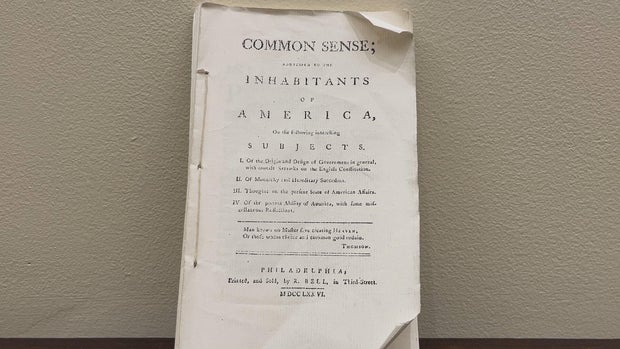
Putman said Paine argued two key points in "Common Sense." First, that monarchies are inherently corrupt. Secondly, therefore, the only solution to that is independence. That notion of forming a new nation, independent of British control, was revolutionary for the time, Putman said.
It was "the first time that someone had put into words a basic argument for, not just integration into the British Empire or a loosening of restrictions, but for an independent country in North America," Putman said.
Not all were in favor of Paine's arguments in "Common Sense," but the work became an instant success. It was a bestseller in its time, and historians said it reached people throughout the Colonies.
"This pamphlet sold more copies, by far, than any other book had sold in American history," Putman said. "And even if you didn't own a copy of the pamphlet, you might've heard it read aloud in a coffee shop."
Putman credited the work as a catalyst that helped shift the Colonies' view from seeking a better arrangement with Great Britain to one of outright independence. Its impact was seen quickly. Less than six months later, Putman said many of the foundations of "Common Sense" can be seen in America's most treasured Revolutionary document.
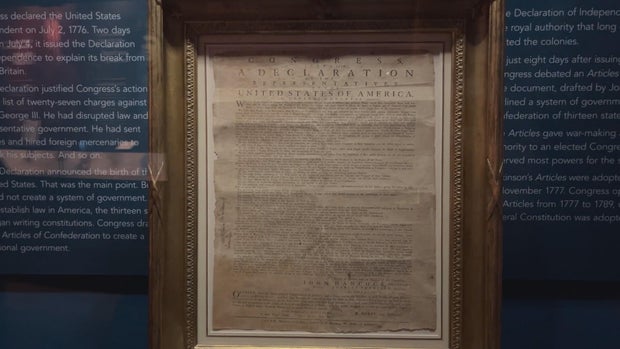
"Common Sense is what ignited a widespread movement that led to July 4, 1776," Putman said. "The Declaration of Independence formalized the arguments Common Sense made. This was kind of a theoretical work. What we should be doing, what might be possible. And then right here in Philadelphia, not even six months later, we make it a reality."
Today, a historic marker sits near the site where "Common Sense" was first printed, just steps away from a small street that bears Paine's name.
As the nation prepares to celebrate this historic anniversary of its independence, Putman said Paine's work remains a worthwhile read 250 years later.
"I think what Thomas Paine would've wanted you to be thinking about 'Common Sense' today is not that it was a good argument or right or wrong," Putman said. "He would want you to read the work, to look at your world, to use reason and rationality, and to make up your own mind about what was right."
The Museum of the American Revolution has an early copy of Paine's "Common Sense" on display for public viewing. You can see it during the museum's normal hours.