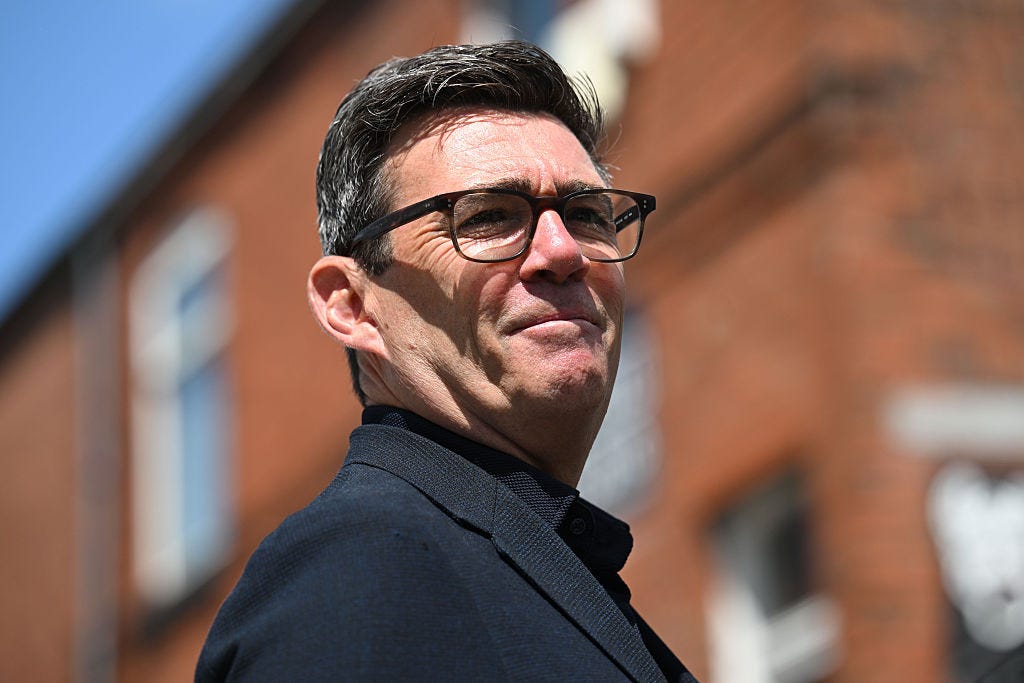
British Prime Minister Keir Starmer announces resignation
London — British Prime Minister Keir Starmer announced Monday that he was resigning from his position as the leader of the ruling Labour Party, which will also see him replaced as the country's leader.
Starmer has been under mounting pressure to resign for weeks, following a disastrous round of local elections for his party in early May, but his decision came after a political rival from within Labour, former Manchester Mayor Andy Burnham, made it clear that he would challenge the prime minister for his job.
Starmer had vowed to stay in his post, but his position became untenable as more and more Labour Party colleagues concluded his time was up. The timetable for his departure sped up after Burnham left his role as mayor and then won a seat last week as a Member of Parliament for his local constituency — a necessary move as prime ministers have long been chosen from among sitting members of the House of Commons.
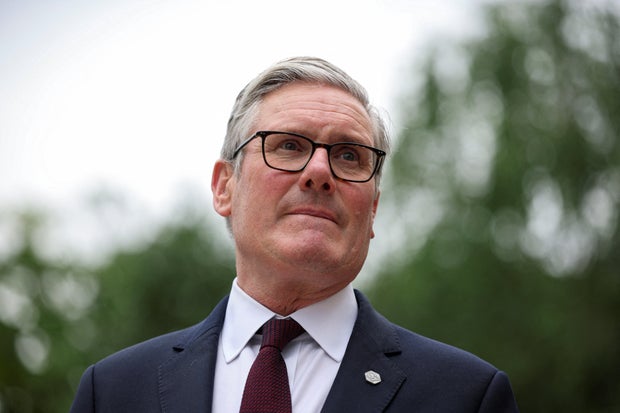
It marks the end of a tumultuous reign for Starmer less than two years after his Labour Party was swept to power in a resounding national election victory — and less than two months after voters made their frustration with his handling of national affairs clear in a round of local elections.
In a statement delivered outside his office and official residence at 10 Downing Street in London, Starmer extolled the virtues of his time in office, then added:
"The question my party is asking now is whether I am best placed to lead us into the next election. I have heard the answer… and I accept that answer with good grace. Every decision I have made has been about putting the country I love first."
"I will resign as leader of the Labour Party," he said.
If the Labour Party decides to unite around one person as its next leader, without an internal contest, Starmer could be out of the premiership by July. If there is a leadership contest, the new leader will be decided by the time lawmakers return to parliament in September after their summer break.
Starmer said he would give his successor "my full and unequivocal support."
Starmer appeared to choke up toward the end of his remarks as he spoke of his children, whom he called his "pride and joy."
He said that after stepping down from the "biggest job in the country," he would now spend time on "the most important job … being the best husband I can, to my fantastic wife Vic, who has been a rock by my side through good times and bad."
On Sunday President Trump posted on his Truth Social platform that Star had "failed badly on two very important subjects- IMMIGRATION AND ENERGY (OPEN NORTH SEA OIL!). I wish him well!"
The rise of Andy Burnham
Starmer's widely tipped successor is former Manchester Mayor Andy Burnham, who won a local election last week to return to parliament as a member of the House of Commons. While not required explicitly by law, British prime ministers have been chosen from among sitting members of parliament (MPs) for decades.
Burnham announced Monday, to the surprise of nobody, that he would be putting himself forward for the party leadership, and thus to be the new prime minister, saying the process should be "conducted in an orderly and responsible way."
Burnham and Starmer have previously disagreed on some issues.
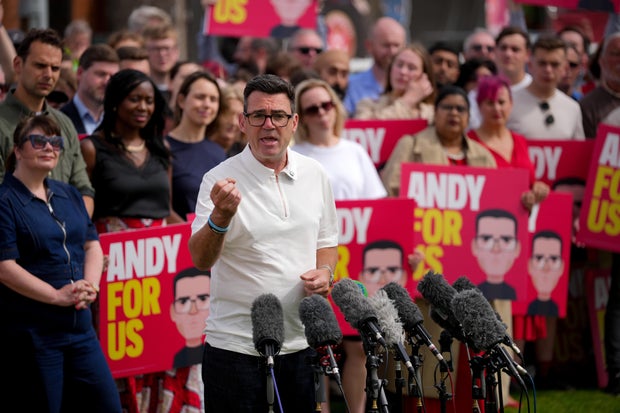
If the party decides to have a so-called "coronation" instead of a leadership contest, Burnham is expected to be the next leader of the country, though other Labour politicians have voiced interest in contesting the leadership.
Giving his acceptance speech after winning his local seat in parliament last week, Burnham — often called the "King of the North" after nearly a decade as the Mayor of Manchester — left no doubt that he hoped to lead the party and the country.
"Everyone knows that politics isn't working," said Burnham, who ran unsuccessfully for the Labour Party's leadership in 2010 and 2015. "Everyone can feel that the country isn't where it should be. Tonight could, just could, be the turning point."
Former national health secretary Wes Streeting told Politico last week that he wanted a "genuine contest" to decide the next leader of the party, and he had said he would stand, describing himself as a "plucky underdog." On Monday, however, he fell in line behind Burnham and said he would support him for the party's leadership.
"Having spoken at length with Andy in recent days, I'm convinced that there is a place for those ideas under his leadership," Streeting said in a statement shared on social media.
"We could spend the summer exaggerating small differences, or we can roll up our sleeves and help him to deliver the change our Party and our country needs," he added. "That is the choice I am making."
How the U.K. can get a new leader without an election
Under Britain's political system, voters do not directly elect their prime minister.
The general public elects their local members of parliament, and if one party controls a decisive majority of the seats in the House of Commons, as Labour has since the last national elections in 2024, that party's leader generally is seated as the prime minister.
As long as the party maintains its majority, it can replace its leader either through an internal party election if there are multiple challengers, or by consensus.
When either action is taken, however — and it has happened much more often, with six prime ministers inhabiting 10 Downing Street over the last decade — the new national leader can quickly come under pressure to call a new national election, to show they have the support of the nation, not just their party.
"I know I have my doubters"
Political historians will likely say the writing was on the wall for Starmer in the wake of the local elections in early May that saw Labour hemorrhage seats.
In votes for local council seats in England, and seats in the semi-autonomous legislatures of Wales and Scotland, Starmer's Labour Party lost big. It shed 1,000 local council seats and lost its firm grip on the Welsh legislature, which it had controlled for 27 years.
The populist, anti-immigration Reform UK party was the big winner on the day. The party, led by President Trump's ideological ally Nigel Farage, won nearly 1,300 local council seats in England and made huge gains in both the Scottish and Welsh legislatures.
The local elections were seen, much like the U.S. midterms, as a referendum on the current government, and they were a disaster for both Labour and Starmer, a former government lawyer whose popularity has plummeted since he led his party to a decisive national victory in 2024.
Starmer vowed several times to fight on, even as fellow Labour members resigned from his cabinet.
"I know I have my doubters and I know I need to prove them wrong," he said in a speech a few weeks ago with shirt sleeves rolled up, "and I will do so."
But it wasn't enough.
Labour lawmakers seemed unimpressed by the effort, with parliamentarians telling CBS News' partner network BBC News that his post local-elections speech in May, "made me feel sorry for the PM," that it "really didn't cut the mustard," and, perhaps most damningly: "Meh."
Throughout his nearly two years in office Starmer struggled to shrug off criticism that he was more of a manager than a leader.
The final blow may have come last week, when Defence Secretary John Healey — a Starmer loyalist — resigned over Starmer's military spending plans. Armed forces minister Al Cairns followed soon after. A total of 20 ministers resigned during Starmer's tenure.