With Ryan pick, Romney is no longer playing it safe
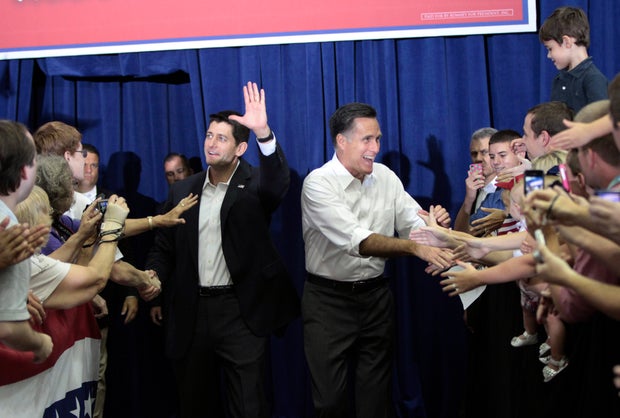

He's no longer playing it safe.
With his selection of House Budget Chairman Paul Ryan, Mitt Romney changed the course of a candidacy that had been defined by its cautious approach, bringing to it an immediate surge of excitement while simultaneously opening the floodgates to significant political hazards.
By shunning supposedly "safe" picks such as former Minnesota Gov. Tim Pawlenty and Ohio Sen. Rob Portman, Romney also took a significant step toward defining the approach to governing he would take in the White House.
In choosing Ryan, a seven-term congressman who has spent almost his entire adult life working in the nation's capital, the presumptive nominee declined to bolster his image as an outsider at a time when Congress' popularity has reached new lows.
"I believe my record of getting things done in Congress will be a very helpful complement to Governor Romney's executive and private sector success outside Washington," Ryan said upon being unveiled as the VP pick Saturday morning in Norfolk, Va. "I have worked closely with Republicans as well as Democrats to advance an agenda of economic growth, fiscal discipline, and job creation."
More than anything, the choice of the 42-year-old Wisconsin congressman brought to center stage Ryan's plan to address the nation's fiscal woes head-on, in part by overhauling Medicare and Medicaid.
Soon after the pick was announced, CNN published internal talking points that Romney aides had distributed to campaign surrogates.
Those points included suggestions that Romney would not adopt the Ryan budget plan and would instead continue to offer a distinct proposal of his own.
A senior Romney aide told RCP that the candidate's decision not to fully embrace the Ryan plan was "not news," referring to an interview that the former Massachusetts governor conducted with ABC News early last year. "His plan is not the plan I'll put forward. I have my own plan," Romney said in the interview. "I'll be putting that out before I debate President Obama."
Thus, the already fine line that Romney had been walking on this issue has now become even more delicate.
But no matter how Romney answers the inevitable questions about how much he agrees with his running mate's proposals, the placement of Ryan on the GOP ticket is delighting the party's right flank.
For the past week, a rising chorus of conservative opinion-makers has publicly urged the candidate to make Ryan his choice, a sentiment reflecting a broader concern that following a safe playbook would not be enough to defeat Obama in November.
According to campaign aides, Romney settled on Ryan on Aug. 1, days before The Weekly Standard opened the pro-Ryan salvo by urging him to "go for the gold" and pick either the Wisconsin lawmaker or Florida Sen. Marco Rubio.
Regardless of timing, the decision brought a collective sense of glee among conservatives, whose support for Romney has wavered throughout his two runs for the presidency.
The Ryan pick appeared to equally delight Democrats.
"In naming Congressman Paul Ryan, Mitt Romney has chosen a leader of the House Republicans who shares his commitment to the flawed theory that new budget-busting tax cuts for the wealthy, while placing greater burdens on the middle class and seniors, will somehow deliver a stronger economy," Obama campaign manager Jim Messina said in a statement.
Within hours of the announcement, the president's campaign website had added a section on Ryan, calling his budget plan a "sham" and dubbing the Republican ticket the "go back team."
The most immediate effect of the Ryan selection in swing states is that it leaves no doubt as to whether Wisconsin's 10 electoral votes will be in play for the Republican ticket. They are now.
Ryan is widely known and popular in his home state and district, and the Romney campaign was already firming up plans on Saturday to have Ryan make campaign appearances there, possibly on Sunday.
But nowhere is the Ryan selection more fraught with political risk than Florida -- a state whose much larger prize of 29 electoral votes Romney likely must win in order to be elected president.
Florida's huge population of older voters could be particularly susceptible to charges that Ryan's plan to restructure Medicare and potentially allow some privatization of Social Security would jeopardize those popular government programs.
The venue for Romney and Ryan's highly anticipated speeches at the Republican National Convention -- Tampa -- further elucidates the stakes attached to the data-loving former businessman's daring move to shake up the race.