Wisconsin recall elections on tap for Tuesday
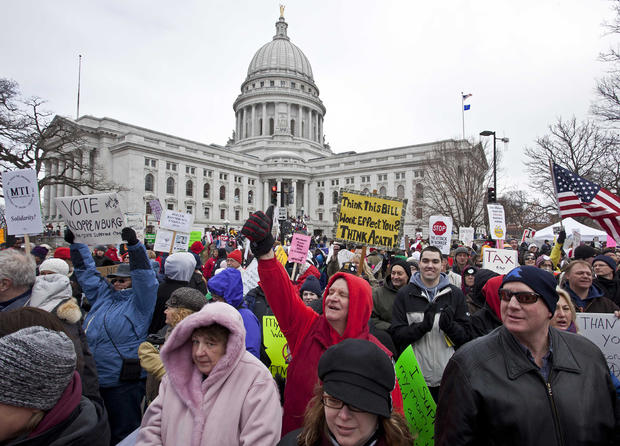
After a bitter fight earlier in the year that spurred weeks of raucous protests and prompted lawmakers to flee the state, the Wisconsin political battle over union rights culminates this week with the recall elections of six Republican state senators. One Democratic state senator survived a recall election last month, and two more Democrats face recall votes next week.
The recall effort is unprecedented in terms of the number of state lawmakers on the chopping block and the amount of money and national attention it has drawn. And while the recall elections were inspired by Republican Gov. Scott Walker's ultimately-successful effort to roll back collective bargaining rights for unions, the recalls have become a broader referendum on the Republican agenda that Walker and the GOP-controlled legislature have pursued. Republicans control the state Senate 19 to 14, so Wisconsin Democrats need to win three of tomorrow's elections and survive next week's in order to gain control and derail the GOP agenda.
Republicans in the state have vowed to keep the repeal of collective bargaining rights in place as long as Walker remains governor, the Milwaukee Journal Sentinel reports, but the outcome of the recall elections could impact a range of agenda items -- like the possible expansion of a school voucher system, proposed cuts to Medicaid, and the passage of laws in the state to implement the federal health care reforms. On top of that, outside interest groups involved in the campaigns have focused on the impact the recalls could have on issues like abortion.
While the recalls could directly impact Wisconsin politics, they also could have national implications. Political strategists are watching to see if Republican governors like Walker can politically withstand the blowback from taking on unions. They're also watching to see how much momentum the Democratic party has built up, after suffering significant losses to Republicans in the 2010 elections. Wisconsin could prove to be a key state for President Obama in 2012.
With state and national politics at play, third-party groups have enthusiastically jumped into the mix, already spending nearly $30 million, the Wisconsin State Journal reports. The final tally of money spent by the candidates and outside groups could top $40 million -- double the amount spent in all 116 of the 2010 Wisconsin state legislative races combined.
On the left, groups like the grassroots organization Progressive Change Campaign Committee have purchased ads and mobilized voters. PCCC said that as of Sunday night, its members had put out more than 300,000 calls to voters and spent more than $2 million, in conjunction with the group Democracy for America, to support Democrats. On the right, groups like Wisconsin Family Action and Wisconsin Club for Growth have been engaged, spending more than $400,000 in one particularly competitive district alone, the Associated Press reports.
With all the attention the recalls have garnered, it may not be too surprising that local election officials expect turnout to be higher than the typical rates for a special election. The city clerk in Fond du Lac, Wisconsin, told the Milwaukee Journal Sentinel that the volume of calls, voter registrations and absentee ballot requests her office has received is comparable to a gubernatorial race.