When to Ally and When to Acquire
The Idea in Brief
Many companies view acquisitions and alliances as interchangeable strategies for spurring growth. But each strategy has unique advantages and disadvantages. Firms that ignore those differences risk acquiring companies they should have collaborated with or allying with those they should have bought.
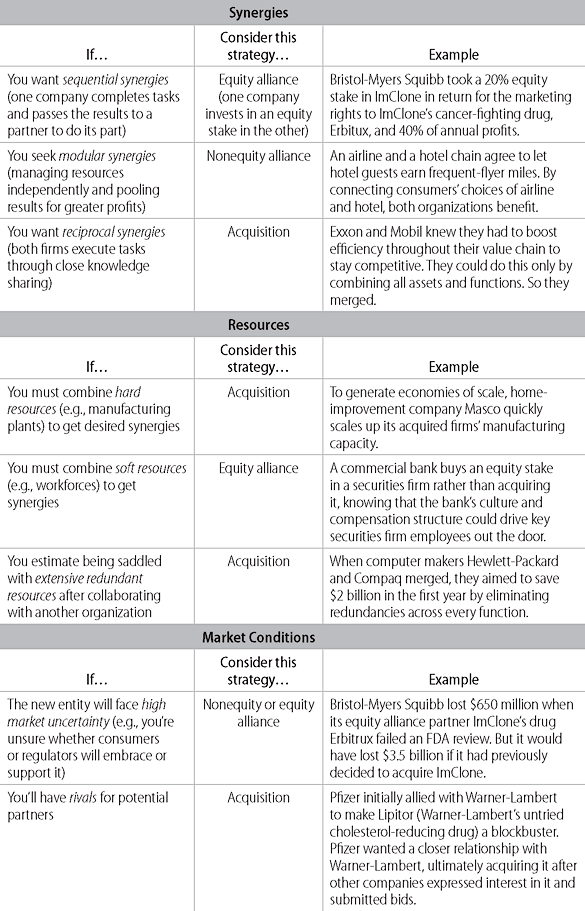
To escape this fate, know when to use each strategy. Dyer, Kale, and Singh advise basing your choice on the types of synergies you want, the type of resources you'll need to combine, and market conditions. For instance, if you want to generate synergies by combining your and another company's workforces, forge an alliance. Why? Acquisitions often spark a talent exodus in target firms. But if you're combining manufacturing plants to gain synergies, go with acquisition so you control economies of scale.
Cisco discovered the advantages of knowing when to acquire or ally. Over ten years, it purchased 36 firms and entered into 100+ successful alliances. Its market capitalization grew 44% every year.
The Idea in Practice
Copyright 2007 Harvard Business School Publishing Corporation. All rights reserved.
- Purchase the full-length Harvard Business Review article here.
- Visit Harvard Business Online.
- See more on Strategy and Execution at Harvard Business Online.
Further Reading
Articles
Not All M&As Are Alike--and That Matters
Harvard Business Review
March 2001
by Joseph L. Bower
Even if your company has decided on an M&A instead of an alliance, keep in mind that different acquisitions/mergers can have very different strategic aims. These include: dealing with overcapacity through consolidation in mature industries; rolling up competitors in geographically fragmented industries; extending into new products and markets; substituting for R&D; and exploiting eroding industry boundaries by inventing an industry. Each strategic intent presents unique integration challenges. To address those challenges, be sure to assess the acquired company's culture. Depending on the type of M&A you're considering, your approach to the culture in place will vary, as will the degree to which culture will interfere during integration.
Harvard Business Review
June 2005
by David Ernst and James Bamford
Whenever your company opts to establish alliances, you need to look critically at them afterward to see whether they're delivering their promised value. If they are not, you may need to restructure them or intervene to correct performance problems. Evaluate your ventures on these dimensions: ownership and financials, strategy, operations, governance, and organization and talent. Identify root causes of problems in any of these dimensions, not just the symptoms. Decide whether to fix, grow, or exit the arrangement. If you're going to fix or grow, assemble 3-4 restructuring options, test them with shareholders, and get parent companies' approval. Execute the changes, assigning accountability to specific groups or individuals.
Launching a World-Class Joint Venture
Harvard Business Review
February 2004
by James Bamford, David Ernst, and David G. Fubini
Even if an alliance is right for your company, it may not necessarily deliver on its promised value. How to ensure success? Devote adequate time and attention to planning the launch and executing the deal. The launch phase begins when the parent companies sign a memorandum of understanding, and it continues through the first 100 days of the alliance's operation. During this period, convene a team dedicated to exposing inherent tensions early and tackling four key tasks: 1) Building and maintaining strategic alignment across the corporate entities, each of which has its own goals, market pressures, and shareholders. 2) Creating a shared governance system for the parent companies. 3) Managing the economic interdependencies between the parents and the alliance. 4) Building a cohesive, high-performing organization.