Men detained in El Salvador's notorious prison detail harrowing experiences: "You're in hell"

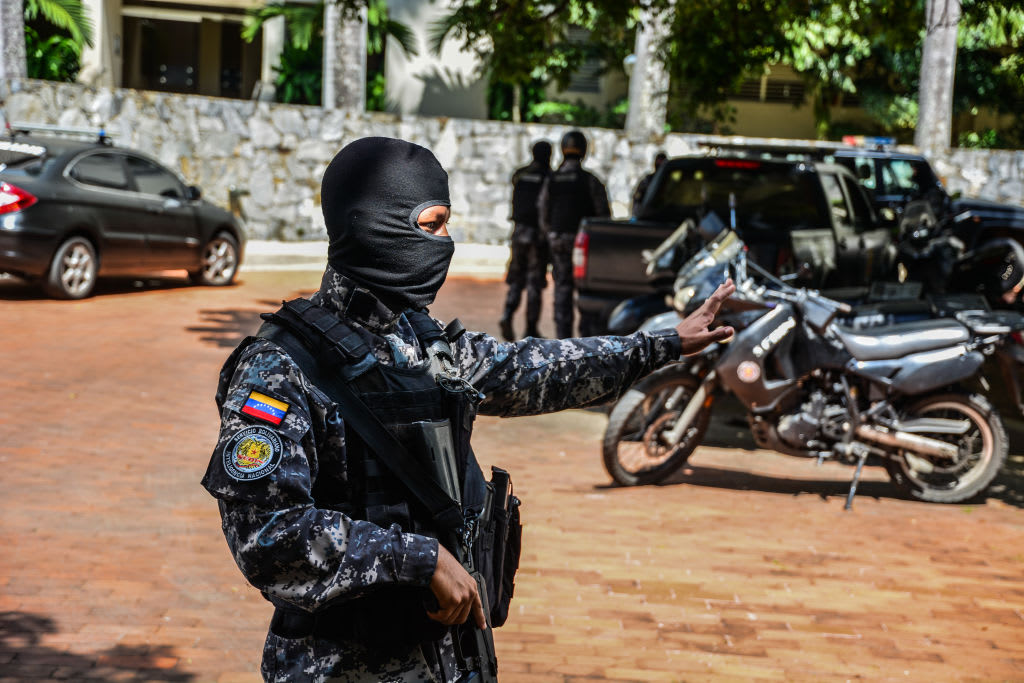
The repression of the Maduro regime over more than a decade forced eight million Venezuelans to flee, nearly a million of them to the United States.
Last year, as part of the biggest U.S. immigration crackdown in recent history, hundreds of those Venezuelans were deported to El Salvador – a country most had no connection to. President Trump, who campaigned on dismantling the Venezuelan gang known as Tren de Aragua, brokered a $4.7 million deal with El Salvador's government that allows the U.S. to send Venezuelan deportees to El Salvador's notorious Terrorism Confinement Center, or CECOT.
Two Venezuelans 60 Minutes spoke with say they were both detained in the U.S. after trying to enter the U.S. and request asylum. Luis Muñoz Pinto says he did not enter illegally, but rather entered for an appointment with Customs and Border Protection as part of the CBP One program. He was detained by Customs from that appointment and was later among those deported by the U.S. and sent to CECOT.
The Venezuelans said that once at CECOT, they were beaten, forced into cramped cells and made to perch on their knees for hours on end. They say lights were on in the cells 24/7, food and medicine were withheld and the same water they had for bathing and going to the bathroom had to be used for drinking.
"There was blood everywhere, screams, people crying, people who couldn't take it and were urinating and vomiting on themselves," said Munoz Pinto, a 27-year-old college student who spent four months in CECOT. "When you get there, you already know you're in hell. You don't need anyone else to tell you."
New research and records are backing up many of their claims.
Alien Enemies Act used to deport some Venezuelans to harsh conditions at CECOT
International observers have warned CECOT was violating the United Nations standard for minimum treatment of prisoners. Three years ago, under the Biden administration, the U.S. State Department cited "torture" and "life-threatening prison conditions" in its report on El Salvador.
The Trump administration invoked the Alien Enemies Act, a law not used since World War II, to rapidly deport some of the men, bypassing ordinary immigration proceedings.. The Trump administration says the men are terrorists and violent gang members.
Since November, 60 Minutes has made several attempts to interview key Trump administration officials on camera about CECOT. The Department of Homeland Security declined 60 Minutes' request for on camera interviews and referred all questions about CECOT to El Salvador. The government there did not respond to 60 Minutes' request.
The Trump administration has arranged more deals, some valued at millions of dollars, to offload U.S. deportees to other so-called "third countries," which are usually nations to which the migrants have no connection. Among them are war-torn South Sudan and Uganda, which have well-documented histories of torturing prisoners.
What we know about the Venezuelans sent to CECOT
Rapid deportations have been a key part of the Trump administration's immigration overhaul. The administration considers anyone who crosses the border illegally to be a criminal. Illegal border crossings have dropped to historic lows.
The White House claims the detainees sent to CECOT were the worst of the worst.
"These are heinous monsters, rapists, murderers, kidnappers, sexual assaulters, predators who have no right to be in this country and they must be held accountable," White House press secretary Karoline Leavitt said in March
60 Minutes has repeatedly asked Homeland Security for the complete records and criminal backgrounds of all 252 Venezuelan men the U.S. sent to CECOT. It would not provide them.
"We are confident in our law enforcement's intelligence, and we aren't going to share intelligence reports and undermine national security every time a gang member denies he is one. That would be insane," a Homeland Security spokesperson said this past week.
Nonprofit Human Rights Watch said in an 81-page November report, called "Welcome to Hell," that it had determined nearly half of the Venezuelans sent to CECOT had no criminal history.
The report says that only eight of the Venezuelan men "had been convicted of a violent or potentially violent offense." Human Rights Watch deputy director Juan Pappier said they cross-referenced federal arrest databases with databases in all 50 U.S. states. They also reviewed criminal records in Venezuela and other countries where the migrants had lived.
"ICE's own records say that only 3% of them had been sentenced for a violent or potentially violent crime," Pappier said.
60 Minutes reviewed the available data from Immigration and Customs Enforcement, which confirms the findings of Human Rights Watch. The ICE data is incomplete and is missing information about 26 of the 252 men. It shows 33 of the men had criminal convictions and 70 men had pending criminal charges in the U.S., which could include immigration violations. The data is anonymous, making it difficult to verify.
Neither of the two detainees 60 Minutes spoke with has been convicted of any crimes in the U.S.
Criteria behind deportations
Some immigration attorneys say the administration has used flawed criteria to deport migrants.
60 Minutes reviewed a document that ICE agents used to assess Venezuelans. A person with eight points could be designated as a Tren de Aragua gang member and deemed deportable. Venezuelans could get four points for displaying "insignia, logos, notations, drawings or dress known to indicate allegiance to TDA." Tattoos that immigration officers suspected of being gang-related earned four points.
Muñoz Pinto has tattoos. He says none of them have anything to do with any criminal groups.
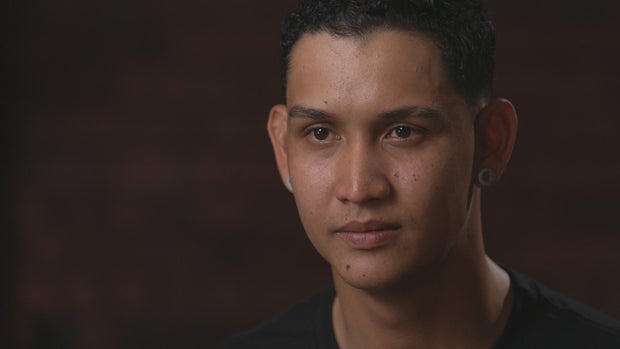
"I explained to them, saying that I didn't belong to any gang, to which the agent responded, 'but you are Venezuelan,'" Muñoz Pinto said.
Muñoz Pinto says he has no criminal record, not even a traffic ticket.
Five gang experts told 60 Minutes tattoos are not a reliable way to identify Venezuelan gang members because, unlike some Central American gangs, such as MS-13, Tren de Aragua does not use tattoos to signal membership.
What the deportees say they endured in CECOT
Muñoz Pinto is now in Colombia after he was released from CECOT in July. He and the other Venezuelan men were sent back to Caracas in exchange for 10 Americans who had been imprisoned in Venezuela.
He said his immigration struggles date back to 2024, when he was in Mexico, hoping to seek asylum in the U.S. Muñoz Pinto did not enter the U.S. illegally, he says, but had a scheduled appointment with Customs and Border Protection in the U.S.
"They just looked at me and told me I was a danger to society," Muñoz Pinto said.
He was detained from that appointment and spent nearly six months locked up in the U.S. before he was sent to CECOT with other Venezuelans.
"When we got there, the CECOT director was talking to us. The first thing he told us was that we would never see the light of day or night again," Muñoz Pinto said. "He said 'Welcome to hell. I'll make sure you never leave.'"
Deported Venezuelan national Wuilliam Lozada Sanchez said at CECOT, they were forced into stress positions, with guards watching for signs of movement, and those who couldn't endure 24-hours on their knees were taken to "the island."
"The island is a little room where there's no light, no ventilation, nothing," Lozada Sanchez said. "It's a cell for punishment where you can't see your hand in front of your face."
Guards would come in regularly to beat detainees inside the island, Lozada Sanchez said.
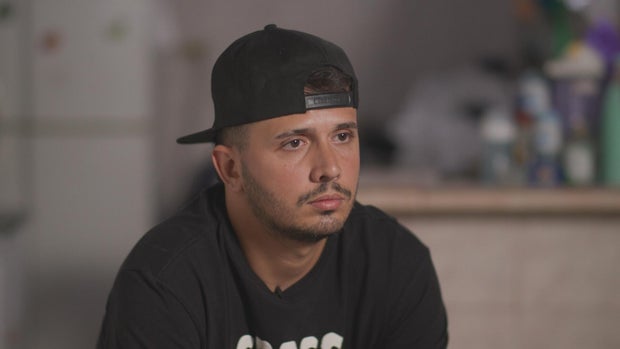
"The torture was never-ending," Muñoz Pinto said. "They would take you there and beat you for hours and leave you locked in there for days."
The Human Rights Watch report on conditions at CECOT says that three of the deportees they interviewed detailed sexual violence by the guards.
The men say they grew weaker by the day.
"The sicker and more injured we were, the better it was for them," Muñoz Pinto said.
They lived in cramped cells with metal bunks stacked four high. They say there are no mattresses or sheets. Inmates said they had no access to the outdoors and no contact with relatives during their time in CECOT.
Student research, records, influencer videos back up migrant claims
CECOT was built in 2022 as a key part of Salvadoran President Nayib Bukele's sweeping anti-gang crackdown. The massive prison, designed to hold 40,000 inmates, is a point of pride for Bukele, who regularly allows social media influencers to tour it.
Influencer videos were among the records reviewed by Human Rights Watch, which worked with students at the University of California, Berkeley's Human Rights Center to learn more about what happens inside CECOT.
"I think one of the things that the work of this team has really shown is that a lot of these stories can be believed," said Alexa Koenig, director of U.C. Berkeley's Investigations Lab, which trains students to research war crimes and human rights violations.
To help verify the deportees' stories for Human Rights Watch, the team of students combed through open source data for weeks. Students were trained in advanced techniques and to follow strict international standards for obtaining digital evidence that can be used in courts.
They analyzed satellite images, mapped the prison and identified the specific module inside CECOT in which the Venezuelans were held.
One influencer video they reviewed featured someone who toured an isolation cell, which matched the description of "the island" where detainees described being tortured.
A video show-and-tell of the armory confirmed CECOT had the weapons the Venezuelans say guards used on them. A video interview with the prison warden also proved to be helpful to the students. In it, the warden confirmed lights are on 24/7.
They also reviewed a video from U.S. Department of Homeland Security Secretary Kristi Noem's March tour of CECOT, which shows her recording the video in front of a cell full of heavily-tattooed men.
"We know that those men in her video are not Venezuelans. They are Salvadorians, probably accused of being gang leaders and probably people who have been in jail for many, many years in El Salvador," Pappier said.
Berkeley students determined that all the visible men had tattoos of either an "MS," a "13," or an "ES" for El Salvador — all tattoos associated with El Salvadoran gangs, not Venezuelan.
Details the team focused on can help bring about accountability, Koenig said.
"Whether it's the court of public opinion or at some point in a court of law," she said.
Ongoing disputes over status of deported men
In a statement to 60 Minutes, the White House said, "President Trump is committed to keeping his promises to the American people by removing dangerous criminal and terrorist illegal aliens."
Homeland Security deflected all questions about abuse allegations at CECOT, saying the men were not under U.S. jurisdiction while in El Salvador.
But last month, a federal judge ruled that the U.S. had maintained what's called "constructive custody" over the Venezuelans who were sent to CECOT under the Alien Enemies Act. The judge ordered the Trump administration to give those men the due process they were denied.
In a declaration to the court, Secretary of State Marco Rubio explained, in part, that bringing the deported Venezuelans to the U.S. for hearings or holding remote ones at this time would risk, "material damage to U.S. foreign policy interests in Venezuela."