Weddings: Navigating same-sex marriage etiquette
Two months after same-sex marriage became legal in New York in June 2011, Greg Scordato and Michael Messer were engaged. The wedding planning began shortly after that, and while the couple says it was very fun and special, it also unexpectedly spurred a "tremendous number of questions."
But thankfully they had Bernadette Coveney Smith to help them navigate their big day.
In 2004, Smith launched 14 Stories, a same-sex wedding planning firm, with offices in New York and Boston, so she was able to help answer many of their questions. She worked with Scordato and Messer over the past 18 months as they maneuvered through the wedding planning process -- from the location of the reception to picking a theme. Scordato and Messer ended up choosing a "sophisticated funhouse" concept: "vintage carnival meets Berlin cabaret meets 'Moulin Rouge.'"
An estimated 80,000 same-sex couples have said "I do" in legal marriages in the United States. And as more states legalize same-sex marriage, a rising number of couples are asking the same sort of questions that Scordato and Messer did before tying the knot.
Those questions begin as early as the proposal. When it comes popping the question, Smith says there really are no rules. "Some couples have one partner who's like, 'I really want to be proposed to. So they will typically verbalize that in that case," she said. "But keep in mind, that that typically happens when the law changes. So if a couple has been together for 20 years and all of a sudden it's legal for them to get married where they live, chances are they're going to look at each other and say, 'Hey, do you want to get married?' There's not always that typical pop-the-question great proposal story."
There are times when couples can boast two proposals to share. "A lot of times, couples will each take turns popping the question, so there will end up being two stories," Smith said.
Another thing that's not standard is the couple's entrance at the ceremony. With same-sex marriage, almost anything goes.
"In a gay wedding sometimes there are two brides. Sometimes there are no brides," said Smith. "A lot of times the decision is influenced by the space. So if there's a narrow room, or it's in a church -- where there's only room for one aisle -- or there's one aisle that exists, then we typically have the couple walk in together holding hands. It's also a metaphor for two becoming one."
Other times, the couple may enter simultaneously -- but in two different aisles. "And if they have a wedding party the wedding party is also walking simultaneously. In a big wide open space, we'll do the two aisles," Smith said.
When it comes to wedding day attire, the options really run the gamut here, too. "Gay men are going to wear what they want to wear. A lot of times it will be complementary but not matching," Smith said. "Once and awhile, they literally have the same thing on. But a lot of times it's complementary colors or similar ties," she said.
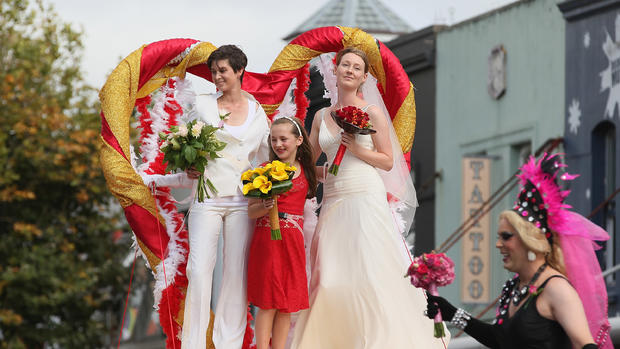
Lesbian brides, meanwhile, tend to go all out in terms of creativity -- from black cocktail dresses to saris or bright colored gowns. It's not uncommon to see both women in the standard white dress. The suit is the hard part. "Sometimes a woman is looking for a more masculine suit," she said. "Those are really hard to find."
Smith's Gay Wedding Institute, which gathers same-sex wedding data from her client-base, points out that 42 percent of lesbian brides each wear a wedding gown; 12 percent wear two suits; and 46 percent wear one dress and one suit.
Elizabeth Graves, editor-in-chief of Martha Stewart Weddings, said her team has received more queries about same-sex weddings lately. "We often field questions about how to adapt hetero traditions, such as who walks down the aisle first? Or, can we both wear white? The answer usually is, 'it's up to you,'" Graves said. "Some couples approach from the side and meet each other in the middle to marry. It's also nice to see when both parents walk a son or daughter down the aisle together arm in arm."
More traditional components are finding their way into same-sex weddings, too. Smith said, "We've done a lot of Jewish weddings, so it's easy to incorporate Jewish traditions like the breaking of the glass...Non-Jewish couples might do things like a unity ceremony with a candle -- more spiritual than religious. A lot of my clients who were raised Catholic want to hire someone who looks like a priest to marry them. They feel like the guests will perceive it as more valid."
Graves added, "We are seeing so many heartfelt same-sex celebrations. I'm always touched because it's not a right anyone is taking lightly or for granted and you can see that in the faces of the couples. It is also a sort of rally of support, which sadly many couples don't always get."
Those heartfelt ceremonies often come with a hefty price tag. According to Smith's data, 67 percent of same-sex couples pay for the weddings themselves. "It varies a lot by the age of the couple," she said. "If it's an older couple, which many same-sex couples are, they're going to be paying themselves. If it's a younger couple, then they are more likely to get help from at least one set of parents. It depends, of course, on how much their family is involved and accepting."
Statistics from the Gay Wedding Institute also show that only 16 percent of same-sex couples say they have no emotional support from parents, while a majority -- 63 percent -- have the emotional support of both sets of parents.
Another same-sex wedding trend? Smith said that she sees more and more couples registering for charities in lieu of gifts. "They'll have a custom wedding website through Human Rights Campaign or Marriage Equality USA where couples can actually go online and donate to that charity -- or they'll register at a place like NewlyWish.com, which is an alternative registry that you can register for experiences. And of course, there's people who register at Bloomingdales. But we also see more people doing honeymoon registries."
Scordato and Messer, who were married on May 4 in New York, said they never imagined that one day they'd be able to legally exchange vows; they didn't grow up dreaming about having a certain type of wedding. Which is why Smith wants to work with couples like them.
"I got into this because I felt like there was a need for someone to help same-sex couples navigate a very traditional wedding industry," Smith said. "My mission is to treat these weddings differently -- to make sure a couple never has to keep coming out of the closet every time they meet with a venue, or meet with a photographer...to make sure they don't see contracts that say 'bride and groom.'"