Wall Street braces for Election Day, with anxiety
Fear is in the air on Wall Street.
The upheaval in the U.S. presidential race over the past week -- with GOP hopeful Donald Trump pulling ahead of Democratic challenger Hillary Clinton in the latest ABC/Washington Post poll, reversing a 12-point deficit -- has many investors frantically preparing for rising odds of a Trump victory and the implementation of his aggressively nationalist trade, immigration and financial reform ideas.
The Dow Jones industrials index tested below the 18,000 level on Tuesday, risking a breakdown from a narrowing four-month trading range (chart below). Small-cap stocks in the Russell 2000 are worse off, already trading to levels not seen since July. Based on options market activity and internal market indicators, insiders expect things to get worse.
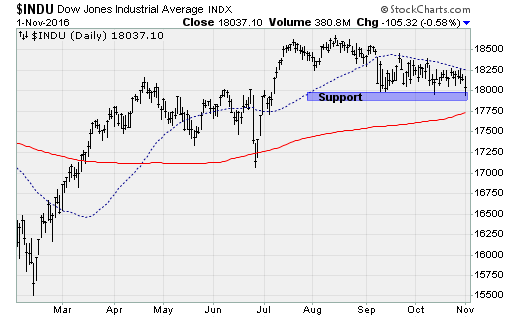
Here’s the big point: The more Trump’s odds rise and the more the market weakens in response, the more Trump’s odds will rise. The cycle is self-feeding because stock market volatility heading into Election Day has historically benefited the nonincumbent party’s candidate. Which is Trump, in this case.
Much depends on whether the real estate mogul will continue to enjoy polling momentum all the way until the final votes are cast. Technically, the market is extremely vulnerable to a breakdown here. October’s trading volume were the lightest in 40 years for a month that has had its share of excitement (1929, 1987 and 2008 market crashes). Realized volatility, or how much stocks bounced around last month, was the second-lowest since 1990.
Market breadth, or the percentage of stocks moving higher, has been declining for months, which suggests that bulls have been focusing on an ever-smaller group of stocks. That’s not exactly a sign of confidence. Just 26.7 percent of the stocks in the NYSE are above their 50-day moving averages, a measure of short-term strength. Compare that to a high of more than 70 percent in September, 82 percent in July and 90.4 percent back in April.
And yet stocks, as represented by the Dow, are still trading near levels seen in April. That’s not sustainable: Either stock prices fall to reinvigorate broad buying interest or investors chase a market “melt-up” here despite elevated valuations and an uncertain outlook for earnings and the economy.
Other dynamics in play include fresh weakness in crude oil (on OPEC’s inability to agree on a production freeze) and new U.S. dollar strength, both of which will weigh on corporate earnings. And don’t get me started on Friday’s ridiculous third-quarter GDP report which, on its face, was the best in two years. Only after factoring out one-time boosts related to soybeans (I’m serious), growth was closer to 1.4 percent -- in line with the tepid pace we’ve seen all year.
No surprise then that Wall Street pros are now piling into put option protection against further market weakness, bolstering the CBOE Volatility Index (VIX). Known as the “fear gauge,” this measure touched 20.4 in trading on Tuesday, a four-month high. An analysis by Goldman Sachs (GS) shows that the VIX typically rises in the days before Election Day.
But we’re ahead of what’s typical: Over the last six elections, the median result had the VIX at 18.