U.N. raises flag on newest nation: South Sudan
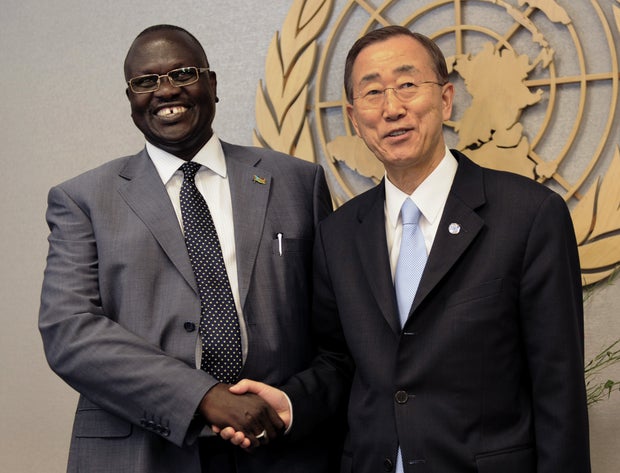
Today, the flag is being raised at U.N. Headquarters in New York for the new Republic of South Sudan.
Five days after President Obama granted U.S. recognition of South Sudan, the U.N. General Assembly voted to admit the Republic as its newest nation, the 193rd member of the world organization, after the Security Council recommended its admission.
U.S. welcomes birth of new nation, South Sudan
The U.S. -brokered agreement to divide Sudan into two nations ended two decades of costly civil war and resulted in a day of celebration in Juba, South Sudan last Saturday as it declared its independence. "After so much struggle by the people of South Sudan, the United States of America welcomes the birth of a new nation," President Obama said from Washington, as the U.S. formally granted recognition during the independence ceremony attended by U.N. Secretary General Ban Ki-moon.
But today, undermining the jubilation, as the admission vote at the U.N. welcomed South Sudan, a wave of bombings hit South Kordofan, a region located outside of its new border to the north, populated by the Nuba people, many of whom fought with south Sudanese groups during the civil war.
And a group co-founded by George Clooney, the "Enough Project," today revealed satellite imagery of mass graves in South Kordofan, which it says supports earlier reports of systematic killings and mass burials in the region within Sudan, bordering the new Republic of South Sudan.
"Enough Project" confirms evidence of mass graves
South Sudan's membership in the U.N. and its recognition by the U.S. is the formal step in the creation of the nation, but the 2005 peace agreement leaves several decisions to be made between the north and the south, including some of the borders and how oil revenue will be distributed. South Sudan is oil rich and needs the northern pipeline to transport the oil.
China, reliant on oil from the north, is actively promoting rapprochement with the north. At the U.N. Security Council meeting on Wednesday for South Sudan's membership, Wang Min, deputy permanent representative of China's Mission to the U.N. called on the international community to normalize relations with Sudan at the same time that Beijing also recognized the new government of South Sudan and supported the Council's recommendation to grant it membership in the U.N.
South Sudan's independence will be difficult for the U.N. to protect. Although the new peacekeeping mission in South Sudan is authorized by the Council with a stronger mandate (under Chapter 7, meaning peacekeepers can use force when civilians are threatened) than the previous mission, with 7,000 soldiers, it may not be authorized to intervene in South Kordofan because the government of President Omar al-Bashir requested the withdrawal of the 10,400 peacekeepers as part of the peace agreement. The U.N. voted earlier this week to end the earlier mission.
"The United States is sending a clear message along with other Council members that it wants the United Nations to remain in the two areas, especially at this critical juncture," President Obama's U.N. Ambassador Susan Rice said.
Nonetheless, the new Republic of South Sudan is now a U.N. member and the hard-fought division is formal between the predominantly Arab Muslim north and the African Christian south. Keeping the north at bay will be part of the challenge.