Trump says U.S. prices are "coming down tremendously." Here's what the data shows.
President Trump delivered a message Tuesday evening aimed at the millions of Americans struggling to afford daily necessities, saying his administration is "crushing" inflation and that "prices are coming down tremendously." Economic data tells a different story.
Prices have edged higher for much of Mr. Trump's first year back in the White House, with inflation in September rising at an annual rate of 3% (the most recent available inflation data because of the recent U.S. government shutdown).
Inflation dipped to a low this year of 2.3% in April, but it has steadily ticked up since then and now stands at the same rate as in January, when Mr. Trump was inaugurated, federal data shows. Economists attribute the rise partly to the Trump administration's new tariffs on imports, with Federal Reserve Chair Jerome Powell pointing to those levies as a key factor behind the recent uptick.
Inflation now "is higher than earlier in the year as inflation for goods has picked up, reflecting the impact of tariffs," Powell said at a press conference on Wednesday to discuss the central bank's latest interest rate cut.
Some Wall Street analysts think prices are likely to continue creeping up for a while. Mark Vickery, senior market analyst at Zacks Investment Research, estimates that the Consumer Price Index rose at an annual rate of around 3.3% in November.
To be sure, many economists, as well as the Fed, expect any additional pickup in inflation to be short-lived before easing in 2026. Powell on Wednesday said the tariff effect will likely create a one-time rise in prices that should fade over the coming year. The Fed expects inflation to recede to 2.4% next year, down from about 2.9% in 2025.
From a longer-term perspective, inflation has indeed fallen sharply since hitting a 40-year high of about 9% in June 2022 in the aftermath of the pandemic. For shoppers, however, a lower inflation rate doesn't mean prices are declining — only that they're rising at a slower pace.
Consumers tend not to view pocketbook issues through the lens of official inflation measures, a somewhat abstract metric that tracks price fluctuations over time, experts have long noted. Instead, many shoppers focus on their actual dollars-and-cents spending, including whether their out-of-pocket expenses are higher than they were in the past, according to research from the University of Florida.
By that yardstick, Americans are spending more on everyday basics than they were a year ago, and far more than they did just before the pandemic, CPI data shows.
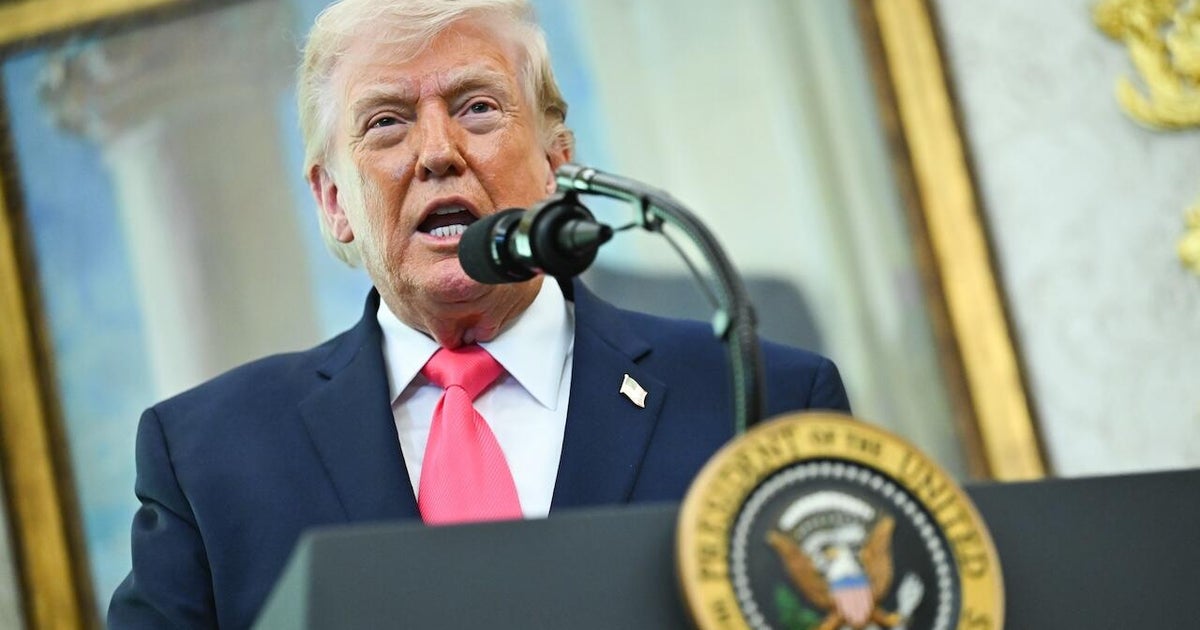
Mr. Trump's remarks, made Tuesday in Mount Pocono, Pa., came as his administration touts the president's economic policies ahead of next year's midterm elections.
"I have no higher priority than making America affordable," Mr. Trump said in the speech.
Prior to the speech, Mr. Trump had decried affordability as a "hoax" perpetuated by Democrats, although some Republicans, including Rep. Marjorie Taylor Greene, have differed with him on the issue. Greene told CBS News that she doesn't believe affordability is a hoax, adding, "Everyone's bills have either stayed the same or gone up."
"You can't gaslight people and tell them that their bills are affordable," Greene said.
White House spokesman Kush Desai expressed confidence that Mr. Trump's agenda will cool inflation and boost worker wages.
"President Trump inherited the worst inflation crisis in a generation from Joe Biden's incompetence, and his Administration has rapidly cooled inflation to a 2.5% annualized rate," Desai said in a statement to CBS News. "As the administration's supply-side policies of tax cuts, deregulation and energy abundance continue taking effect, Americans can count on inflation continuing to fall and real wages continuing to rise."
Food
Americans paid 2.7% more for food bought at the grocery store in September than they did a year earlier, according to the most recent CPI figures. That may not seem like much, but their grocery bills have climbed roughly 49% since 2020.
- See the CBS News price tracker showing changes in the price of food, gas, utilities and other costs
Some food costs are also rising much faster than the rate of inflation, with beef steaks surging almost 17% from a year ago, according to the CPI data. Earlier this month, the Trump administration sought to lower some grocery prices by exempting foods like beef, coffee and bananas from new country-specific tariffs.
Shoppers on Tuesday told CBS News' Nancy Cordes that they are making tradeoffs and scrimping to afford groceries.
"The cost of beef is astronomical. I will mainly get what's on sale," Anne Marie Hadley, a retired special education teacher who was shopping Tuesday at Schiel's Family Market, a family-owned grocery store in Scranton, Pa., told Cordes.
Housing
While mortgage rates have dropped this year, housing remains out of reach for most would-be buyers. More than 75% of homes across the country are unaffordable for the typical household, Bankrate said in a report this week.
A homebuyer today needs to earn $131,400 a year to afford a typical home in the U.S. — almost double the roughly $65,000 needed five years ago, according to the Federal Reserve Bank of Atlanta.
Almost three-quarters of Americans said housing has grown more unaffordable in their communities in recent years, according to an October poll from YouGov and the University of Florida Center for Public Interest Communications.
Gas
One area where consumers are getting a break is at the pump, with gasoline prices down from a year earlier. Gas declined 0.5% in September from a year earlier, CPI data shows. And earlier this month, gas dropped below $3 a gallon on average, marking the lowest price since May 2021.
"It was just reported that four states had $1.99 a gallon," Mr. Trump said on Tuesday. "We are right now involved in more energy, and have more energy in the works by far than we've ever had before."
The decline is due to strong refinery output and lower crude oil prices, as well as to softer seasonal fuel demand, GasBuddy has said.
Yet while fuel prices have dropped, other energy costs have increased. Residential electricity prices around the U.S. rose more than 10% over the first eight months of 2025, according to the National Energy Assistance Directors Association, an educational and policy organization. By comparison, power costs rose roughly 6% over the trailing 12 months.
As of June, nearly one in 20 U.S. households was seriously behind on their utility bills, according to a report from The Century Foundation, a nonpartisan think tank, and advocacy group Protect Borrowers. Over the last three years, the average overdue balance on utility bills climbed from $597 to $789, a 32% jump, the groups found.
— With reporting by CBS News' Nancy Cordes.