The Pulse nightclub survivor who can't vote but wants you to
“I know what you feel when you are going to die,” says Javier Nava, as his pupils drift to the edges of his eye sockets. “That feeling, that night, changed me.”
Nava, a 33-year-old Mexican-born restaurant worker, is reflecting on the Pulse Nightclub shooting in Orlando, Florida. He was a victim of the attack.
A bullet is still lodged deep inside Nava’s abdomen. He was in the hospital for almost a week, then a wheelchair for almost a month, and unable to sit for a long periods of time without feeling a jarring pain inside of him.
But he is getting better. He can sit without pain now and he hopes to train for a 5K in the coming months. Still, memories of that night, when four of the eight people he was with were murdered, often fill his thoughts. When he needs to cry, he does. He also visits a therapist regularly.
Yet Nava is not only focused on his own recovery. He has resolved to contribute to something grander than himself and get involved in politics.
“Our minds changed, for good. Not for bad. That is how Pulse changed our lives,” Nava says of himself and his Cuban-American husband, Adrian Lopez.
“People tell me, ‘you are here for a reason.’ And a few months ago, I pass someone crying in the street, now I want to be a part of it,” Nava says.
There is a holdup: Nava cannot vote. He came to the US illegally in 2004 to work for a friend’s construction company. He is currently moving through the process to become a US citizen, as he recently married a Cuban-American. Before the Pulse shooting, Nava wanted to gain legal status because he did not want to live in constant fear of being deported. But mostly he just wanted to keep on doing his work and living his Orlando life
Since the shooting, however, Nava is adamant: he wants to gain citizenship so that he can vote. He wants to change the status quo. Even when he is cutting limes for margaritas at the Mexican restaurant where he works, he is thinking about social change. He engages in political discussions with his customers -- something he never envisioned himself doing.
He is now a proponent of gun control. He does not think that anyone should be able to buy a gun. But his political thinking goes beyond that. Nava says that the Pulse shooting has led him to have conversations with all kinds of people. His eyes are now open to a wide range of issues that Americans face on a daily basis, including domestic violence.
“Everyday I am learning something. I feel good about that,” Nava says about digging into the issues. He has now met with Hillary Clinton, Gabby Giffords and taken photos with Rep. Patrick Murphy, who is challenging Sen. Marco Rubio in Tuesday’s election.
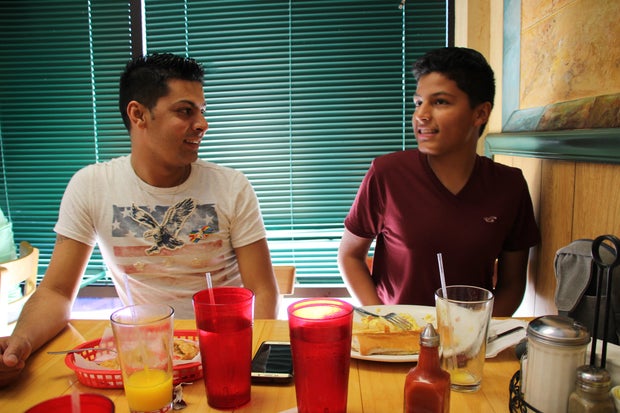
Over an empanada breakfast with his son in Orlando, Nava describes his energy since the Pulse shooting. Adjusting the rainbow pin that he wears, as a memory of the attack, he says that he has inspired people to get involved in the community.
Some people randomly hug him when they see him with the pin on. As he speaks, an image of Trump speaking at a rally in Tampa, just a few hours away, lights up the TV screen above his head. He glances up briefly. But does not care to talk about the candidate. Nava believes his time is more usefully spent by talking to others, encouraging them to vote. He busily texts his friends, telling them to vote. He will also be driving a friend to the polls on Tuesday because she doesn’t have a car.
“I cannot vote but I make sure the people around me are reminded that they can vote,” Nava says. “In that way I feel like I’m voting. I can’t – but I do through them.” He was offended when his husband went to cast his vote early and forgot to tell him. He considers that vote to be “their” vote.
Over the last few weeks he constantly reminded them that they could vote early, where they could vote, and that this was the most important elections of their lifetime. Though he is a Clinton supporter, Nava has not been formally volunteering for the campaign. He is doing it the old-fashioned way: talking to people anywhere he can.
“There are some bad moments. But when I have those moments I think of my friends. I am here, they are not,” he says. “That is why I am doing what I am doing.”