The 2 investor fears weighing on stocks
Stocks closed below recent support levels on Friday as bailout negotiations between Greece and the European establishment look set to go right down to the wire at the end of June.
A better-than-expected headline producer price inflation reading, along with a strong retail sales report earlier in the week and a solid May payroll report, also increases the odds of a hawkish takeaway from the Federal Reserve's policy announcement, press conference and updated economic projections on Wednesday.
By falling below the 18,000 and the 2,100 levels, respectively, the Dow Jones industrial average and S&P 500 fell below thresholds that were first touched back in December.
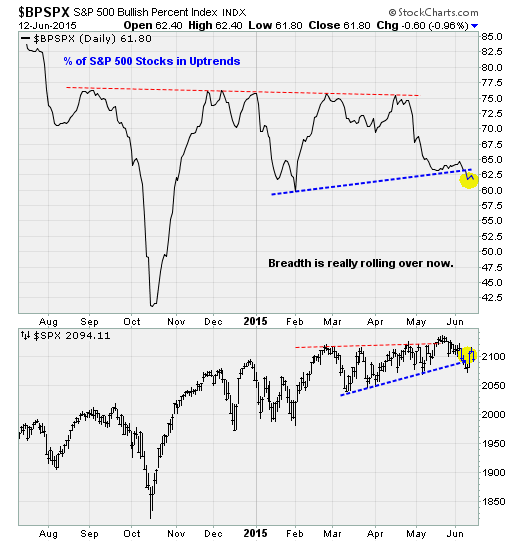
Technically, market breadth keeps rolling over as fewer and fewer stocks hold the major indices aloft -- a sign of growing vulnerability as investors remain indecisive as two major catalysts loom.
First, let's talk Greece, that little country on the Aegean sea that's captivated global markets for years.
Late last week, global markets went from believing a new bailout deal for Greece was imminent (on reports Germany was willing to accept a piecemeal deal) to fearing outright default (after talks in Brussels broke down on Thursday night).
Athens is running short of cash as it requests local government transfer all available cash to the central bank. While a $1.8 billion payment to the International Monetary Fund at the end of the month is the center of focus the chatter is that the first sign of stress will be missed payments to workers and pensioners which could come at any time.
Reuters is reporting that European officials have held their first formal talks on the possibility of a Greek default. The upcoming meeting of Eurogroup finance ministers in Luxembourg on June 18 is seen as the last best chance of securing an agreement to release funds to Athens in order to make the June 30 payment deadline.
Both sides appear to be hardening their positions, with German politicians rallying behind their hard-line finance minister while Greek Prime Minister Alexis Tsipras proclaimed optimism at an open-air concert as anti-bailout protestors once again take to the streets. On Thursday, European Commission President Jean-Claude Junker invited Tsipras into a meeting room he described as the "torture room."
Alberto Gallo at RBS believes the odds still favor a last minute compromise by Tsipras, who's been watching his approval rating drop as Greeks clamor for a deal. There are wrinkles, such as whether compromise would result in the loss of support of the hard-left members of his coalition government.
Societe Generale is looking for discussions to continue to the very last minute with a deal possible at the EU Summit on June 25 and 26.
The bigger news this week will be the outcome of the Fed's two-day policy meeting on June 17.
As noted by economists at IHS Global Insight, this will be the first policy meeting since 2006 in which the Federal Open Market Committee members will actively consider raising interest rates. A surprise June rate hike isn't entirely off the table, but is seen as unlikely with a September liftoff widely expected.
Michael Hanson at Bank of America Merrill Lynch told clients in a research note Friday that the updated "dot plot" of Fed interest rates expectations should still pencil in two rate hikes this year and four in 2016 -- suggesting rate moves in September and again in December.
The team at Societe Generale disagrees and is looking for the dot plot to be downwardly revised -- as it was in March, spurring a market rally -- to show only one rate hike this year and four next year. This will be driven by a downward revision to their full-year 2015 GDP growth estimate to a range of 2.0 percent to 2.2 percent from 2.3 percent to 2.7 percent at the March meeting.
Still, the potential remains for a negative market response. The Fed's dot plot reflects a much more aggressive path of interest rates than futures traders are pricing in. That suggests the assumption that the Fed's cheap money stimulus will go on and on is misplaced, setting the stage for disappointment.
This seems to be the message of the steady withdrawal of buying demand from the stock market as represented by the breadth pullback highlighted above.