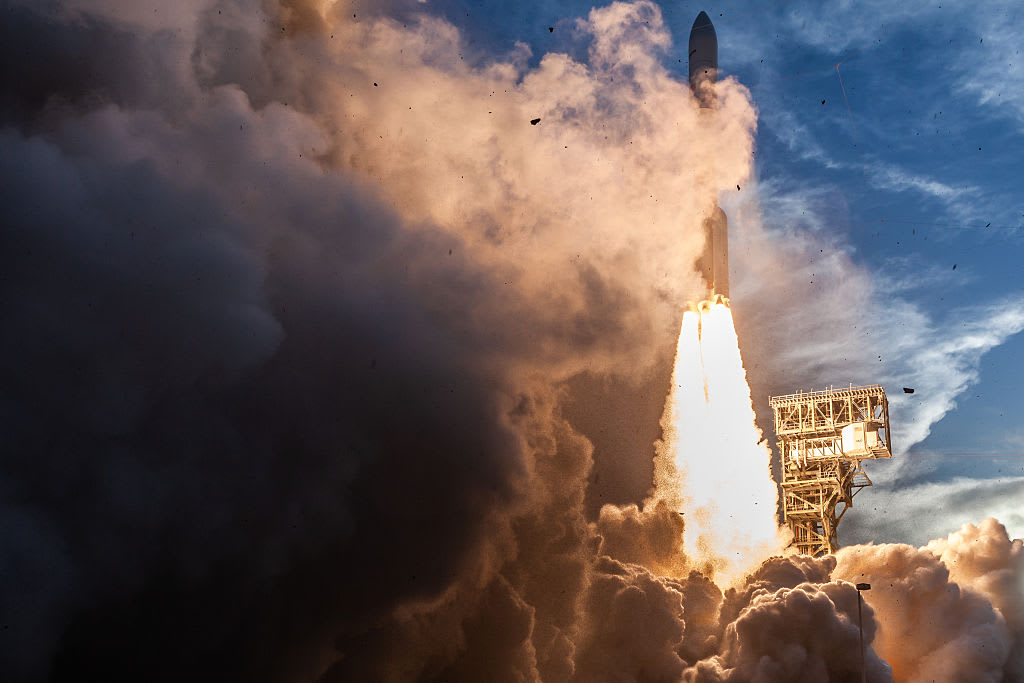
Spacewalkers begin final phase of multi-year space station power system upgrade
Two astronauts stepped outside the International Space Station Thursday for the first of two spacewalks, one week apart, to install a final pair of roll-out solar blankets that will complete a complex, years-long upgrade of the lab's aging power system.
Running well ahead of schedule, NASA's Anil Menon and Canadian Space Agency astronaut Joshua Kutryk installed the first set of ISS roll-out solar arrays, or IROSAs, on the left side of the lab's power truss as planned.
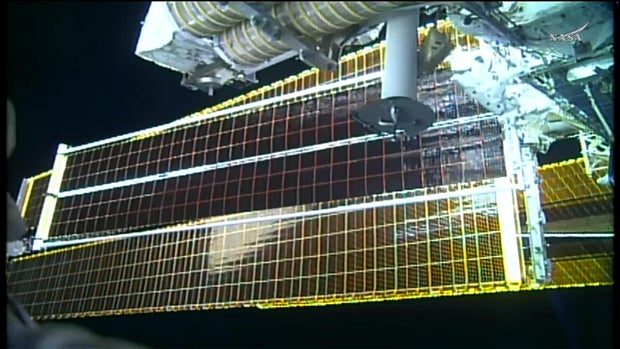
As a safety precaution, they waited until the station was in orbital darkness, with no sunlight generating any power, before connecting cables tying the new IROSA into the lab's power circuits.
Four hours and 23 minutes after the spacewalk began, as the space station moved back into orbital daylight, Menon used a power tool to unbolt a final restraint, and the IROSA slowly unrolled, stretching out to its full length of 60 feet in about 10 minutes.
"Engineers and electrical officers here in mission control are happy with what they're seeing from the new array, which will add eight kilowatts to the overall power capability of the complex," said NASA commentator Rob Navias.
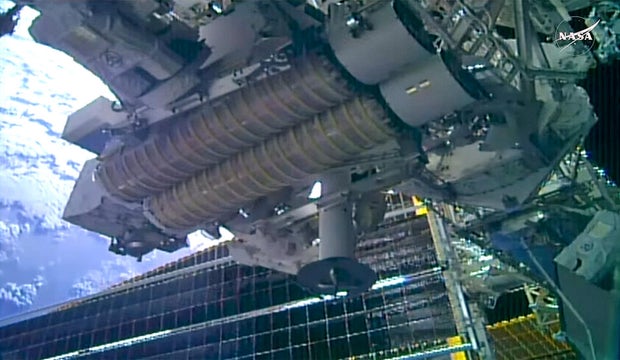
With the seventh IROSA successfully installed, Menon and Kutryk carried out a few "get-ahead" tasks, preparing the final IROSA for installation next week, and returned to the Quest airlock, bringing the seven-hour 11-minute spacewalk to an end at 3:08 p.m. EDT.
"Well, being outside, I can say that it is always sunny in space, except for a few orbits, and quite incredible what we've been able to do to provide new solar arrays to space station," Menon said from the airlock. "In fact, we've been powering our efforts in space and doing complex operations like this for over 26 years."
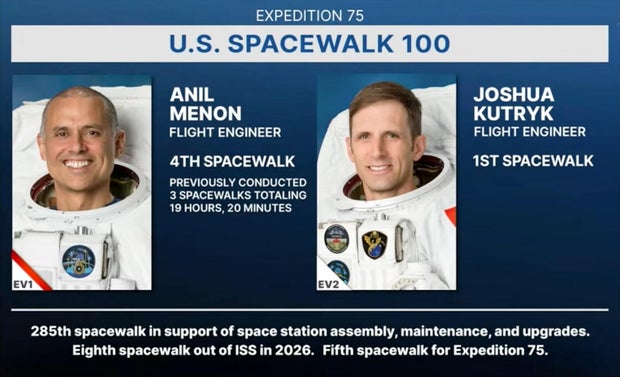
It was the fourth spacewalk for Menon but the first for Kutryk.
"We knew you're going to absolutely crush it," Menon said to his partner. "Everyone had those high expectations for you, and you absolutely delivered."
The new IROSA and the final unit that will be installed during a spacewalk next Thursday will complete an upgrade that began in 2021 when the first of eight ISS roll-out solar arrays was installed at the base of an existing solar wing.
The IROSAs are needed to offset age-related degradation that has reduced the power output of the station's original arrays. The new panels are smaller, but they are more efficient, featuring state-of-the-art solar cells.
Before the first IROSA was installed, the original arrays were generating about 152 kilowatts of power. The six IROSAs installed to date have boosted that up to about 200 kilowatts. With the final two sets, some 215 kilowatts of power will be available to sustain the lab through its planned retirement and de-orbiting in 2030, supporting life support systems, research and visiting vehicles.
The final two IROSA's were delivered to the station aboard a SpaceX Cargo Dragon capsule earlier this month with each one folded in half and stowed in the ship's unpressurized trunk section.
The station's robot arm, operated remotely by flight controllers at the Johnson Space Center in Houston, pulled the IROSAs out of the Dragon and stowed them on the left side of the lab's power truss to await installation.
Floating in the station's Quest airlock, Menon and Kutryk switched their suits to battery power at 7:57 a.m. to officially kick off the 285th spacewalk since station assembly began in 1998. The spacewalk began in orbital darkness, prompting Kutryk to observe, "the night is dark and full of wonders."
Menon and Kutryk unbolted the first of the two stowed IROSAs from its carrier so Menon, anchored to the end of the station's 58-foot-long robot arm, could carry it over to its mounting point farther outboard along the power truss.
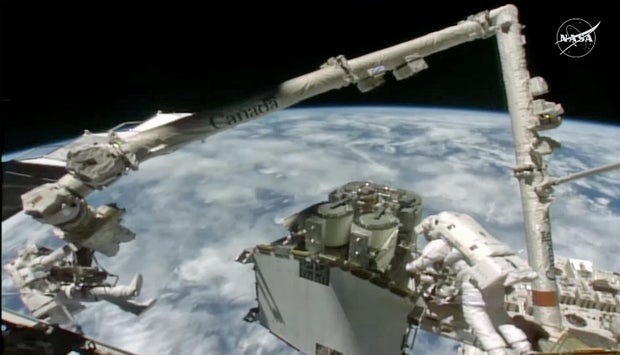
"They are around 750 pounds in that folded configuration, they're about 10 feet long, and so it's a lot to handle," said Garrett Hehn, a spacewalk flight director.
He said flight controllers developed "a pretty elegant series of maneuvers" to move Menon and the IROSA on the robot arm "where we've tried to rotate around the actual center mass of the arrays rather than the crew member. It was a lesson learned from previous EVAs of how we could make it a little less tiring on Anil when he's got to hold that array in his hands."
All of that went well, and the seventh IROSA, still folded in half, was installed on a previously assembled support fixture at the base of one of the station's left-side inboard solar wings. The two halves then were unfolded and bolted together.
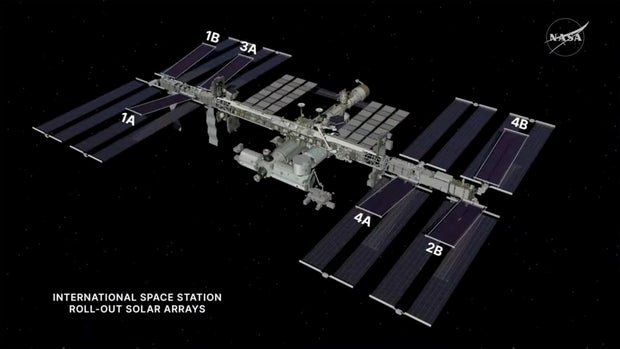
Working when the station is on Earth's night side and the arrays weren't generating any power, the spacewalkers connected four electrical cables tying the IROSA into power channel 2A. Once that work was completed, the array was unrolled.
The IROSAs deploy somewhat like a tape measure winding home, with "stored energy" built in that lets the blankets unroll without motors or other drive mechanisms.
"These arrays, I kind of think of them like a snap bracelet, if you remember that time," Hehn said. "They basically have a series of magnets up the side where they deploy with enough energy that it just continues rolling out steadily. That process will take about 10 minutes."
Menon and Kutryk plan to float back outside Nov. 5 to install the final IROSA on a solar wing at the far right end of the power truss. The robot arm does not have the reach to carry Menon and the new blankets to the far end of the truss, so he and Kutryk will hand it off to each other leap frog fashion to get it all the way to the waiting support frame.
From there, installation and deployment will mirror the work done Thursday.
"ISS is building towards future exploration missions in deep space and beyond," Kutryk said after re-entering the station's airlock. "That's why we're doing this. And so today was a step forward for the future of the space station. But it's also another step of many towards the EVAs that teams will hopefully be doing on the surface of the moon."