Raul Castro Focuses on Flagging Economy in Speech
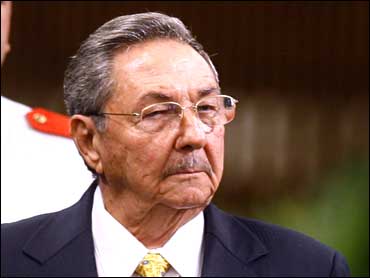
Lacing his remarks with criticism of U.S. and European Union policy toward Cuba as well as attacking the foreign press for its "distorted and ill intentioned" coverage of recent events on the island, President Raul Castro addressed the closing session of a communist youth congress Sunday.
Castro decried what he called "one of the most vicious and best managed media campaigns" against Cuba in the last 50 years and vowed not to cede to international pressure to force change in the country's human rights policy.
The U.S. and the EU, he charged, are trying to blackmail his government by supporting recent opposition hunger strikes.
"While hypocritically raising the human rights flag, they are manipulating, cynically and without shame, the death of a person who was in prison for fourteen common crimes," Castro railed.
In late February, Orlando Zapata Tamayo, to whom Castro referred, died after a lengthy hunger strike. Now an independent dissident journalist, Guillermo Farinas, is fasting to demand the release of nearly two dozen prisoners. Farinas, however, in the intensive care unit of a local hospital is allowing himself to be fed intravenously, as well as to receive antibiotics against any possible infection provoked by his hunger strike.
Licete Zamora, a spokeswoman for Farinas, told CBS News by telephone Sunday that doctors were treating him for his diabetes.
Castro denounced that the strike was encouraged and supported by forces in the United States and Europe.
The main thrust of the Cuban leader's speech however - and probably the part of most interest domestically - was the island's economic crisis and the need to get the economy moving if there is to be any hope for the survival of the Revolution led to victory by his older brother Fidel in 1959.
"Today, more than ever before, the economic battle is the main task and the focus of the ideological work of the cadres, because it is on this work that the sustainability and the preservation of our social system rest," Castro told the gathering.
The speech was carried live on Cuban television at 6:30 p.m. local time and calls made to gather reactions reveal that the viewing audience at that time was not massive.
But the issues Castro talked about are ones that are being raised constantly by people trying to make ends meet on inadequate salaries and in the face of shortages of all types.
"Without a sound and dynamic economy and without the removal of superfluous expenses and waste, it will neither be possible to improve the living standard of the population nor to preserve and improve the high levels of education and health care ensured to every citizen free of charge," Castro warned.
Efforts to reduce government food subsidies for consumers last year were highly unpopular. Potatoes and dried peas were removed from the ration system that provides cheap but limited food items to every household and their prices went up accordingly. The threat to totally end price controls on other food items drew an outcry from the population and the government refrained from moving ahead with the plan.
Castro further noted that, "Without an efficient and robust agriculture that we can develop with the resources available to us - avoiding the dream of the large allocations of the past - we can't expect to sustain and rise the amount of food provided to the population, that largely depends on the import of products that can be grown in Cuba."
He offered the example of the millions of dollars spent to import beans which could have been grown on the island.
The crux of the matter, Castro said, is "If the people do not feel the need to work for a living because they are covered by extremely paternalistic and irrational state regulations, we will never be able to stimulate love for work or resolve the chronic lack of construction, farming and industrial workers; teachers, police agents and other indispensable trades that have steadily been disappearing."
Although not detailed by Castro Sunday, the economy faces a chronic problem in the amount of petty theft by workers who steal everything from food to stationary from their jobs because they can not get by on their earnings. Absenteeism is another persistent issue. Government efforts to crack down on a thriving black market have made some headway but cannot be considered a success as witnessed by the number of people knocking on doors offering to sell everything from lobster to electric appliances at "prices you can't refuse".
In Sunday's speech Castro did place emphasis on the issue of inflated payrolls.
"If we keep the inflated payrolls in nearly every sector of national life and pay salaries that fail to correspond with the result of work, thus raising the amount of money in circulation, we cannot expect the prices to cease climbing constantly or prevent the deterioration of the people's purchasing power," he said. "We know that the budgeted and entrepreneurial sectors have hundreds of thousands of workers in excess; some analysts estimate that the surplus of people in work positions exceeds one million. This is an extremely sensitive issue that we should confront firmly and with political common sense."
Felix, a 60-plus retired teacher, doesn't disagree with Castro but asks what will be done with the excess workers, most of whom form part of the management bureaucracy.
"They're not going to want to go to work in the fields or in construction," he said. "They have an education; they studied so as to have white collar jobs." Castro acknowledged this in his speech referring to people who constantly turn down the jobs being offered to them.
But most of all, Felix asked if this speech was just more empty words or if the government was really going to do something about the critical situation.
While Castro said he was convinced of the "need to break away from dogma" and to continue "upgrading" the Cuban economic model, he warned against expecting too much too soon.
Acknowledging the dissatisfaction of people with the speed of reforms, he said, "I know that some comrades sometimes get impatient and wish for immediate changes in many areas."
But, Castro added, "We understand such concerns that, generally, stem from ignorance of the magnitude of the work ahead of us, of its depth and of the complexity of the interrelations between the different elements that make society work and that shall be modified."
Castro urged those who want change to come faster to consider the danger that the hasty solution of one problem could bring about yet greater problems.
The Cuban president said the complexity of the situation and the need to take a comprehensive approach were also the reason that the much anticipated Communist Party Congress has been postponed for another few months. There has been speculation among foreign diplomats in Havana that the meeting has been postponed because of disagreements at the highest ruling level over potential economic reforms and the impact they would have on the system set in place by the Castro brothers more than 50 years ago.