Lottery jackpots are getting bigger and harder to win. See the data on Powerball and Mega Millions' top prizes.

Lottery jackpots have exploded in size over the last decade.
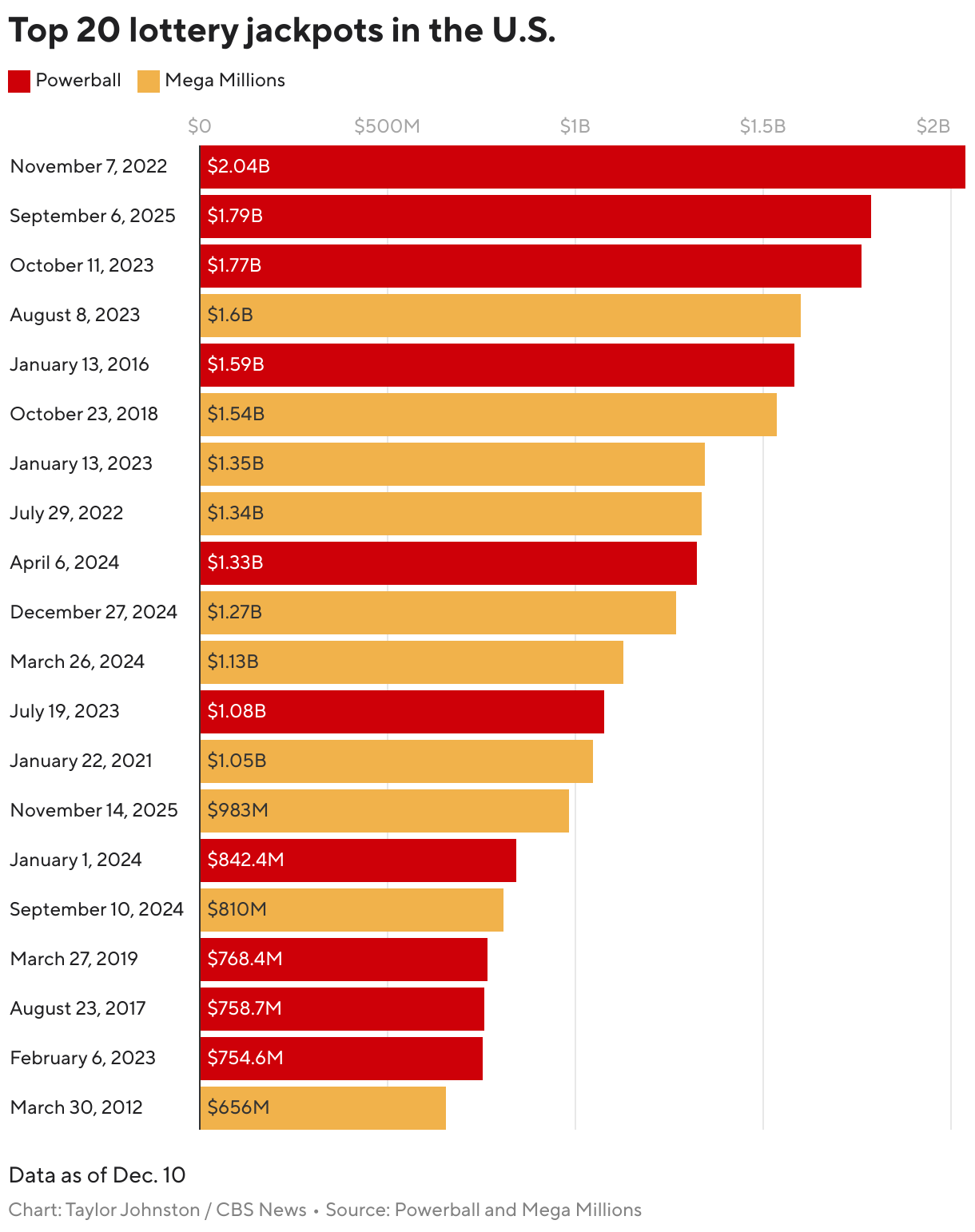
When Powerball launched in 1992, the first jackpot was $5.9 million, according to the Multi-State Lottery Association. Now, the largest Powerball jackpot on record is the $2.04 billion prize won on Nov. 7, 2022.
Mega Millions followed a similar path. Its first jackpot winner in 2002 took home $28 million. Its record prize — a $1.602 billion jackpot won on Aug. 8, 2023 — ranks as the fifth-largest jackpot won in U.S. lottery history.
Thirteen of the 20 largest jackpots have occurred since 2023.
The bigest one this year, Christmas Eve's $1.817 billion Powerball jackpot, is now the second-largest U.S. jackpot ever won.
Here are the biggest U.S. jackpot wins before that:
Only five states don't sell lottery tickets: Alabama, Alaska, Hawaii, Nevada and Utah.
While the prizes are huge, the odds of winning still remain extremely low. Over the last three decades, both games have been redesigned multiple times. Changes have pushed jackpots higher while also adding more ways for players to win smaller prizes.
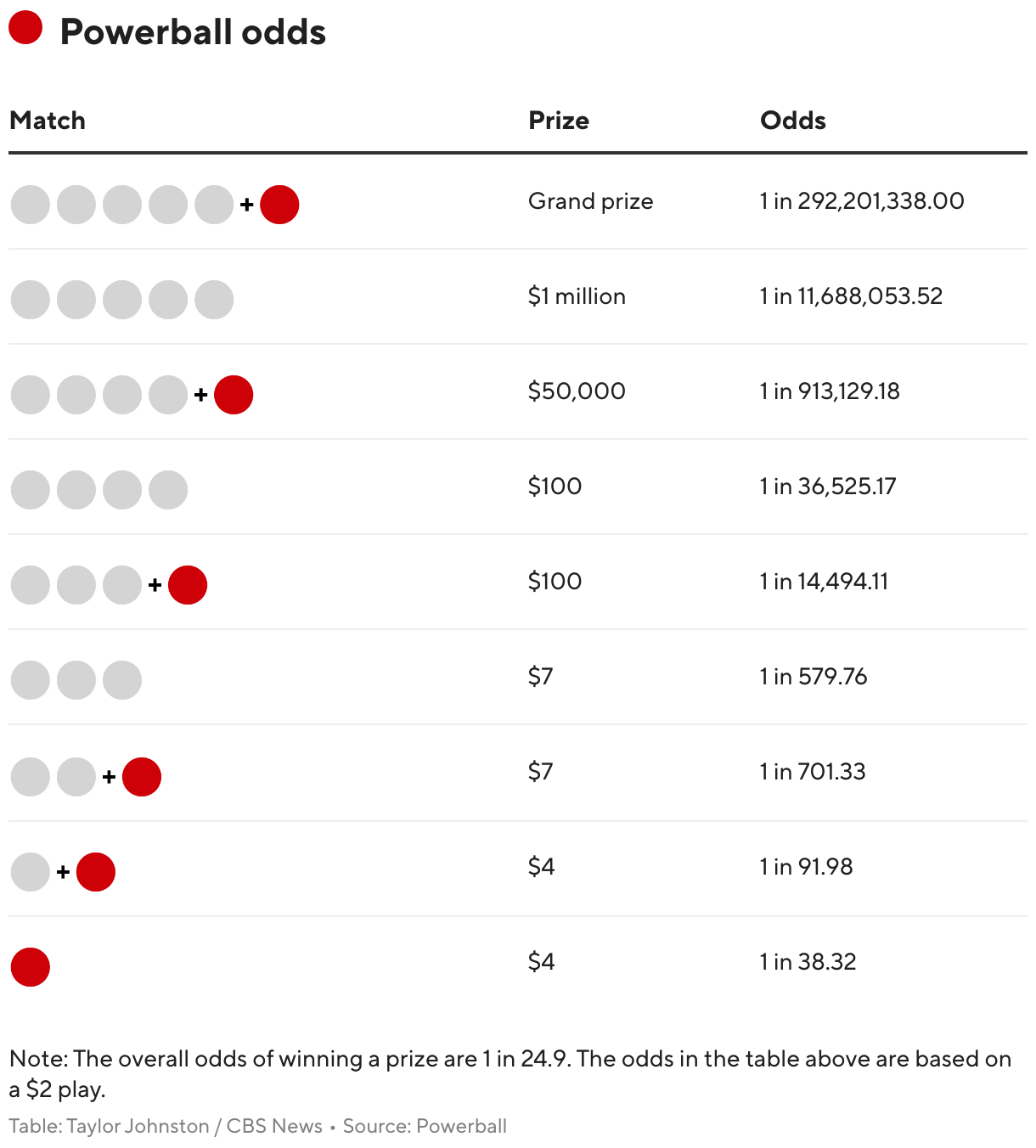
Powerball players choose five numbers from 1 to 69 and one Powerball number from 1 to 26. In 2015, Powerball increased its number of white balls from 59 to 69 and its number of red balls decreased from 35 to 26.
Before the change, the odds of winning the jackpot were 1 in 175.2 million and the overall odds of winning any prize were 1 in 31.85. After the redesign, the jackpot odds became steeper, 1 in 292.2 million, while the overall odds of winning a prize improved to 1 in 24.9, according to the Multi-State Lottery Association.
Mega Millions requires players to pick five different numbers from one to 70 and one Mega Ball number from one to 24. A ticket wins the jackpot by matching all six numbers in a drawing.
In 2025, Mega Millions changed its games to a larger starting jackpot ($50 million vs. $20 million), which "improved odds to win the jackpot and improved overall odds," according to Dan Miller, a spokesperson for Mega Millions.
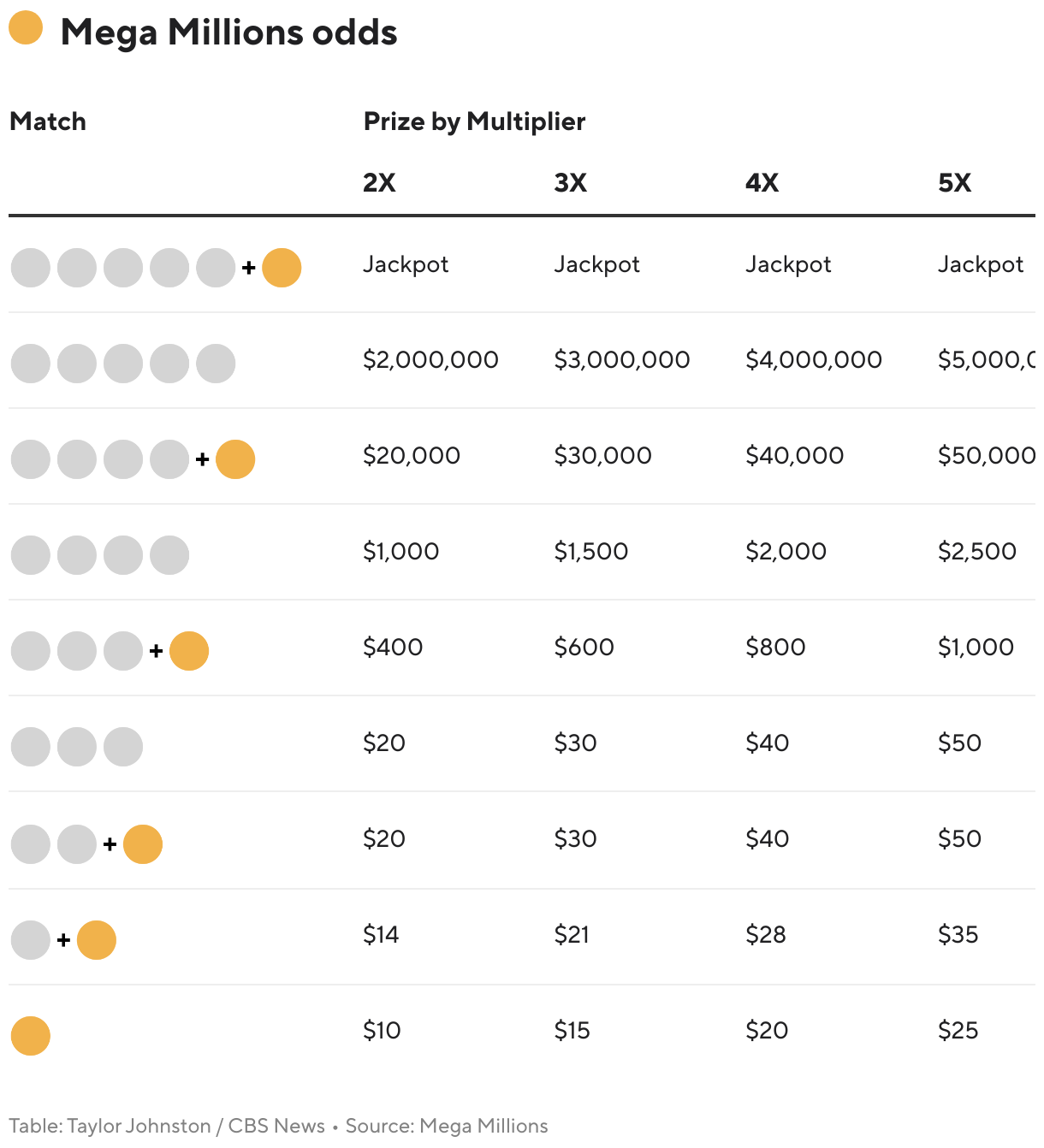
"Everyone who wins is winning more because of the embedded multiplier in the new game that takes all non-jackpot prizes and multiplies them by 2X, 3X, 4X, 5X or 10X," Miller said in an email. Through Friday, Dec. 5, he said, "there have been 70 drawings in the new game. In that time, players have won $531 million in non-jackpot prizes. In the old game, those same prizes would have been valued at $119.8 million. That's a 343% increase in player winnings."
For example, under the old rules, matching just the Mega Ball was a break-even outcome: a $2 ticket earned a $2 prize. Under the new game, that same match now comes with a built-in multiplier. The minimum prize is $5, which is then multiplied — meaning a player can now win $10, $15, $20, $25 or even $50 instead of just $2.
The odds to win the jackpot improved from 1 in 302.6 million to 1 in 290.5 million. This is because of Mega Millions removing the one gold Mega Ball from the game, Miller said.
The new game has 24 Mega Balls instead of 25, which improves the odds of picking the right combinations of numbers to win the jackpot. The overall odds to win any prize went from 1 in 24 to 1 in 23.
There's more money in play as well: Powerball increased the price of a ticket from $1 to $2 in 2012. Mega Millions increased its ticket prices from $1 to $2 in 2017 and from $2 to $5 in April of this year.