"Pinched: How the Great Recession Has Narrowed Our Futures and What We Can Do About It" by Don Peck
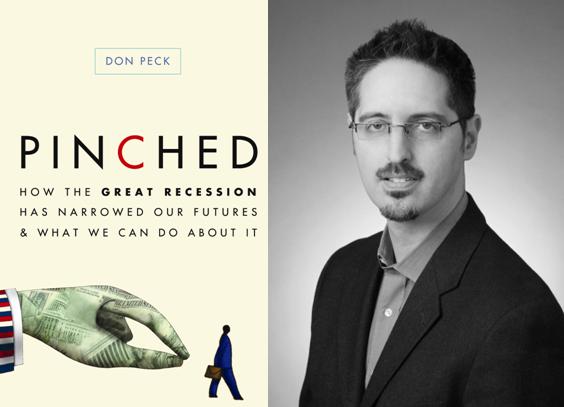
Jeff Glor talks to Don Peck about "Pinched: How the Great Recession Has Narrowed Our Futures and What We Can Do About It"
Jeff Glor: What inspired you to write the book?
Don Peck: In 2009, as I was talking to labor economists, economic historians, and students of major financial crises about what had just happened, almost all of them were saying that recovery was likely to be very, very slow. And when I started reading histories of extended hard times -- the Depression, but also the 1970s and the 1890s -- I began to see the many, many ways (some of them quite surprising) in which society can change as tough times linger beyond a few years. It also struck me how periods like this one leave legacies that often last for decades -- changing the character of generations, the size and structure of families, the paths of different cities and communities, and so on.
So I thought it would be interesting and valuable to try and write about how this period is changing -- and will continue to change -- our society, based on a combination of history, direct reporting, and analysis. I also thought that there might be value in underlining just how deep and long-lasting the damage from periods like this one can be, and suggesting some public actions that can help us recover faster.
JG: What surprised you the most during the writing process?
DP: When I started my reporting for this book (and the Atlantic article that preceded it), I thought young people would bear the lightest scars from the Great Recession -- twenty-something's have fewer responsibilities, and are in and out of the job market anyway, so I figured they'd be able to cope more easily with a bad job environment. But in fact, both history and economic research show that today's young adults are likely to bear some of the deepest and most enduring scars from this period. The first few years on the job market are incredibly important to setting one's career trajectory, and a lot of research shows that people who first come into the job market during a recession not only start out behind, they never catch up to where they would have been had they graduated into better times. The Millennial Generation, on the eve of the recession, was as audacious a generation as this country has ever known. But the character of the Millennials, as well as their financial futures, are changing in this period, in complicated ways. Most of those changes are unfortunate, but some are positive -- and all of these changes are likely to endure well beyond recovery.
JG: What would you be doing if you weren't a writer?
DP: My first (short!) career was in management consulting, and the one thing I miss about that occupation is the problem-solving element. If I weren't a writer today, I'd probably be doing some form of policy analysis -- some of my interests are a bit wonkish, and that sort of work would combine writing, research, and analysis, all of which I enjoy.
JG: What else are you reading right now?
DP: Coming off a year of reading and writing almost exclusively about the recession, I've been binging on the "Game of Thrones" series, which I think is a terrific imagination of medieval statecraft, among its other attractions. In between, I'm reading David Kennedy's upcoming book, "Don't Shoot," a fascinating examination of strategies to reduce crime in America's most violent places, and also the autobiography of Ulysses S. Grant (don't ask).
JG: What's next for you?
DP: I want to continue writing about the economy, with more focus on how we can recover and build a more resilient society. I'm very interested in Sun Belt cities like Las Vegas and Phoenix, places that were middle-class meccas and are now struggling -- so I'd like to write about how these places can recover, what they're doing to replace housing construction as big industries, and what looks promising in general.
For more on "Pinched," visit the Random House website.