The Fed's preferred inflation gauge shows prices rising at fastest pace in 3 years
The Personal Consumption Expenditures index — the Federal Reserve's preferred inflation measure — rose at a 4.1% annual rate in May, highlighting the central bank's challenge in reining in prices.
The reading matched economists' forecasts for the PCE report to come in at 4.1% annually, according to financial data service FactSet. That compares with an annual increase of 3.8% in April, and represents the highest level since April 2023.
Core PCE, which strips out volatile energy and food prices, rose 3.4%, slightly higher than the 3.3% forecast by economists.
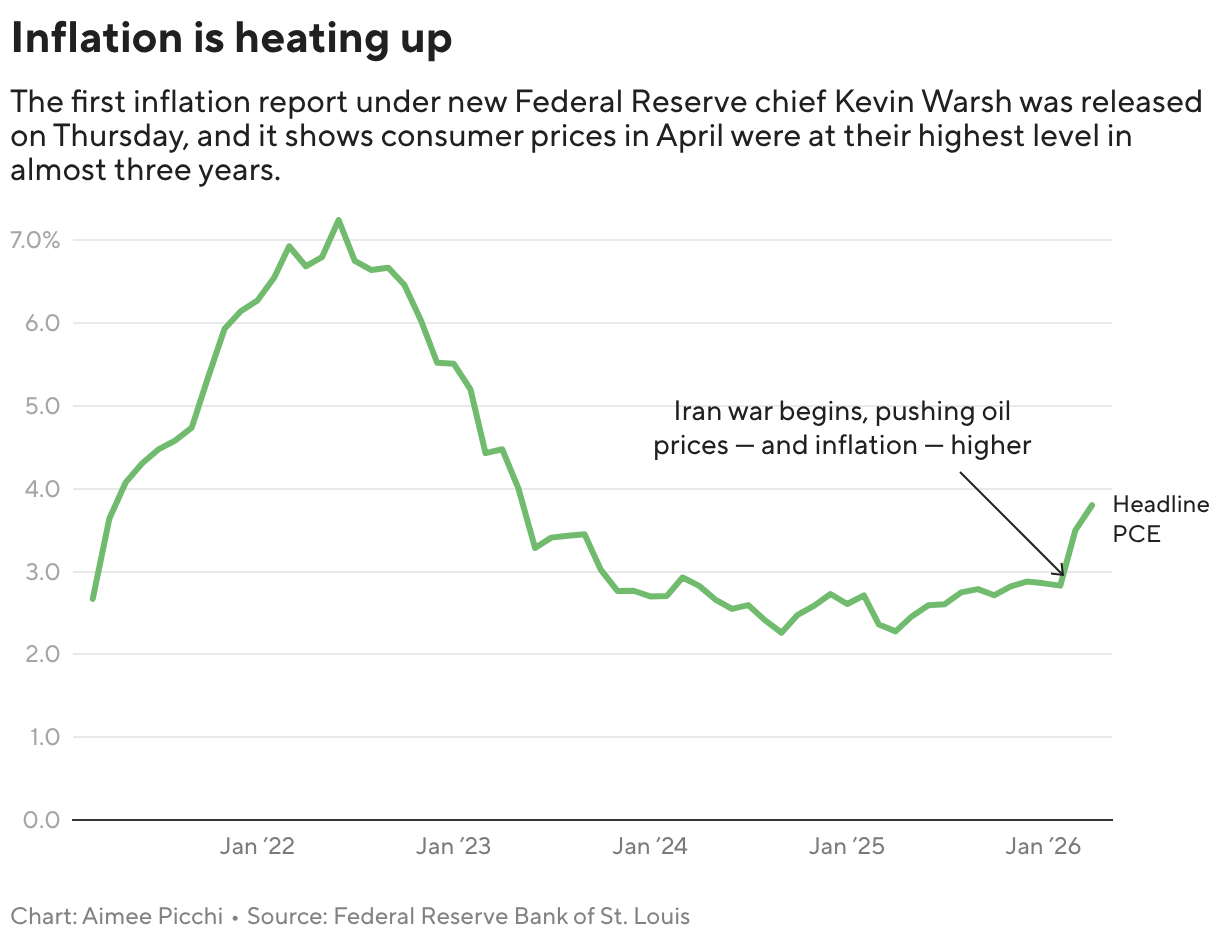
The Iran war reignited inflation by driving up oil and gasoline prices, leaving American drivers paying the highest fuel costs in three years.
May's PCE report could mark the peak of the latest inflation surge because crude oil prices eased in June amid hopes that the Strait of Hormuz, the key Persian Gulf waterway that handles 20% of global oil flows, could soon reopen. That drop in energy costs isn't reflected in the latest PCE data, analysts noted.
"It's our expectation that inflation will start going lower now that the Strait of Hormuz has reopened and oil prices are coming down, so that may alleviate some of the pressure on the Fed, but next month's data needs to be lower than what we are seeing today if that is going to be the case," said Chris Zaccarelli, chief investment officer for Northlight Asset Management, in an email.
Oil prices have plunged close to their levels when the Iran war started in February, with Brent crude, the international benchmark, dipping 34 cents, or 0.5%, to $73.40 a barrel on Thursday, down more than 35% from its most recent peak of about $114 a barrel, according to FactSet.
"We estimate headline inflation has peaked and will trend lower in the second half of the year, assuming the Strait of Hormuz remains open," Nationwide chief economist Kathy Bostjancic said in an email.
Despite the jump in prices last month, the latest inflation data shows consumers continued to spend strongly in May, economists noted. Adjusted for inflation, spending rose 0.3% from April to May. Inflation-adjusted incomes rose for the first time in four months, picking up 0.3%, which could bolster consumer spending in the coming months.
"Real personal spending is rising at a pace consistent with the trend growth rate of GDP," Carl Weinberg, chief economist at High Frequency Economics, said in a report. "That is good news!"
Households were likely helped by this year's larger tax refunds and by stock market gains, which "helped buffer the negative drag from higher gasoline prices," Bostjancic said.
Impact on interest rates
Earlier this month, Federal Reserve Chairman Kevin Warsh vowed to tackle inflation, saying at his first interest-rate decision meeting that the central bank is determined to lower inflation to 2% annually. The Fed held its benchmark interest rate steady at its June 17 meeting, but left the door open to a rate hike later this year.
Higher gas prices aren't the only factor fueling inflation. The AI buildout has made computer components more expensive, with Apple announcing last week that it would raise prices on its computers and iPads due to higher costs.
Service prices also rose sharply last month, driven by costlier restaurant meals, hotel rooms, auto repairs and healthcare.
A separate government report on Thursday showed that the economy expanded at a 2.1% annual rate in the first three months of the year, an upgrade from a previous estimate of 1.6%. And the number of people seeking unemployment benefits fell last week, a sign that layoffs remain low.
The combination of stronger GDP growth and lower energy prices may keep the Fed from budging interest rates anytime soon, economists said Thursday.
"Today's data is a reminder that inflation remains well above target and growth remains solid," Ellen Zentner, chief economic strategist for Morgan Stanley Wealth Management, said in an email. This will keep the Fed on hold for quite some time, until conditions allow for a cut."