Federal Reserve holds interest rates steady but leaves door open to hike
The Federal Reserve on Wednesday left its benchmark interest rate unchanged amid resurgent inflation, but nearly half of its policymakers said they would support a rate hike later this year.
The Federal Open Market Committee (FOMC) kept the federal funds rate, which affects borrowing costs for consumers and businesses, in its current range of 3.5% to 3.75%. Economists had widely expected the central bank to keep rates steady.
The so-called easing bias — a sentence in recent FOMC policy statements signaling the central bank was leaning toward cutting interest rates — was removed from the June guidance, which was significantly slimmer than the typical statement.
"You might have already noticed something, a difference in today's policy statement," Federal Reserve Chairman Kevin Warsh said in a press conference to discuss the Fed's latest interest rate decision. "It's a bit shorter, a bit simpler and it dispenses with some older language. That statement just gives you the facts as best we can judge it."
The Fed also released its Summary of Economic Projections (SEP) on Wednesday, which shows that nearly half of FOMC members said they could support a rate hike later this year. The vote to keep rates steady was unanimous, with all FOMC voting members in favor of maintaining the current range.
"Inflation remains elevated relative to the Committee's 2% goal, in part reflecting supply shocks that have driven price increases in certain sectors, including energy," the FOMC said in Wednesday's statement.
Stocks fell on Wednesday after the Fed opened the door to possible rate hikes this year, surprising investors who had largely expected the central bank to stay on hold. The S&P 500 fell 70 points, or 0.9%, to 7,441 in afternoon trading, while the Dow Jones Industrial Average declined 0.7% and the tech-heavy Nasdaq Composite Index sank 1%.
"With nine FOMC members projecting rate hikes within the next year and significant changes made to the policy statement, the meeting represented a significant shift in Fed messaging," Indeed Hiring Lab economist Felix Aidala said in a report.
Hawkish shift
This week's Fed meeting is the first presided over by Warsh, Mr. Trump's pick to succeed former chair Jerome Powell.
During the press conference announcing the FOMC's decision, Warsh highlighted what economists expect to be a major shift in the Fed's communication practices, including more circumspect policy statements and less forward guidance. He also said the central bank is creating five task forces to review how it handles or assesses issues ranging from communications to inflation data.
Warsh pledged to drive inflation down to the Fed's 2% annual target, something the U.S. economy hasn't seen in more than five years.
"If I saw somebody in the grocery store, what I would say to them is that we cannot have a very significant effect on particular prices, the price of oil in the markets today, or even the price of a dozen eggs," Warsh said. "But it's to make sure that those changes in oil or beef or eggs or milk don't broaden in the economy, don't have second and third effects."
He added, "We're going to deliver on it."
"Today's meeting confirms that the Fed's recent hawkish shift was not just about higher energy prices," Kay Haigh, global head and CIO of Fixed Income and Liquidity Solutions at Goldman Sachs Asset Management, said in an email. "Despite the recent pullback in oil, half of the members of the FOMC expect rate hikes as soon as this year, reflecting strong labor market and inflation data."
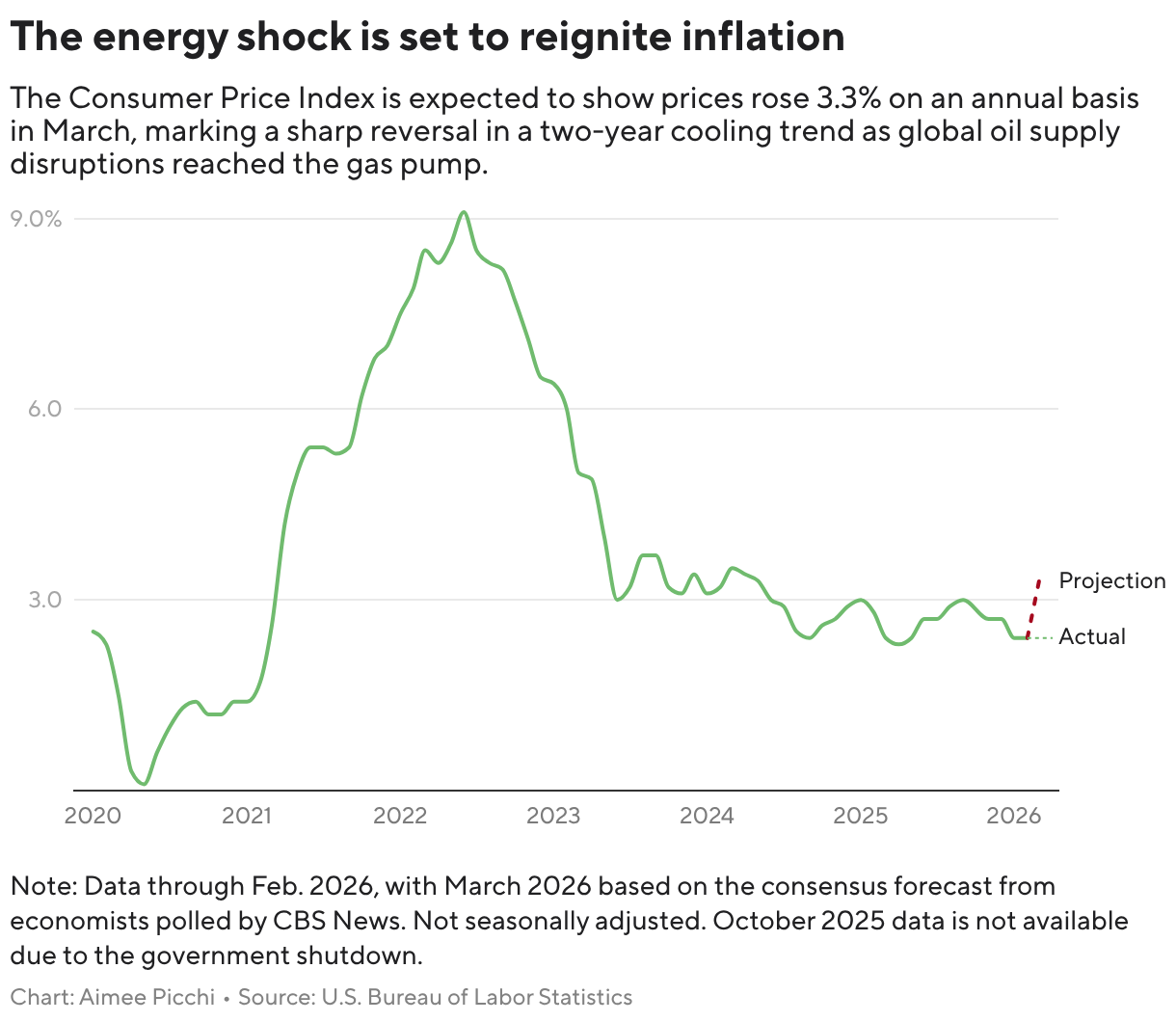
Mr. Trump had repeatedly pressed Powell, whose term as Fed chief ended in May, to lower interest rates. But with U.S. inflation at its highest level in more than three years and well above the Fed's 2% annual target, Fed officials are telegraphing that higher borrowing costs may be in store.
Speaking to reporters on Wednesday at the Group of Seven Summit in France, Mr. Trump suggested that lower interest rates would boost the economy, while also expressing support for Warsh.
"It's hard to believe. It just keeps the country down, and it's so unusual," he said. "But we have a very good guy over there right now, so I'm guided by what he wants."
Warsh noted that the FOMC's economic projections show the federal funds rate will sit at 3.8% at the end of 2026 and 3.6% at the end of 2027. The current effective rate stands at about 3.6%.
The Fed's new inflation forecast
Another major change in the Fed's economic projections is a sharp increase in inflation expectations for 2026. The central bank's previous forecast, issued in March, forecast that the Personal Consumption Expenditures index, the Fed's preferred inflation gauge, would end the year at an annual rate of 2.7%.
But in today's forecast, the FOMC members are penciling in inflation rising to an annualized 3.6% by year-end. Excluding volatile energy and gas prices, inflation could hit 3.3%.
"The median official now expects headline and core inflation well above 3% by the end of this year, and core inflation to reach 2.5% by end-2027," Oxford Economics said in a note to investors.
Warsh came across as "confident and calm" in his first press conference, said Heather Long, chief economist at the Navy Federal Credit Union, in an email.
"He convinced the world that he's serious about taming inflation," she said. "There is now a firm expectation of 1 rate hike by the end of 2026 and a growing belief there could be two hikes."