Pakistan Militants Step Up War on U.S. Supply Chain
This story was filed by CBS News' Farhan Bokhari in Islamabad.
Taliban-linked Islamic militants from Pakistan's populous Punjab province are at the center of investigations into an unprecedented midnight attack on a convoy of more than 50 trucks carrying supplies for Western troops in Afghanistan. At least seven people were killed and five injured in the brazen Tuesday night attack very near the country's capital.
The disruption of the supply chain has forced the U.S. and other NATO countries to pursue alternate routes through the former Soviet republics of central Asia, routes which are much longer than the direct drive through Pakistan.
Since former President George W. Bush led the invasion of Afghanistan in 2002, following the Sept. 11 terror attacks, as much as half the fuel supplies and more than 60 percent of other supplies used by U.S. and other Western forces in Afghanistan have passed through Pakistan.
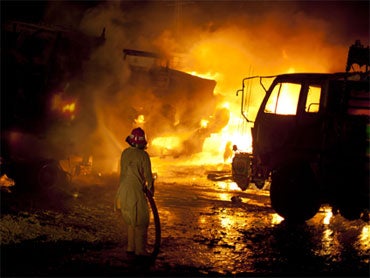
Above: A Pakistani fireman tries to extinguish flames after suspected militants attacked a military supply convoy in Sangjani, near Islamabad, Pakistan, June 9, 2010.
The Taliban and their allies periodically take advantage of Afghanistan's landlocked geography by targeting the crucial supply convoys to disrupt the flow of essential goods to troops in Afghanistan.
But unlike previous attacks in Pakistan, which have taken place mostly in the remote area near the Afghan border, the militants stunned Western officials with their latest attack at a supposedly well-protected truck depot near the capital city of Islamabad.
"This is clearly mind boggling. These people I thought will not strike at such a facility so close to the capital," said a Western defense official in Islamabad early Wednesday. "The militants have a history of attacking relatively unprotected places and carrying out suicide attacks, but this is something else, it clearly escalates the challenge," said the official, who spoke on condition of anonymity.
Last month, a group of Islamic militants killed at least 80 people in two well-coordinated attacks targeting congregations of the Ahmediya minority sect in Lahore, the provincial capital of the Punjab. The Ahmediya claim to be a sect of Muslims but were officially declared as heretics in Pakistan in the 1970s.
Unlike mainstream Muslims, who consider the Prophet Muhammad to be the last messenger of God, the followers of Ahmediya claim that Mirza Ghulam Ahmed, who claimed to be a prophet in 19th century India, was the last prophet.
Analysts warned after Tuesday's attack that growing violence in the Punjab -- home to more than 60 percent of Pakistan's population -- must be considered an escalation in ongoing violence linked to the Taliban. The militants involved in the Lahore attacks, according to a police investigator, were believed to include militants from Islamic hardline groups in the Punjab.
On Wednesday, a Pakistani security official told CBS News, the attack late on Tuesday night, "seems to present us with the footprints of militants from the Punjab. This will be a matter of great concern. The threat previously came from areas close to the Afghan border but now seems to be growing in Pakistan's heartland."
The Western defense official who spoke to CBS in Islamabad agreed with the assessment.
"We are now in a difficult phase. Alternative routes into Afghanistan can be found, but they are a longer distance and more difficult than the one through Pakistan. The war in Afghanistan will not come to a sudden end if we can't take supplies through Pakistan, but the logistics do become more complicated," said the official.