Obama's Message to U.S. Businesses: Get Home by Curfew
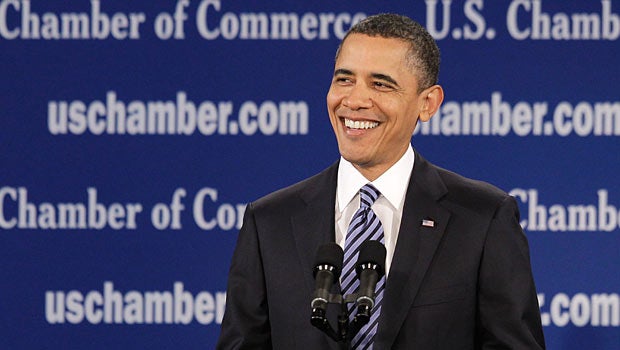
To understand President Obama's speech to the U.S. Chamber of Commerce Monday morning, it's helpful to think of the president as an aggrieved parent and the business community as the teenager who's sick and tired of the rules of the house.
The top priority for the Chamber - the powerful conservative business lobby that serves as a conduit for some of the nation's largest companies (notably in the banking and health care fields) to fight many of the administration's policies - is to deal with "the regulatory tsunami" it says its members face. According to the Chamber, there are too many regulations keeping the business community from fully thriving - regulations that represent "the single biggest challenge to jobs, our global competitiveness, and the future of American enterprise," according to President Tom Donohue.
(Above, CBS News' Brian Montopoli and Rob Hendin discuss the president's speech.)
The president said Monday that he is sensitive to that concern, noting that he has "ordered a government-wide review" of potentially "outdated and unnecessary regulations" - adding that "if there are rules on the books that are needlessly stifling job creation and economic growth, we will fix them." Like a parent willing to make practical concessions to a teenager chafing at outdated limits on his freedom, Mr. Obama was acknowledging that the other side had a case.
But he went on to say that there were still going to be some house rules - and for good reason.
"Not every regulation is bad," he said. "Not every regulation is burdensome on business. A lot of the regulations that are out there are things that all of us welcome in our lives. Few of us would want to live in a society without rules that keep our air and water clean, that give consumers the confidence to do everything from investing in financial markets to buying groceries."
He then went on to essentially attempt to try to his adversary by pointing to a few failed arguments from the past.
"Early drug companies argued the bill creating the FDA would 'practically destroy the sale of ... remedies in the United States,'" he said. "That didn't happen. Auto executives predicted that having to install seatbelts would bring the downfall of their industry. It didn't happen. The President of the American Bar Association denounced child labor laws as 'a communistic effort to nationalize children.'"
In other words: You've told me before that I was ruining your life by not letting you stay out all night with your friends. But I think we both know I made the right decision.
Mr. Obama's speech was a gesture to move in the direction of making peace with a business community with which he has an ostensibly frosty relationship. (And it wasn't the first: Already this year the president has tapped JP Morgan Chase executive Bill Daley as his chief of staff, promoted Goldman Sachs consultant Gene Sperling to hear the National Economic Council and brought in General Electric CEO Jeff Immelt to lead a new council on jobs.)
But it was not a capitulation: It was more akin to an offer of a truce grounded in the notion that neither side can get everything it wants. This has been the posture for Mr. Obama dating back to the December tax cut compromise, and opinion polls suggest that it resonates with Americans, many of whom have had to make the same sorts of compromises within their own families.
Not that everyone was pleased: Erica Payne, the founder of the public policy group the Agenda Project, told Hotsheet the speech "let the Chamber off really easy."
"It's a group of people who are, in essence, responsible for most of the problems that we face and not to call them out directly is I think a missed opportunity," she said.
House Speaker John Boehner, meanwhile, assailed the president following the speech for allegedly taking steps to protect "job-crushing regulations."
"Time and again, the Obama Administration has used its regulatory powers to go around Congress and impose hidden taxes on employers and small businesses," he said.
The president rejected both perspectives in favor of one grounded in the notion that each side has to do its part so long as everyone is living under the same roof. "Even as we make America the best place on Earth to do business," he said, "businesses also have a responsibility to America."
Indeed, change a few words and this section of the speech sounds like a sympathetic parent acknowledging the challenges of high school: "I understand the challenges you face. I understand you are under incredible pressure to cut costs and keep your margins up. I understand the significance of your obligations to your shareholders and the pressures that are created by quarterly reports. I get it."
Or, going back to the parent-teenager analogy: I get it. We're cool. Let's just both make some compromises. We've both got to live here, after all. I know we can make it work. And I don't want to fight any more.