Obama's Conundrum: Matching Job Creation and Spending Cuts
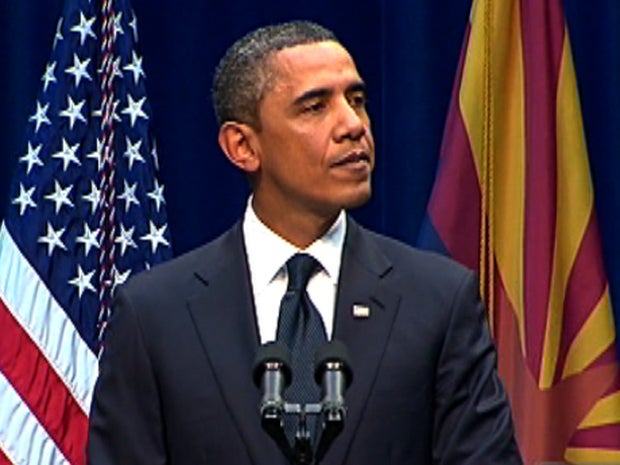
President Obama's visit to General Electric's birthplace in Schenectady, New York today comes as part of his 2011 economic push. So far almost everything he has done this year has been focused on the economy, from his editorial in the Wall Street Journal promising to rollback burdensome regulationsto hiring a new Chief of Staff, Bill Daley, who has strong ties to the business community.
In his non-announcement announcement that President Obama will run for re-election, White House Press Secretary Robert Gibbs said working on the economy is the highest priority. "We've started and we've made some progress on getting our economy back in order, and I think the President wants to continue to do that," he said.
Overnight, the White House continued the trend: It announced that Jeffrey Immelt, the CEO and Chairman of General Electric, had been named chair of a brand new advisory group, the President's Council on Jobs and Competitiveness.
In a statement, President Obama said, "As we enter a new phase in our recovery, I have asked the new Council to focus its work on finding new ways to encourage the private sector to hire and invest in American competitiveness."
Meanwhile, the Republican Study Committee, a large group of conservative House Republicans, is focused on cutting spending. The RSC yesterday offered a detailed plan to cut the federal budget deficit. Their plan would "save taxpayers $2.5 trillion through 2021. It starts by keeping House Republicans' pledge to take current spending back to 2008 levels and repeal unspent funds from the failed 'stimulus,'" according to the group's release. It would eliminate federal funding of Amtrak, the National Endowment for the Arts and the US Agency for International Development, among other cuts.
In today's Washington Post, Freshman GOP Representative Joe Walsh (R-IL) defended the deep cuts. "If we don't do something like this, the Republican Party is going to be in trouble electorally in the next two years. The voters sent us here to do this," he said.

The Post says that the cuts mean roughly a 30 percent reduction in most federal agency budgets. The article cites Democratic estimates showing the cuts could result in large numbers of federal workers being laid off, including 4,000 FBI Agents and 5,700 Corrections officers.
The Chair of the Republican Study Group, Rep. Jim Jordan (R-OH), told CBS News that spending is the biggest threat to the country.
"Everyone understands, this is as basic as second grade mathematics, you can't keep spending more than you take in. Every single American is going to be hurt if we continue on this path," he said.
A top Tea Party coordinator agrees. CBS News asked the coordinator whether too much cutting would result in mass layoffs, either from the federal government or companies with federal contracts, and hurt the economic recovery.
"What economic recovery?" he responded - arguing that most Americans haven't seen an economic recovery and are more concerned about the trillions in dollars of federal debt. (CBS News polling suggests that they are less concerned with the deficit than the coordinator seems to think.)
This is the crux of the debate that will consume Washington for the next two years: Republicans who want to cut spending and reduce the size of the federal government - probably laying off thousands of federal workers in the process - versus a president and Democratic Party who want to grow the economy and reduce unemployment first and cut spending second.
A stronger economy with lower unemployment is almost essential for President Obama if he wants to win reelection in 2012.
"They need to have economic recovery occur, secondly, they need to be in position to get credit for it," said Democratic strategist and CBS News consultant Jamal Simmons.
"The Republicans are in a little bit of a bind, the economic recovery doesn't help them politically, but they can't be in a position of rooting against America," he added.

Simmons says the tables were turned in 2004, as John Kerry battled President George W. Bush. "The economy was clearly starting to recovery in fall of 2004; it wasn't good for John Kerry, but there was nothing they can do about it," he said.
The White House battling the Republican Party over cuts may not be the only conflict. Simmons says that Speaker John Boehner will have to fight against the more conservative branch of his party to make sure spending cuts don't threaten or derail the economic recovery.
"The problem is a political problem. The Tea Party people want cuts to occur, putting Boehner in a very awkward position," said Simmons. "He must try to satisfy that wing of the party, while doing the responsible thing. He has to decide what he wants his legacy to be: how much will it be to help the GOP's political goals or how much will it be helping the country."
The president also has to walk a fine line "figuring out what to communicate in terms of his values of what he's going to protect in a budget cut," said Simmons. He said President Clinton set the agenda in budget battles with then-House Speaker Newt Gingrich, saying he'd protect spending for Medicare, education and the environment. "Everybody knew what Clinton was fighting for," said Simmons.