New Photos Show Scope of Hungary Sludge Disaster
(CBS/AP) New satellite photos released by NASA show the scope of the caustic red sludge accident that killed eight people when it burst from a reservoir at an aluminum company in western Hungary last week.
The images, taken Oct. 9 from NASA's Earth Observing-1 satellite show a close up of the plant and the nearest villages, and a wider shot of the region.
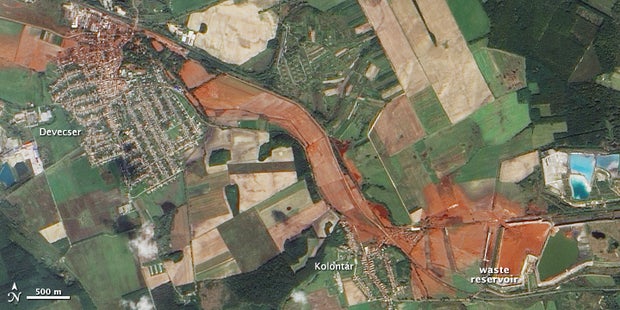
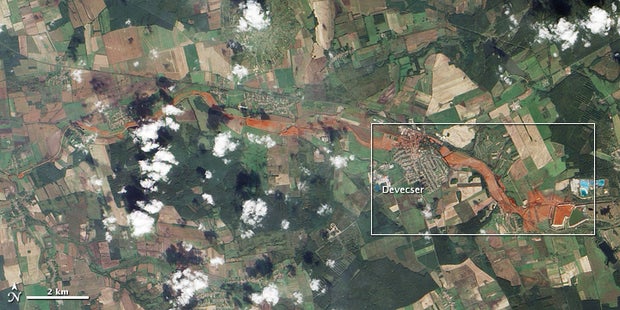
According to NASA, the plant appears along the right edge of both images, and incorporates both bright blue and brick red reservoirs. The breach of the retaining wall is apparent in the close-up view. Sludge cut a channel through the northwest corner of the waste reservoir and spread onto nearby fields.
The sludge forms a red-orange streak running west from the plant. The wide-area view shows the spill thinning but remains visible for several miles to the west.
Police are also examining an aerial photograph taken months before showing a faint red trail trickling through the container wall.
Police are looking at the photo as part of an investigation into how part of the wall containing the caustic slurry could have given way without structural weaknesses being detected by inspectors who visited the site two weeks ago.
On Monday, Hungarian police have detained the director of the aluminum company responsible for the flood.
Police said they were questioning managing director Zoltan Bakonyi on suspicion of public endangerment causing multiple deaths and environmental damage.
The body of the flood's eighth victim, an elderly woman, was found Monday afternoon near Devecser. The woman was the last person reported missing.
In Kolontar, the town closest to the damaged storage pool, which is 25 acres in size, construction continued of a new containment wall to protect the area in case of a new flood.
Last week's sludge spill flooded three villages in less than an hour. Fifty people are still hospitalized, several in serious condition. About 184 million gallons of the sludge was released.
The damaged reservoir still contains 2.5 million cubic meters of sludge, but it no longer has a large layer of water on top, so any new spills are expected to move slower and travel less distance -- probably no more than about a half-mile -- than the first one did.