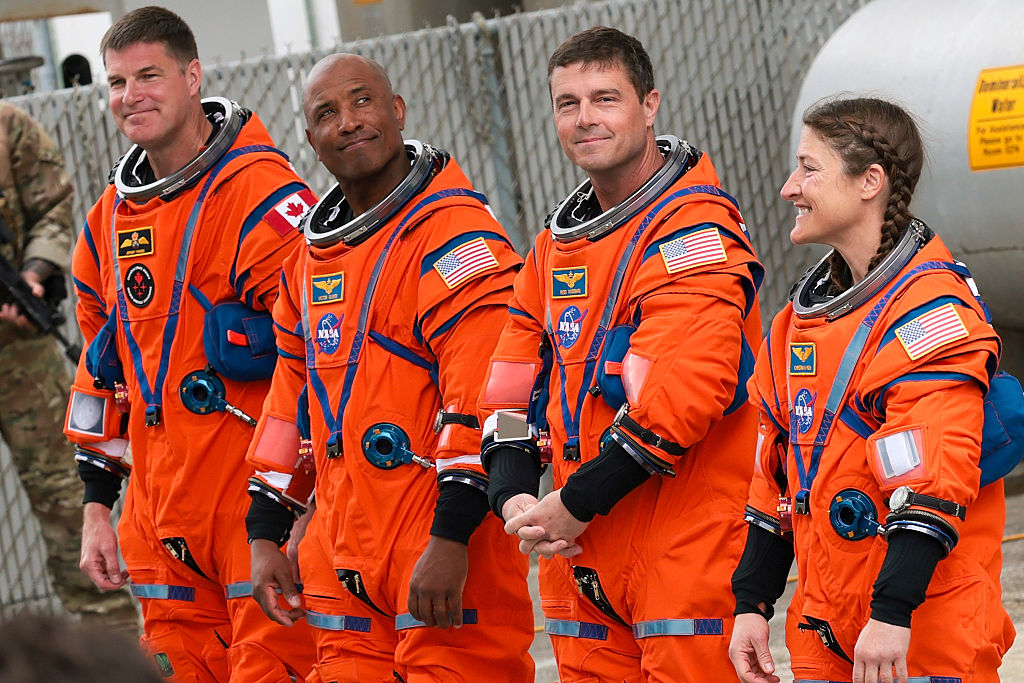
Artemis II astronauts say they're "ready to go" for moon launch ahead of 49-hour countdown
On the eve of the launch countdown for their trip around the moon, the Artemis II astronauts said Sunday they're "ready to go" as ground teams prepare their rocket for blastoff Wednesday, weather permitting.
Artemis II commander Reid Wiseman, Victor Glover, Christina Koch and Canadian astronaut Jeremy Hansen flew to the Kennedy Space Center from Houston on Friday to prepare for launch. Isolated in medical quarantine, they fielded questions from reporters Sunday during a virtual news conference.
"Things are certainly starting to feel real here at the Cape," said Koch, who carried out six spacewalks during a 328-day expedition aboard the International Space Station in 2019-20.
"Our families joined us yesterday, and we had a chance to be in the pre-test brief[ing] for the actual starting of the launch countdown," she added. "So we're excited to be a part of all that."
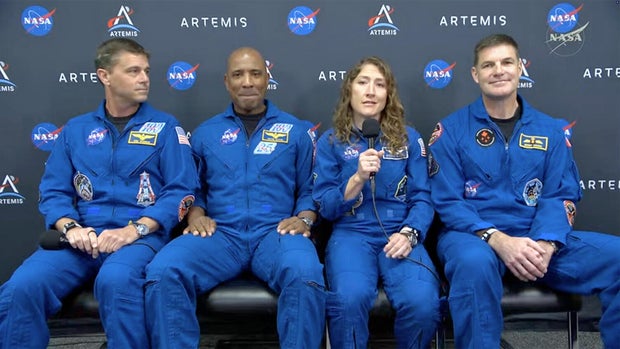
The astronauts originally hoped to take off in early February, but work to fix hydrogen fuel leaks, and more recently, trouble pressurizing the rocket's upper stage propulsion system, combined to push the launch to April 1.
While the crew is optimistic about their chances of getting off the ground Wednesday, Wiseman cautioned that it is a test flight.
"This is the first time we're loading humans on board," Wiseman said. "And I will tell you, the four of us, we are ready to go. The team is ready to go, and the vehicle is ready to go."
"But not for one second do we have an expectation that we are going. We will go when this vehicle tells us that it's ready, when the team is ready to go. So we might go out to the pad, and we might have to try again a few more times. And we are 100% ready for that."
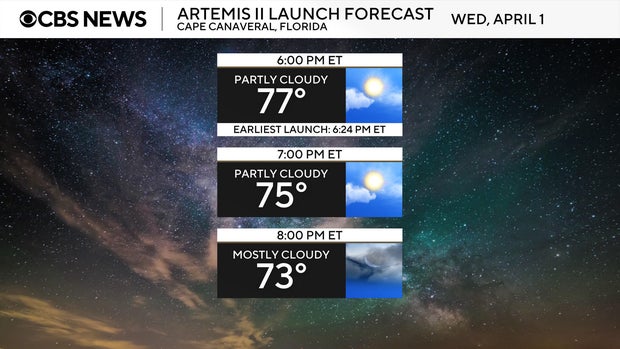
The 49-hour, 40-minute countdown is set to begin at 4:44 p.m. ET Monday. If all goes well, the clock will hit zero at 6:24 p.m. Wednesday, when the crew hopes to blast off in an Orion crew ship atop a 322-foot-tall Space Launch System rocket — both making their first flight with astronauts on board.
"When you see this vehicle on the pad, you look at the size of this vehicle, and you know it's going one place ... It is going to space, and it is going to go there in a hurry," Wiseman said. "When those engines light, this thing is moving out."
"So it's surreal. I almost want to say, though, I just feel relaxed. It's good to be here. We've trained for this, and we're ready to go."
Forecasters are predicting an 80% chance of acceptable weather, with a 20% chance of high winds and thick clouds that could pose problems.
"Yesterday, we had an important meeting, our launch countdown pre-test briefing," said ground systems manager Shawn Quinn. "This is like the last step before we get into actual launch countdown. And I will tell you that it was one of the cleanest launch countdown pre-test briefings we've ever had. ... We had no significant open work."
The Artemis II mission is the first piloted flight back to the moon in 53 years, a mission designed to thoroughly test the Orion crew capsule's propulsion, navigation, communications and life support systems before setting off for the moon 25 hours after liftoff.
The Artemis II astronauts will not land on the moon or even go into lunar orbit but will instead loop around the far side, using lunar gravity to bend the capsule's trajectory back toward Earth and a Pacific Ocean splashdown off the Southern California coast near San Diego a few minutes after 8 p.m. ET on April 10.
If the crew takes off at the opening of the two-hour launch window Wednesday, they'll travel farther from Earth than any humans before them, reaching a distance of 252,799 miles — about 4,144 miles farther than the record set by the Apollo 13 crew in 1970.
The mission is seen as a trailblazer of sorts, setting the stage for a flight next year in Earth orbit when another crew will test rendezvous and docking procedures with moon landers being built by SpaceX and Blue Origin. NASA plans to follow that flight with one and possibly two moon landings in 2028.