Mubarak Gov't Digs in Heels over Leaving Power
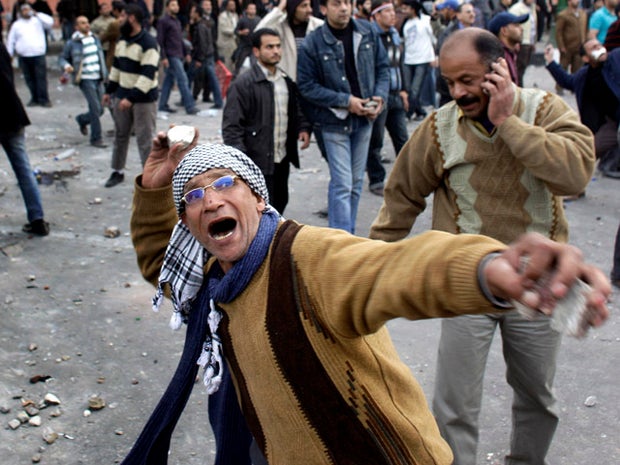
The government of embattled Egyptian President Hosni Mubarak sent clear signals Thursday to the U.S. government and the hundreds of thousands of protesters calling for the 30-year ruler's resignation that he has no intention of fulfilling what opposition forces have called the "Friday of departure."
Mubarak told ABC News' Christiane Amanpour in an interview published Thursday that he would like to leave office immediately but fears that doing so would leave the country in chaos.
All week long, protesters have been telling reporters and television stations that Mubarak must step down Friday. Many expected Mubarak to announce his immediate resignation in a televised speech Monday night. Instead, he said he would continue to stay in power but not run for another term in the election scheduled for this fall.
Live Blog: Egypt in Crisis, Day 10
Complete Coverage: Anger in the Arab World
The interview with Amanpour comes as bloody, violent clashes take place between anti-government protesters and supporters of Mubarak. After eight days of mostly peaceful protests, the clashes began Wednesday, leaving at least five dead and more than nearly 1.000 injured. In the last two days, many in the foreign press and human rights workers have been threatened and prevented from filming and moving about Cairo and other Egyptian cities by pro-Mubarak provocateurs.
Also Thursday, Omar Suleiman, Mubarak's recently appointed vice president, backed Mubarak's comments and blamed the clashes on outside agitators and businessmen.
Suleiman told Egyptian state television in an interview broadcast Thursday that the government needed more time to revise its constitution and prepare for the elections. He blamed the protest movement on foreigners and businessmen, and continued to push the government's position that genuine Egyptians aren't opposing the Mubarak regime.
Al-Jazeera television reported on its website that Suleiman referred to the anti-government protesters as not "part of the Egyptian culture" and that "we all respect Mubarak as father and leader".
Those comments mirrored those of Ibrahim Kamel, general secretariat of Mubarak's administration, who told "CBS Evening News" Anchor Katie Couric Wednesday that "these people that are standing in [Tahrir] square are not Egypt or the Egyptians."
Mubarak's government is consistent in its statement. In recounting one of his conversations with President Obama about not stepping down sooner than later to Amanpour, Mubarak said, "You don't understand the Egyptian culture and what would happen if I step down now," Mubarak said he told Mr. Obama.
His stance over the years has been that a more radical Islamic state, as in Iran, could come into power were his administration to be toppled.
The Obama administration has been increasing its distance with the onetime Middle East ally, signaling that steps to an orderly transition should begin "now."
What remains unclear is how the military will respond.
The prominent role the Egyptian military plays in the country's economy and the deep roots the government's leaders have in the military could present an obstacle for changing the nation.
As CBS News Correspondent Elizabeth Palmer reported Wednesday, the three top cabinet officials appointed by Mubarak a few days ago, including Suleiman, are senior military commanders. Suleiman was also once the country's intelligence chief. Mubarak himself has been hailed as a military hero for his service during the war with Israel in 1973.
In a leaked cable, U.S. Ambassador to Egypt Margaret Scobey said in 2008, "The military operates a large network of businesses - as it becomes a quasi-commercial enterprise itself".
With vast tracts of prime real estate and huge interests in many sectors including hotels, construction and weapons manufacturing, it's estimated to control at least a third of Egypt's $200 billion economy, Palmer reported.
While the clashes proceeded Thursday, Mubarak continues to occupy the country's presidential palace with his family, which Amanpour reports is "heavily guarded by armed troops, tanks and barbed wire."
On Thursday, Secretary of State Hillary Clinton stated that the Egyptian government and the army must bear the responsibility "to protect those threatened and hold those accountable for attacks." On Departure Friday, it will become clear how deep the Mubarak government is digging in its heels and whether it will heed the advice of the U.S., the United Nations and other entities to protect those threatened.