Transcript: María Corina Machado on "Face the Nation with Margaret Brennan," Feb. 1, 2026
The following is the full transcript of the interview with Venezuelan opposition leader María Corina Machado, a portion of which aired on "Face the Nation with Margaret Brennan" on Feb. 1, 2026. The interview was conducted on Friday, Jan. 30, 2026.
MARGARET BRENNAN: And we're joined now by Venezuelan opposition leader María Corina Machado, and it is amazing to see you here in person after so long.
MARÍA CORINA MACHADO: Likewise. Thank you very much.
MARGARET BRENNAN: You met with Secretary of State Marco Rubio this past week. He said the U.S. now does not intend to have any military action or presence inside Venezuela, except for maybe at a reopened embassy there. Is that a good idea to take that military pressure off when the Maduro regime is effectively still in place?
MACHADO: Well, first of all, I have to say that on behalf of the Venezuelan people, we're very, very grateful to the American people, and the first hand- first and foremost, to President Trump, to the secretary of state, and also to your leaders in Congress. I mean, the- the degree of support and care that we've felt in this fight at this moment is enormous, and I think it is clear on the- on the behalf and well being of the American people, but also of the Venezuelan people, and I would say the whole hemisphere. I do not think that the pressure is being taken away. Actually, everything Delcy Rodríguez is currently doing is because she's complying with instructions she's getting from the United States, and important steps are being taken. So I think that the message has been delivered, and so far, we're seeing the results in the actions taken by the regime, and also in the mood and energy that is growing within the Venezuelan population.
MARGARET BRENNAN: Are you, or is anyone in your movement, in touch with Delcy Rodríguez, who's the acting president of Venezuela now?
MACHADO: No, not directly.
MARGARET BRENNAN: No. Why not?
MACHADO: Well, we had offered, since we won the election by a landslide, that we were willing to- to agree in the terms of a negotiated transition, they refused. On the contrary, they decided to unleash the- the- the most cruel, brutal repression wave. There are- as you know, there have been thousands of political prisoners, and they had not demonstrated any willingness to- to stop this cruelty, until January 3rd arrived and- and happened when it happened. So it sent a clear message to them, and they're starting to realize that things have changed for good. So eventually they might understand or- and even very soon, that it is in their best interest to- to accept that transition is unstoppable.
MARGARET BRENNAN: A transition that you hope involves a democratic election at some point. Did Secretary Rubio give you any kind of timeline for the American plans?
MACHADO: What I do have very clear is that the end result is the same. What we want, what the Venezuelan people have voted and struggled and fight for with huge cause and sacrifice, and what the United States government and President Trump also desires. It is a very complex process. I mean, this is a criminal structure that has intertwined with the enemies of the West, Russia, Iran, China, Cuba, extremist terrorist organizations such as Hezbollah, Hamas, the cartels, the guerrilla, all in association with the Maduro regime and Delcy Rodríguez and others. So it's a process of dismantling this structure in the- in a way that it's most orderly under control possible in the short term. And yes, the end game has to be, or the end step has to be, a electoral process in which we can have legitimate power. So I'm talking about a legitimate national assembly, governors, mayors and certainly president.
MARGARET BRENNAN: But for the people in Venezuela still living under that regime, what has actually changed for them, and do they have the patience to wait for what you're talking about, which is basically just hoping that the Rodríguez government does what Donald Trump tells them to do?
MACHADO: Well, it's more than hoping. We're seeing the results, the actions. Are we there yet? Not. And- and I think it's a good point, what you mentioned, patience. How much patience can the Venezuelan people have? Because, I mean, there were over 1,000 political prisoners on January the 1st. Still, there are over 700. Not one military prisoner, political prisoner has been liberated. There are men and women that have been in prison for years. Even the three police of the Policía Metropolitana have 23 years in prison, and they have not been liberated- released yet.
MARGARET BRENNAN: And Secretary Rubio has said it's not happening as fast as America wants it to.
MACHADO: Absolutely. And in- in our case, we want that to happen immediately. Imagine, you know, the mothers of- of- of many of these innocent prisoners have been in vigils for over 23 days and nights. This is something that was unthinkable, Margaret, before January 3rd, and it shows that Venezuelan people are getting more and more empowered, more and more confident that this process will eventually lead to a- to a legitimate government based on the will of the people, but certainly we need to move there and leave evidence that there's no way back.
MARGARET BRENNAN: Yeah, well, President Trump has talked a lot about Venezuela's oil and its natural resources. Do you support the law that was just passed that allows the Venezuelan Government to privatize the oil industry?
MACHADO: Well, first of all, I do not recognize the National Assembly as a legitimate power. It has not been recognized by the Venezuelan people, not even by the American- by the U.S. government.
MARGARET BRENNAN: Not legally, but effectively they--
MACHADO: Yeah, but whatever comes from that National Assembly has no legality. So- because this is an illegitimate power. So certainly, these so-called reforms introduce positive signs in terms of what we, the Venezuelan people, want in the future. We don't want socialism. We don't want the state owning every single, you know, facility or production center. We want private property, but that requires rule of law, long term guarantees for foreign investment, for local investment. But one thing that is the most important of all, in my opinion, you need to have people, talent, specialized, professional, willing to work and develop these enterprises. What happened with the Venezuelan specialized talent? It was forced to flee the country, almost a third of our population, and these are people that are working all around the world. So imagine if a Venezuelan engineer working in Ghawar, the- the largest oil field in Saudi Aramco, would he leave his job and go back to Venezuela, where Delcy Rodríguez, who is part of the cartel, is in- and who originally fired him is in power? Of course, not.
MARGARET BRENNAN: Well, you raised this point, but President Trump just said on camera that United States is going to start peeling back some of these sanctions so that Americans can travel back to Venezuela. He's lifted the air restrictions--
MACHADO: --Well, I think--
MARGARET BRENNAN: --is it safe to go?--
MACHADO: I think it is important to take steps. I think these are signals directed to several actors. First and foremost, to the regime, saying this is going to move forward. There is no way back. And- and- and the regime knows that no American citizen or Venezuelan citizen is going to go back to a country that's still under the power of Maduro regime and the cartel. That's not going to happen. But- but these kinds of actions, I think, give the correct signals in terms that this is going to move ahead. And I do trust the president in what he has said regarding how much he cares about the Venezuelan people, that's something that I think it was quite significant in our conversation.
MARGARET BRENNAN: If you return to Venezuela now, would you be imprisoned, and has the American government said that they will protect you, they will guarantee your safety?
MACHADO: Well, you know, things are changing very fast in Venezuela. If they had captured me before I left, I probably would have been disappeared or worse. Right now, I don't think they would dare to kill me because of the United States presence and pressure and actions. I don't know how much possibility of moving I would have inside Venezuela, certainly they would be very afraid, because the- the regime knows the connection, the intimate connection we have, you know, the Venezuelan people and- and the leadership that won the election, the legitimate government.
MARGARET BRENNAN: You won that election along with Edmundo González at the top of that ticket, even the Trump administration recognized it. Secretary Rubio testified that to Congress, but then the president of the United States stood up there and said to the public that even though you had won that election, you didn't have the public support. And I wonder if you can understand why they made that calculation, that you and your party who won an election couldn't be that transitional government that would do all the things you're talking about?
MACHADO: Well, Margaret, I will concentrate in what he told me in a private conversation, looking each other in the eyes, and I, and I truly believe he understands the nature of this regime. They all know that Delcy Rodríguez is a communist that no one can trust. Not even, you know, the people surrounding her right now does. I mean these are individuals that have strong ties with Russia, Iran, China, Cuba. I mean, she is doing what she's doing because United States is putting enough pressure for them to understand that she has no other option. If that, if that pressure were taken away, she would turn around and go back to where loyal- her loyalty is with these regimes are the enemies of America. So no one is naive here. I think she's doing part of the dirty job of dismantling her own regime and entourage, but that's a- there's a limit to it. For what you said before, you know, people have to be taken account on- of. They have to be involved. And the Venezuelan people, 90% of our people want the same. Not only this regime to go immediately, but we want to live in a country with human dignity, with solidarity, with justice, with freedom. This is all about bringing our kids back home, having our families together. It's about saving lives.
MARGARET BRENNAN: What role would you want in a future Venezuelan government? Because even President Trump says you may have a role in the future. Would you run for president?
MACHADO: I will be president when the time comes. But it doesn't matter. That should be decided in elections by the Venezuelan people. I wasn't allowed to run in the last election, as we mentioned before, because Maduro was afraid to running against me, and he thought Edmundo was not a threat, because nobody knew who he was. And in less than three months, we managed to put the whole country supporting him, because this is- this is matter of freedom. I mean, this is a spiritual fight, an existential fight for Venezuela. Unlike other diasporas, and I want to stress this, our people around the world, here in the United States, want to go back. Go back and live in a country where they're safe, but most of all, where there is a future in freedom and democracy. So if we want those hundreds of thousands and millions of Venezuelan to go back, we need to have a secure and precise timeline through which this transition will advance.
MARGARET BRENNAN: And we don't know when yet--
MACHADO: Not yet--
MARGARET BRENNAN: --from the Trump administration at all.
MACHADO: Not yet. But I'm sure there is, and the secretary of state and many other members of the government, by instructions of the president, a clear willingness to move as fast as possible within, you know, control and order and understanding the complexity of such a criminal structure, but understanding that the voice of the people is what brings legitimacy to this process.
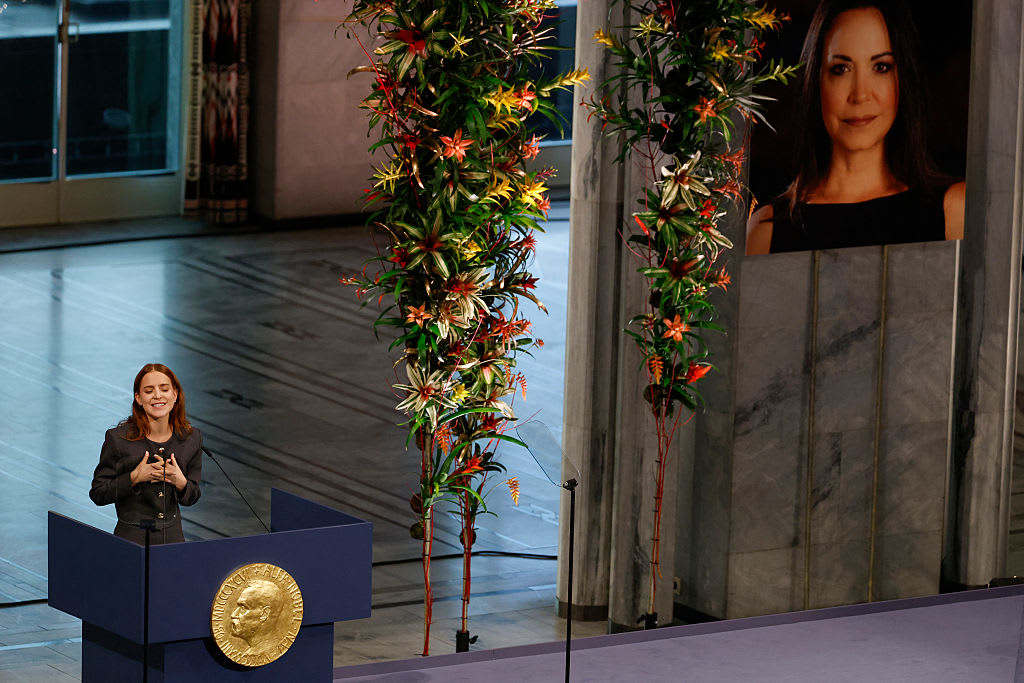
MARGARET BRENNAN: Before I let you go. You know, the last time we spoke, you had made this daring, covert escape by land, sea and air from Venezuela to go and receive that Nobel Peace Prize in Oslo. You've kept those details private, you said, for safety reasons, but you did say you broke your back, you talked about being lost at sea, that you feared that you might lose your life at one point. After all of that, why did you give your Nobel Peace Prize to President Trump after you'd already dedicated it to him?
MACHADO: Look, I think this is a matter of justice, and it's a matter of what's in the superior interest of our country. We the Venezuelan people, are truly grateful for what he has done, and we're confident in what he will do in the- in the days, weeks and months to come.
MARGARET BRENNAN: You believe he supports you.
MACHADO: I do. Because it is- it has to do first and foremost with you, the American people, and how dismantling this criminal structure not only saves millions of Venezuelan lives, it also saves lives in the Americas. And once Venezuela is free, then the Cuban regime will follow. The Nicaraguan regime will follow, even the Iranian regime that has turned Venezuela into its safe haven and satellite only three hours away from Florida. I mean, this has huge consequence for the Western Hemisphere, for United States. So I think this is a win-win situation for investment, for business opportunity, for security reasons, and certainly for migration tensions and crisis. So Venezuela will be free, and I know I will host you soon in a wonderful country that is very grateful to yours.
MARGARET BRENNAN: María Corina Machado, thank you very much for your time today. We'll be right back.