London police use tech to tackle masked phone snatchers

London — Images of masked men riding along London's streets on mopeds or electric bikes and snatching phones straight out of the hand of unsuspecting tourists and locals have gone viral in recent years. The criminals have essentially taken advantage of new, quick but quiet transport technology to get a leg up on police.
The brazen robberies became such a problem in the U.K. capital that London's Metropolitan Police (the Met) developed a special task force — the Interceptors — specifically to combat the two-wheeled bandits. Nearly three years after the unit was established, police data indicate a positive downward trend.
During 2024, at the height of the phone snatching trend, there were 80,000 such offenses across London. As of July this year, 35,000 phones had been snatched, according to official statistics from the Met.
Police officials attribute that downward trend to the Interceptors. The specialist officers are trained in tactical pursuit and they operate across central London, specifically targeting phone thieves.
Cops and robbers, and drones and e-bikes
Taking a cue from their targets, the Interceptors use a combination of assertive on-the-ground policing and technology, including sophisticated cameras, drones and even officers on their own e-bikes, to track down and stop the thieves in their tracks.
They have focused on the central parts of London where tourists are ever-present, and where phone theft has been most frequent.
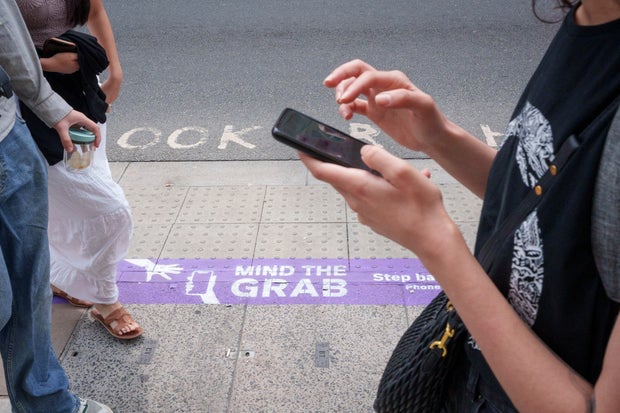
Dramatic police vehicle dash camera video shared with CBS News by the Met shows one of the techniques used by the Interceptors: crashing their own cars or e-bikes right into the suspected thieves to knock them off their wheels.
"We brought in new technology such as e-bikes … we brought in drones, we brought in Automatic Number Plate Recognition cameras. We've brought in all different levels of technology to hone down on how these criminals are operating," Commander Andy Featherstone, the Met's lead officer on phone theft, told CBS News.
He said when a report comes in that a phone has been stolen, "the drone can access the location in a matter of seconds," and then "you've got the eye in the sky, as it were."
"You've then got our Interceptors who are on the ground, and they can pursue and intercept the criminal in a much more safe way than perhaps before, where they would need to be in line of sight to do it and to be able to keep up with them to know where they're going," Featherstone said.
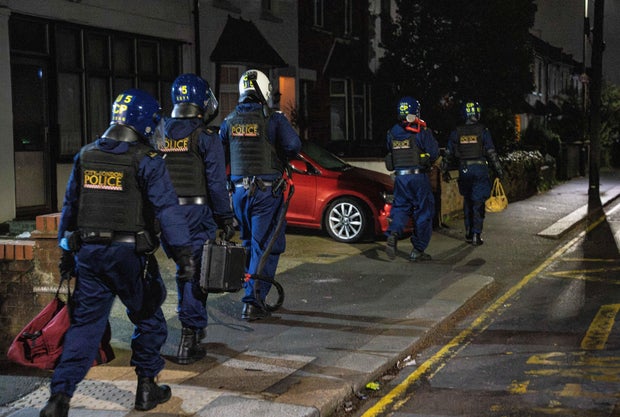
CBS News went along for a ride with the Interceptors and saw officers make two arrests after license plate recognition technology flagged a couple of mopeds with links to suspected crimes.
One of the arrests came after a minor driving a moped failed to stop when officers turned their lights on. A check by officers revealed that the young man had been suspected of phone snatching in London's Ladbroke Grove area just days earlier.
The bigger picture, and a bigger solution
Commander Featherstone told CBS News there are criminal networks behind some of the phone snatching gangs, and that London's police are becoming more effective at tracing the crimes to their roots.
"We discovered that there was an export market here," he said, adding that many of the stolen devices end up in North Africa or Asia, and China in particular, "where huge amounts of these phones are going there to be broken down as parts."
British police are now working with American tech giants including Apple and Alphabet to crack down on phone "jailbreaking" — hacking into the operating system to make a device usable by a new, unauthorized owner — to develop technology that ensures stolen devices are useless to anyone but their owner.
"When you remove the value of a stolen phone in the secondhand market, that is when we'll really break the back of this problem," Featherstone said.