Judge Ronald Gould on his MS: "Just take life a step at a time"
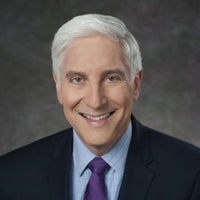
"My life is just an ordinary life where I've been given responsibility, and I do my best to live up to it," said Judge Ronald Gould.
For someone living an "ordinary life," Gould has wielded more power, and surmounted more adversity, than most. He's a federal judge on the Ninth Circuit Court of Appeals in Seattle, one rung below the U.S. Supreme Court. At 79, he shoulders a full caseload despite living with progressive multiple sclerosis, a chronic autoimmune disorder of the central nervous system. It's a condition he faces with grit, and a healthy dose of humor.
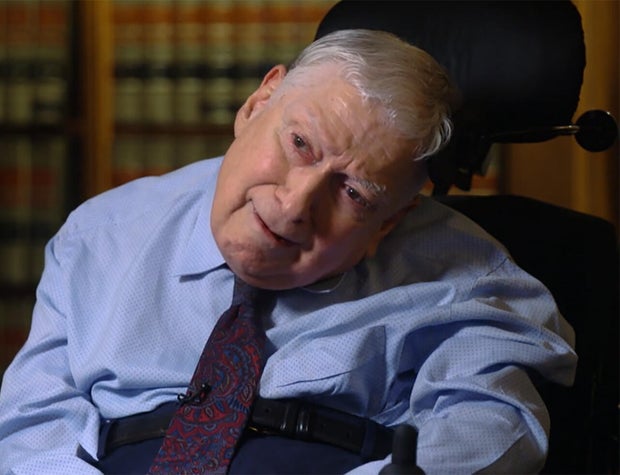
"My MS can still throw me an unexpected curveball," he said. "But you know, just take life a step at a time." Even, he acknowledged, if he can't actually make a step. "I guess for me, it would be a roll of the wheel at a time!"
Gould has been exceeding expectations all his life: Magna cum laude at law school; Supreme Court clerk; and president of the Washington State Bar Association. But it was during his time as a lawyer in private practice that he first noticed something was wrong.
At one point he tried to hide his diagnosis from others: "I remember walking down the street with one of my law partners. I think he suspected something. So, he kept walking faster, and faster, and I couldn't keep up."
The secret was out when he started walking with a cane. Gould soon graduated to a wheelchair, and continued his work at the firm, until he received an unexpected call:
"I was taking a deposition, and a receptionist came in and said to me, 'Mr. Gould, there's a phone call for you.' And I said, 'Well, I can't take a phone call, I'm in a deposition.' And the receptionist said, 'Well, I think you'd like to take this. It's from the White House.'"
He was nominated to the bench by President Bill Clinton, and confirmed by the Senate in 1999. At no point, he said, did he ever question that he could do the job.
When he joined the court, Judge Gould could operate his wheelchair himself. Today, this former mountain climber has lost all use of his arms and legs, and relies on round-the-clock caregivers. Unlike fellow circuit judges who travel to hear cases in other cities, Gould presides remotely.
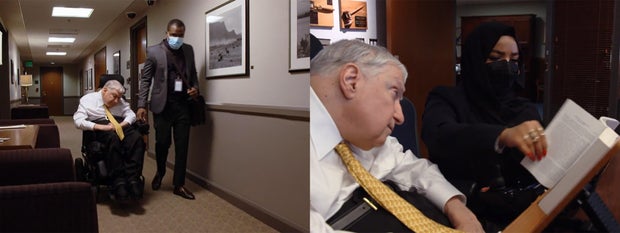
Over the years he's mentored a new generation of lawyers – law clerks like Karla Gilbride. A public interest lawyer in Washington, D.C., Gilbride has been blind since birth. "I always had a lot to say," she told us. "And from the time I was very young, my parents said, 'You're going to grow up to be a lawyer, and you're going to win all your cases, because the judge will get so tired of listening to you that they'll say, 'Okay! You get whatever you want!'"
After clerking for Judge Gould, Gilbride became General Counsel at the Equal Employment Opportunity Commission in 2023, a position she held until President Trump fired her – along with scores of other political appointees – last year. We spoke with her before her firing.
"I think Judge Gould is a very focused and energetic person," Gilbride said. "Having him as a role model helped me to picture that all sorts of things are possible."
Things like arguing before the Supreme Court. Gilbride did that in 2022, an apparent first for a blind lawyer. She spent hours memorizing the justices' voices, so she could respond to each by name. "I like to have a cheat sheet with me of the most important cases," she said. "And I will usually prepare that one-page cheat sheet in Braille."
It allowed Gilbride to face the justices and read her notes at the same exact time. "I think that is where I'm at an advantage, compared to some of my sighted colleagues. But I try not to rub it in too much!"
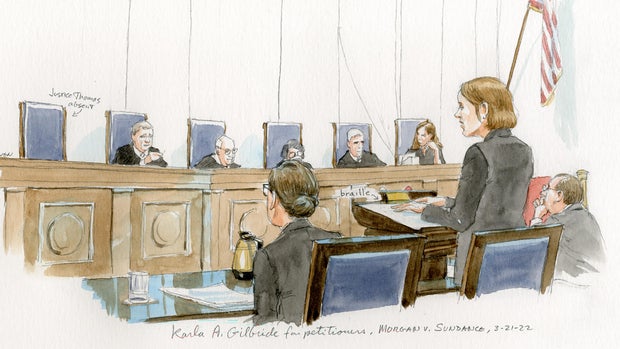
She won the case 9-0.
"For younger folks who are thinking about perhaps wanting to have a career as a lawyer who have disabilities, I want people to know that all roads are open," Gilbride said. "And Judge Gould certainly did that for me."
In his quarter-century on the bench, Judge Gould's decisions have touched on some of the most pressing issues of the day. A 2008 opinion in Witt v. Department of the Air Force helped secure the rights of gays in the military three years before the repeal of "Don't ask, don't tell." In 2017 he was a member of a panel that struck down a Trump administration travel ban from Muslim-majority countries, a decision later reversed by the Supreme Court. And he has written for the majority in cases requiring that cities and businesses make their spaces wheelchair-accessible.
Asked if his experience has helped him gain perspective about those cases that he otherwise might not have had, Gould replied, "Possibly. I think I probably already started with a great deal of empathy for others before I ever knew I had MS."
At an age when many of his colleagues have taken "senior status" (a sort of semi-retirement), Judge Gould has resisted.
He says it has probably been suggested to him that he lighten his load, but Gould's response has been, "I want to keep working full-time as much as I can, as long as I can. If I couldn't do the work, I would expect my colleagues to tell me."
Until then, Ronald Gould plans to do what he has always done: persevere. "Life gives us lots of challenges," he said. "For me, the important thing is to try to meet those challenges, and meet them with optimism and with a positive attitude."
WEB EXCLUSIVE: Attorney Karla Gilbride on challenges facing people with disabilities (Video)
For more info:
- Judge Ronald Gould, Ninth Circuit Court of Appeals, Seattle
- Photos by Alex Clausen, Rollins Emerson, and Jean Hernandez
Story produced by Robert Marston. Editor: Carol Ross.