Is Romney's "Southern problem" overstated?
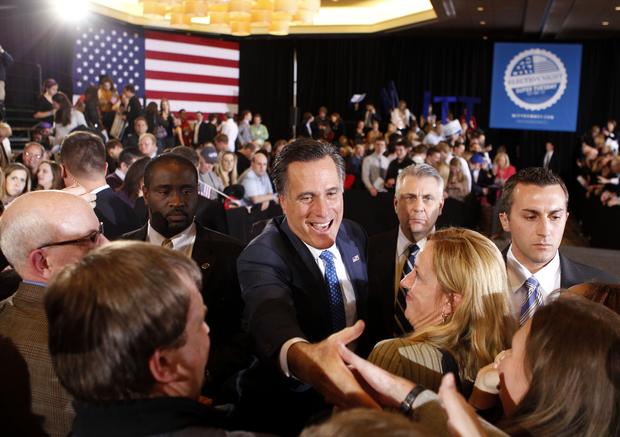

In a recent interview with an Alabama radio station, Mitt Romney alluded to the challenges he faces in the Deep South by comparing campaigning there to playing "an away game."
Indeed, connecting with voters in the heart of Dixie is a particularly difficult test for a Boston business titan who takes the skin off of his fried chicken before eating it and who governed a state that is synonymous with Yankee liberalism.
After Romney increased his delegate lead on Super Tuesday, expectations for him were downgraded to the lowest in recent memory as the GOP primary fight headed to Mississippi and Alabama on Tuesday.
Despite his victories in Florida and Virginia, the lingering question over Romney's ability to win in the South is one of the main reasons he hasn't seized the mantle as the inevitable Republican nominee.
But a closer look at the numbers reveals that Romney's "Southern problem" may be overstated.
As evidence that he is connecting better in the region than has been perceived, the campaign pointed to vote totals from all of the Southern states that have weighed in so far, showing that the former Massachusetts governor actually leads his next closest competitor in the South by over 100,000 votes.
In Oklahoma and in the five former Confederate states that have held primaries so far, Romney has won 37 percent of the vote to Newt Gingrich's 33 percent and Rick Santorum's 19 percent.
Romney's share of the Southern vote has been padded by his resounding victory in Florida -- a state that is arguably more culturally similar to New York than Mississippi -- and his big win in Virginia, where only he and Ron Paul were on the ballot.
But in addition to those victories, Romney finished second in South Carolina, Oklahoma and Tennessee.
And as Romney's GOP competitors face dwindling opportunities to launch a dramatic comeback on the way to the convention, Romney's Southern "problem" figures to become the asset that it has been for every Republican nominee in recent American political history.
"In the general election, the South is going to be a strength for Mitt Romney," said Republican strategist Ford O'Connell. "His weakness in the South means this primary drags on, but once November rolls around, Romney's Southern problem will be over. Southerners may not like Mitt Romney. but they certainly don't like Barack Obama."
Still, it is the South that may pose the biggest hurdle to Romney's goal of locking up the nomination in the near future.
On a campaign swing through Mississippi on Thursday and Friday, he earned some snickers from the press corps when he joked that he was "learning to say 'y'all' " and professed his appreciation for grits -- that most stereotypical of Southern foods.
But Romney drew a crowd of several hundred at a rally in Jackson, Miss., on Friday, and his campaign team appears a bit surprised by polling that suggests he has a real shot to come out of the "away game" with a pair of upset victories.
Romney sits in a three-way tie with Gingrich and Santorum in Alabama and is actually leading in Mississippi by 8 percent, according to a pair of Rasmussen polls released on Friday.
If he wins both states, it will be more difficult than ever for Santorum and Gingrich to continue their claims that Romney is weak in a region that represents the heart of the Republican Party.
Austin Barbour, the nephew of former Mississippi Gov. Haley Barbour and the head of Romney's effort in the Magnolia State, said that the candidate is beginning to connect with Mississippi Republicans, who are just now tuning into the race and realizing that he is their best shot to defeat Obama in the fall.
Asked whether he has any concern that some of his friends and neighbors might stay home in November if Romney is the nominee, Barbour said that his apprehension level about that scenario is "0.00 percent."
"Barack Obama will be the ultimate organizer for the Republican Party," he said. "My people are not going to sit home -- they're just not. Whether you're a fiscal conservative, a social conservative, a moderate conservative -- whatever you are -- you ain't for Barack Obama."