Is "Gina" the Bomb-Sniffing Dog a PTSD Victim? Canine Suffers Like Soldiers, Says Vet
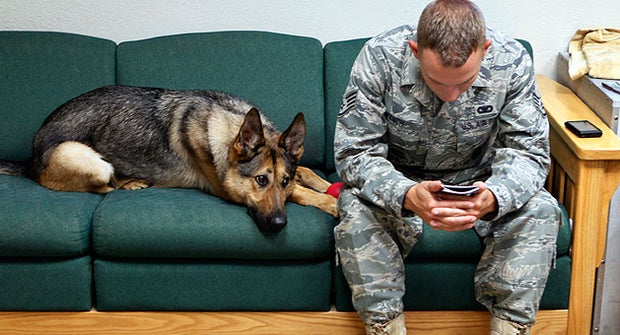
(CBS/AP) Post-traumatic stress disorder is well-documented among American servicemen and women returning from the wars in Iraq and Afghanistan, but its existence in the dogs that serve alongside them is not quite clear-cut.
Still, some veterinarians say animals do experience it, or a version of it.
"There is a condition in dogs which is almost precisely the same, if not precisely the same, as PTSD in humans," says Nicholas Dodman, head of the animal behavior program at Tufts University's Cummings School of Veterinary Medicine.
The military defines PTSD as a condition that develops after a life-threatening trauma.
Victims suffer three types of experiences long afterward, even in a safe environment:
They repeatedly re-experience the trauma in nightmares or vivid memories. They avoid situations or feelings that remind them of the event, and they feel keyed up all the time.
Many military dogs, including those whose job it is to search for explosives, are exposed to noisy, blinding "flash-bang" grenades. Just like soldiers, some dogs are in convoys when they are hit by improvised bombs.
When they finish their tours, some of them exhibit pitiful symptoms and need intensive re-socialization therapy.
Gina is one such dog. She was a playful 2-year-old German shepherd when she went to Iraq as a highly trained bomb-sniffing dog with the military, conducting door-to-door searches and witnessing all sorts of noisy explosions.
She returned home to Colorado cowering and fearful. When her handlers tried to take her into a building, she would stiffen her legs and resist. Once inside, she would tuck her tail beneath her body and slink along the floor. She would hide under furniture or in a corner to avoid people.
Yet some veterinarians dislike applying the diagnosis of post-traumatic stress disorder to animals, thinking it demeans servicemen and women, Dodman says. He says he means no offense to military personnel when he uses the term.