How much emergency savings should you keep while paying off debt?
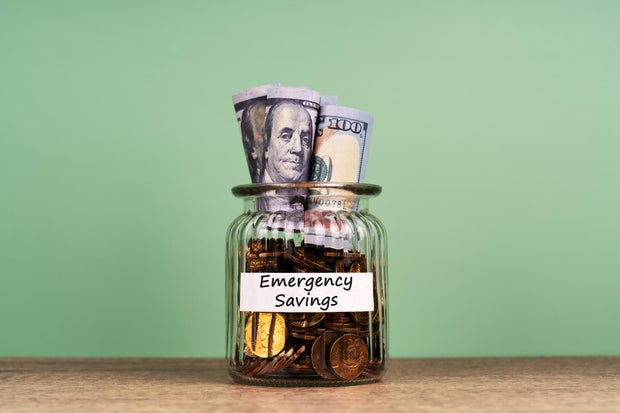
Deciding where the next available dollar should go can be surprisingly complicated for borrowers who are in serious debt and are trying to get their finances back on track. After all, paying down high-rate debt can reduce costly interest charges and free up room in the budget, but putting every spare dollar toward credit card and other debt balances can leave little to put away for the next car repair, medical bill or unexpected expense. And with Americans carrying historically high levels of debt right now, it's important to find the right balance between saving for emergencies and paying off debt.
The latest data underscores just how much debt remains on borrowers' balance sheets. Household debt stood at about $18.8 trillion in the second quarter of 2026, according to the Federal Reserve Bank of New York, while credit card balances climbed by $21 billion during the same quarter, pushing that debt total to $1.26 trillion. And for a sizable share of borrowers, keeping up with those obligations is already difficult. Case in point? A recent Achieve survey found that 34% of respondents were unable to make the full monthly payments on all of their debts.
That can make aggressively paying off debt feel like the obvious priority. Draining your cash reserves to do it can create another problem, though: Without enough emergency savings, even a relatively modest surprise expense could send you right back to a credit card, undoing some of your repayment progress. So, rather than choosing between debt payoff and savings, it may make more sense to determine how much of a financial cushion you actually need while you pay down what's owed.
Find out how Achieve can help you get rid of high-rate debt now.
How much emergency savings should you keep while paying off debt?
The most widely cited benchmark for emergency savings is three to six months of living expenses. However, that target was designed for people who aren't simultaneously carrying high-interest debt. For those in active debt repayment, it makes more sense to start with a scaled-back version of this approach, meaning a starter emergency fund of $1,000 to $2,500.
The logic behind this approach is straightforward. Having a small cash cushion on hand protects you from the most common financial disruptions — a flat tire, a broken appliance or a medical copay — without requiring you to divert too much cash from debt repayment. Once your debt is eliminated, you then redirect that same monthly payment toward building a full emergency fund.
That said, the right amount of emergency savings ultimately depends on your circumstances. If your income is variable or you're self-employed, leaning toward the higher end of that starter range makes sense. In these cases, income disruptions are more likely, and you'll need more runway. Similarly, if you're a homeowner, a $1,000 cushion may be insufficient, as even minor home repairs can run well into the thousands of dollars range. Renters with stable employment and minimal recurring financial obligations can often manage with less, though.
The type of debt you're carrying also matters in this equation. If you have multiple debts on high-rate credit cards, keeping a minimal emergency fund and attacking that debt aggressively is often the right move, as those interest charges compound quickly. Federal student loans or low-rate auto loans are less urgent, as the cost of carrying them while building savings is lower.
Learn more about the debt relief options available to you here.
When debt relief might be the better path forward
For some borrowers, the emergency savings calculus is complicated by debt loads that are simply too large to chip away at through a traditional repayment approach. If your combined monthly minimums are consuming a significant share of your take-home pay, building even a modest emergency fund while staying current on your balances may feel impossible.
In these situations, your debt relief options are typically worth exploring. For example, debt consolidation — either through a loan or a balance transfer card — can reduce your interest rate and simplify your payments while freeing up cash that can go toward savings. Or, a debt management plan through a credit counseling agency can result in lower rates and a structured repayment timeline.
For those carrying substantial debt, an option like debt relief could make more sense. With this approach, the goal is to negotiate with your creditors to agree on a lower settlement amount, making it easier and more affordable to pay off what's owed. Or, in certain cases, bankruptcy may be on the table, though it can carry significant credit implications and should be approached carefully.
Speaking with a debt relief expert or certified credit counselor can help you assess which route makes the most sense given your income, debt load and financial goals. Whatever route you ultimately choose, though, the goal is the same: to get to a place where your debt is manageable enough that building financial resilience — including emergency savings — becomes possible.
The bottom line
There's no universal number for how much emergency savings to keep while you're paying off debt. For most people, though, a starter fund of $1,000 to $2,500 strikes the right balance. It's enough to handle common setbacks without stalling the debt repayment process. That said, if your debt feels unmanageable regardless of how you allocate your money, weighing your debt relief options may be a more effective first step.